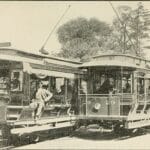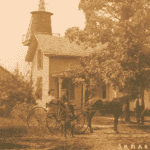


Leslie, Michigan, sits quietly between Lansing and Jackson. At first glance, it appears steady and unchanged. But the History of Leslie Michigan tells a different story—one shaped by rapid shifts in transportation, commerce, and community identity. Today, it reads as a stable, modest Mid-Michigan town. But around 1900, Leslie stood at a crossroads of change—railroads, electric transit, and the early automobile era all passed through its streets in rapid succession.
That short window reshaped the town in ways still visible today.

A Railroad Town Takes Shape

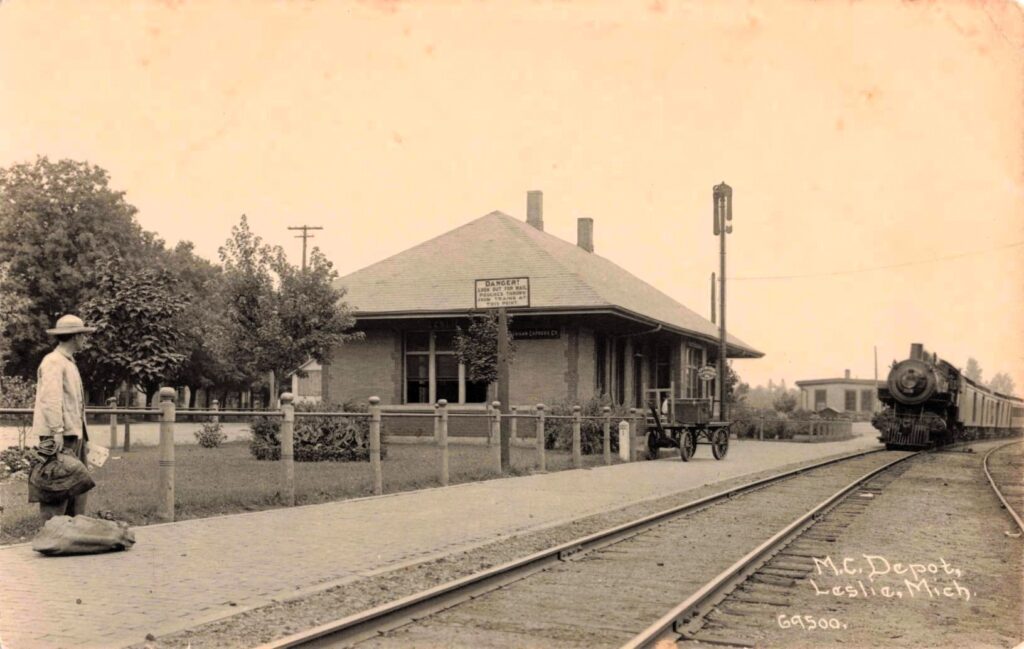
Leslie’s growth began with timing and location. Settled in the mid-1800s and incorporated as a village in 1887, the town developed alongside Michigan’s expanding rail network. The arrival of the Michigan Central Railroad gave Leslie direct access to regional markets.
Farmers from surrounding areas brought grain, livestock, and produce into town. From there, goods moved east and west by rail. That steady flow of commerce made Leslie more than a farming community. It became a service center.
Rail depots were not just transportation points. They were gathering places. News arrived by train. So did mail, equipment, and people. Leslie’s depot connected it to a wider world that smaller inland towns often lacked.
The Interurban Boom

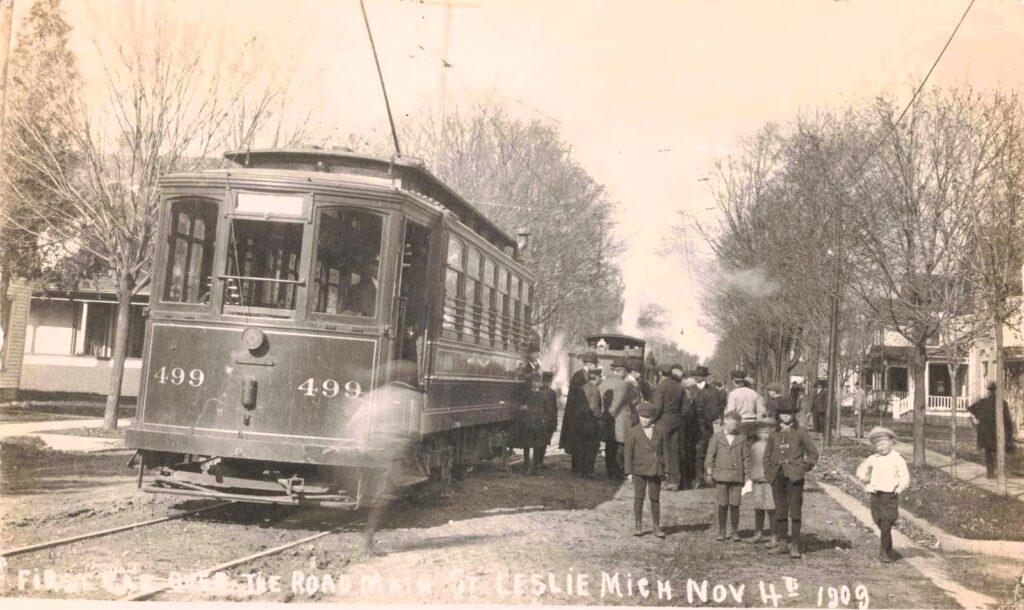
In 1909, Leslie entered a new phase. Electric interurban streetcars began running through town, linking it more directly to Lansing and Jackson.
These were not slow, occasional trains. Interurban cars ran frequently and at relatively high speed for the time. They allowed residents to travel for work, shopping, and social visits in ways that had not been practical before.
This shift changed how Leslie functioned.
A resident could live in Leslie and commute. Visitors could arrive and leave in a single day. Businesses benefited from increased foot traffic. The town, briefly, operated like a small transit hub.
Counterintuitive insight: For a time, Leslie was more connected to nearby cities than many larger towns that lacked interurban access.
Main Street Expansion

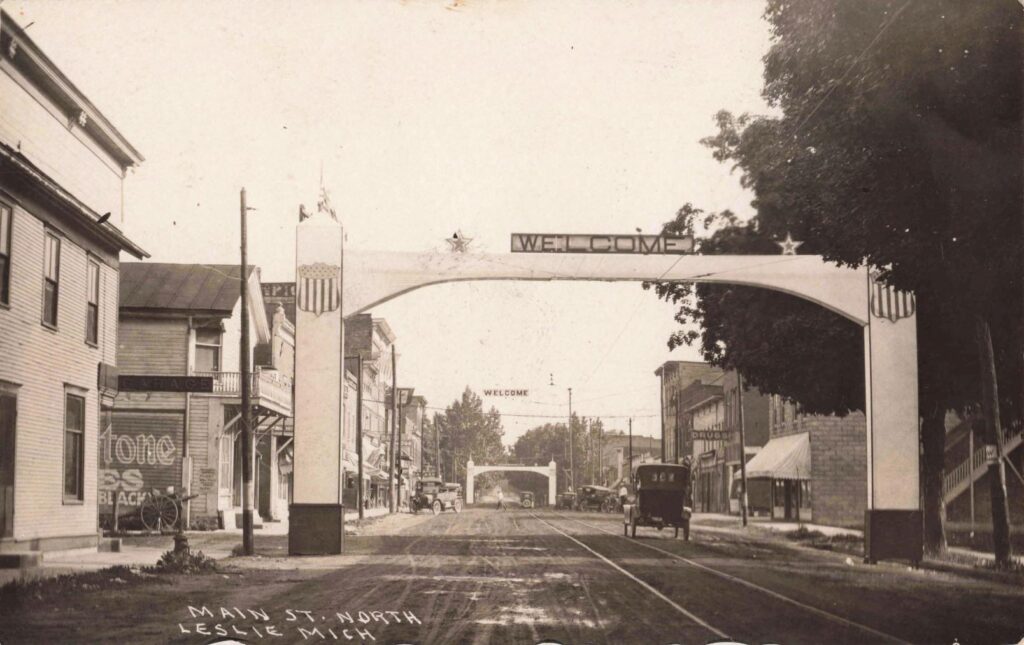
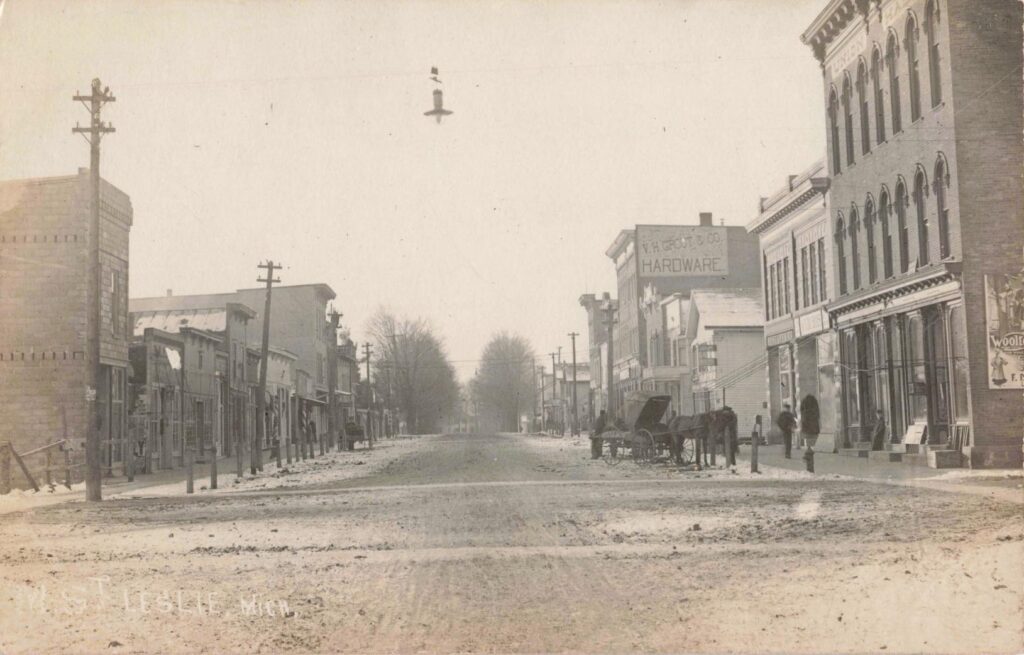
With improved transportation came growth along Main Street. Wooden storefronts gave way to more permanent brick buildings. Businesses expanded to meet demand.
Hardware stores stocked tools and supplies for a changing agricultural economy. Drugstores, restaurants, and general stores filled out the commercial district. A post office building signaled federal investment and long-term stability.
Street life reflected that growth. Horse-drawn wagons shared space with early automobiles. Interurban cars moved down the center of the street. Sidewalks filled with residents and visitors alike.
The town’s layout began to reflect both its rural roots and its growing regional role.
Signs of Confidence

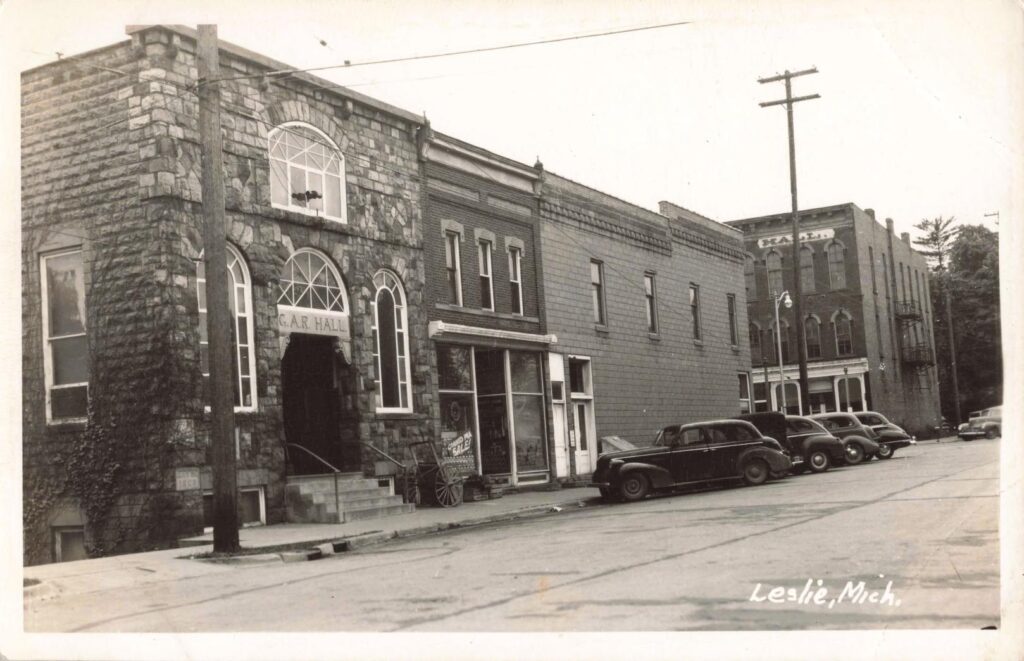
Leslie’s welcome arches, visible in early photographs, were more than decoration. They were statements.
Placed across the street, these arches greeted travelers entering town. They reflected a belief that Leslie was not just a stop along the way, but a destination worth recognizing.
At the same time, civic buildings reinforced that identity.

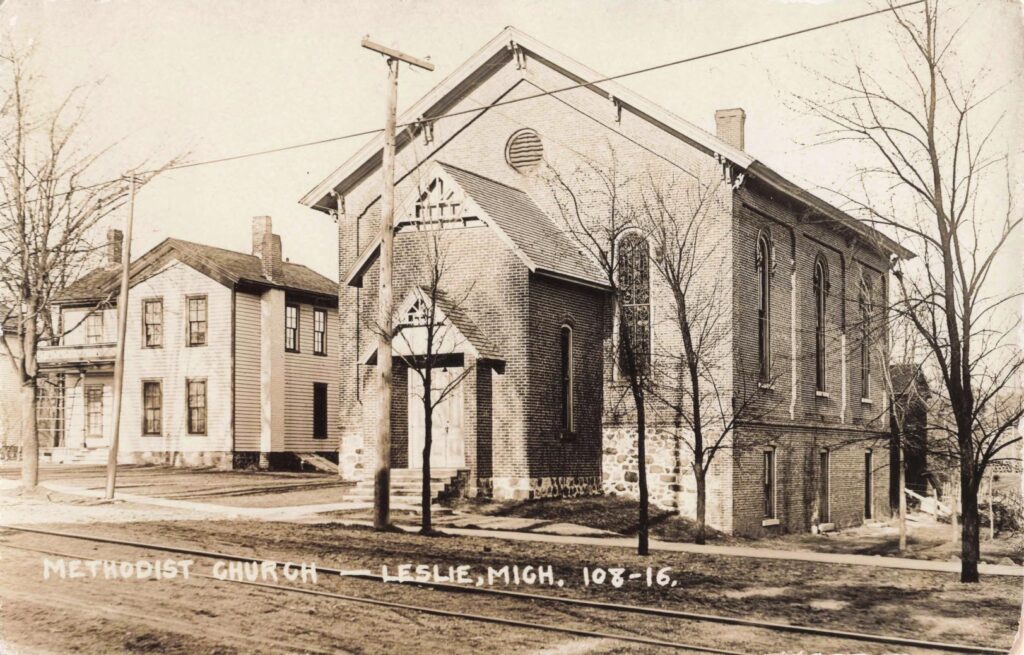
The G.A.R. Hall served as a meeting place for Civil War veterans and community events. Churches anchored neighborhoods and offered stability. The public school building, constructed with care and permanence, showed a commitment to education and growth.
These were not temporary structures. They were investments in the town’s future.
A Community at Work and at Leisure

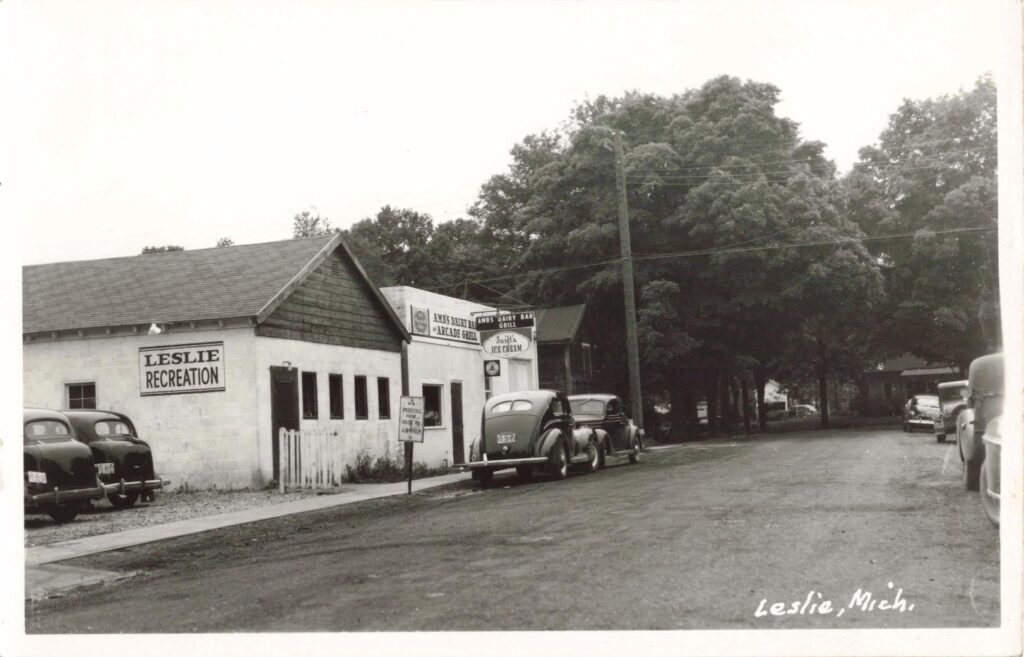
Leslie’s early 20th-century life was not defined solely by work. The town also supported a steady rhythm of social activity.
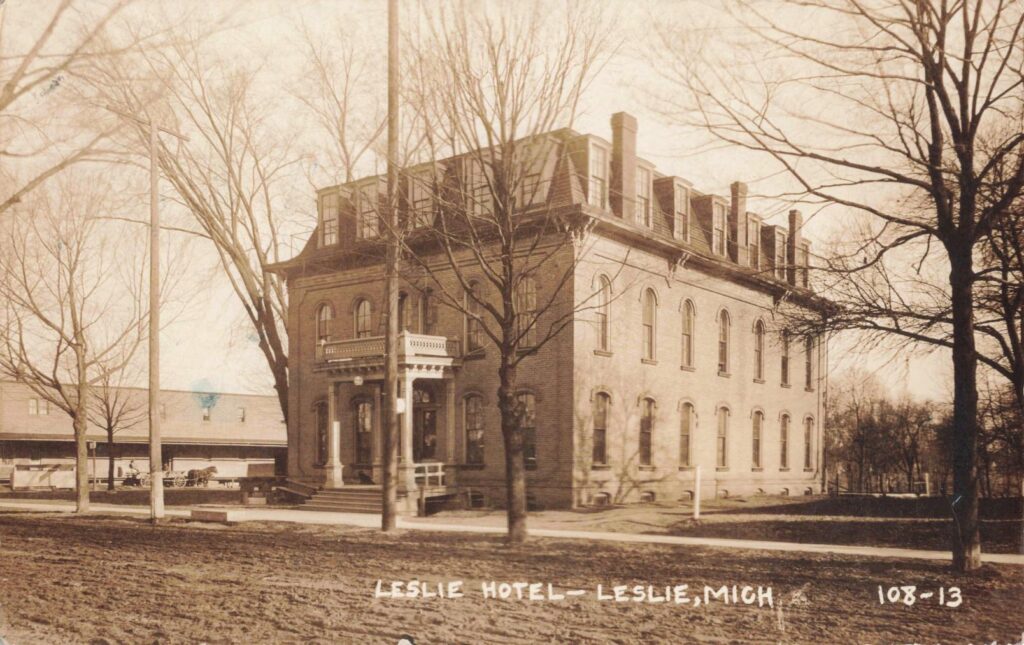
Restaurants and small entertainment venues served both locals and visitors. Ice cream shops, billiard halls, and recreation buildings provided gathering spaces. Hotels such as the Carroll or Halstead House accommodated travelers moving between Lansing and Jackson.
Annual events drew crowds. Parades filled the streets. July celebrations brought decorations, banners, and visitors. Businesses took part, dressing storefronts and extending hours.
These events mattered. They reinforced Leslie’s identity as a community that valued participation and visibility.
The Arrival of the Automobile

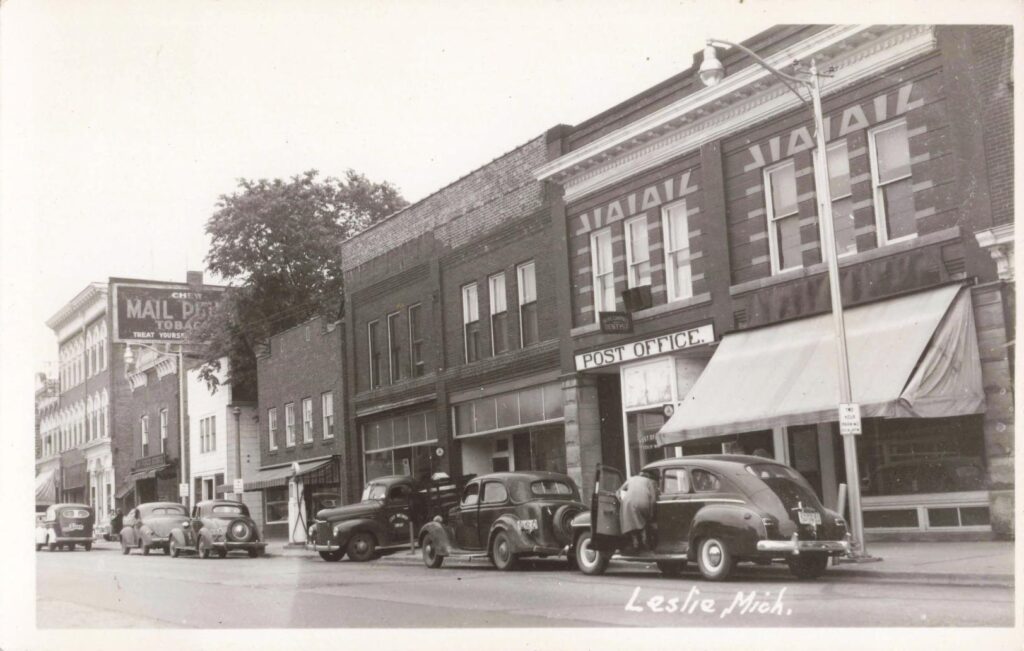
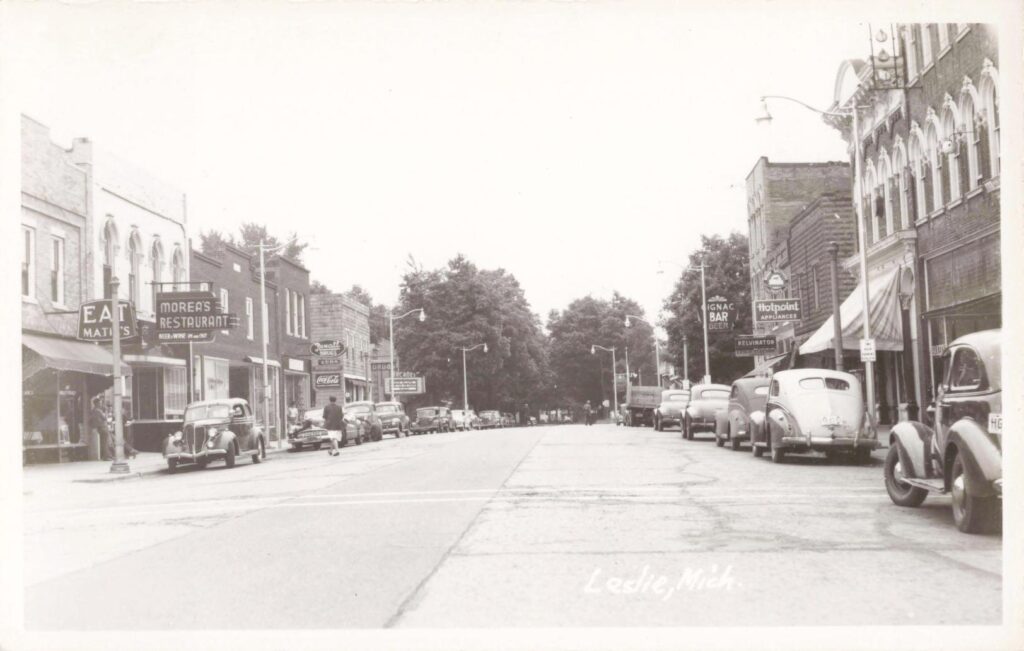
By the 1920s and 1930s, another shift began to take hold. Automobiles became more common. Roads improved. Travel patterns changed.
Where interurban cars once dominated, automobiles began to fill the streets. Parking appeared along curbs. Gas stations and service garages entered the local economy.
This change came quickly.
The same convenience that made interurban travel attractive also made it vulnerable. Cars offered flexibility that fixed rail lines could not match. Gradually, interurban service declined.
Rail traffic slowed as well. Freight still moved, but passenger service became less central to daily life.
Adapting Without Collapse

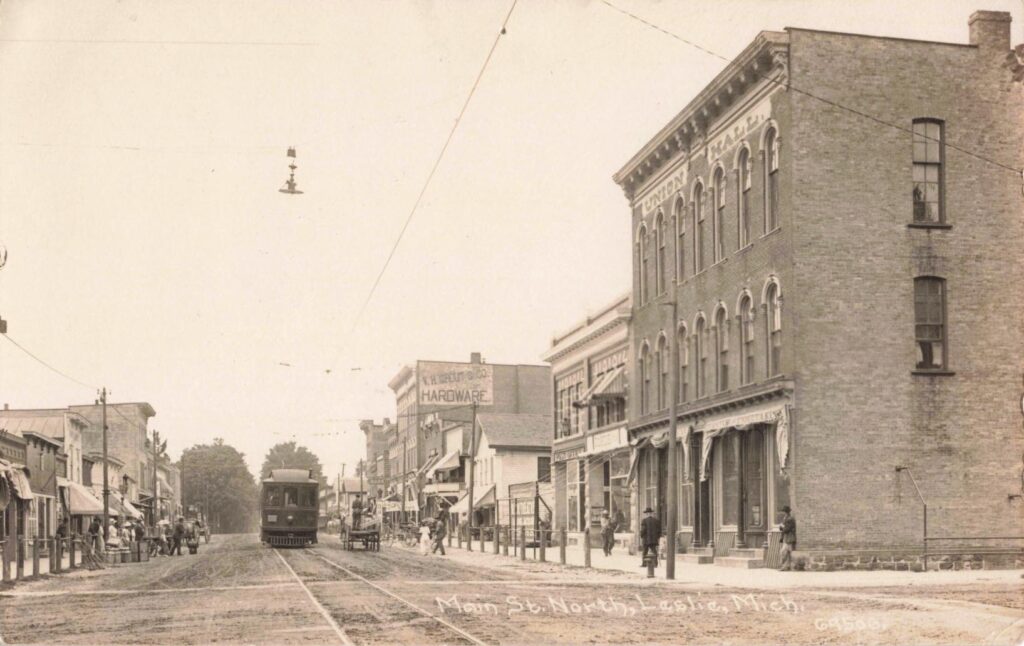
Many towns tied closely to railroads experienced sharp declines when those systems faded. Leslie’s experience was different.
The town did not collapse. It adjusted.
Businesses shifted focus toward local customers rather than regional travelers. Buildings remained in use, even as ownership and purpose changed. The commercial district scaled back but did not disappear.
This quieter transition is easy to overlook. There was no single defining moment of loss. Instead, change came gradually, over years.
Leslie’s ability to adapt may be its most important historical trait.
Architecture as Evidence
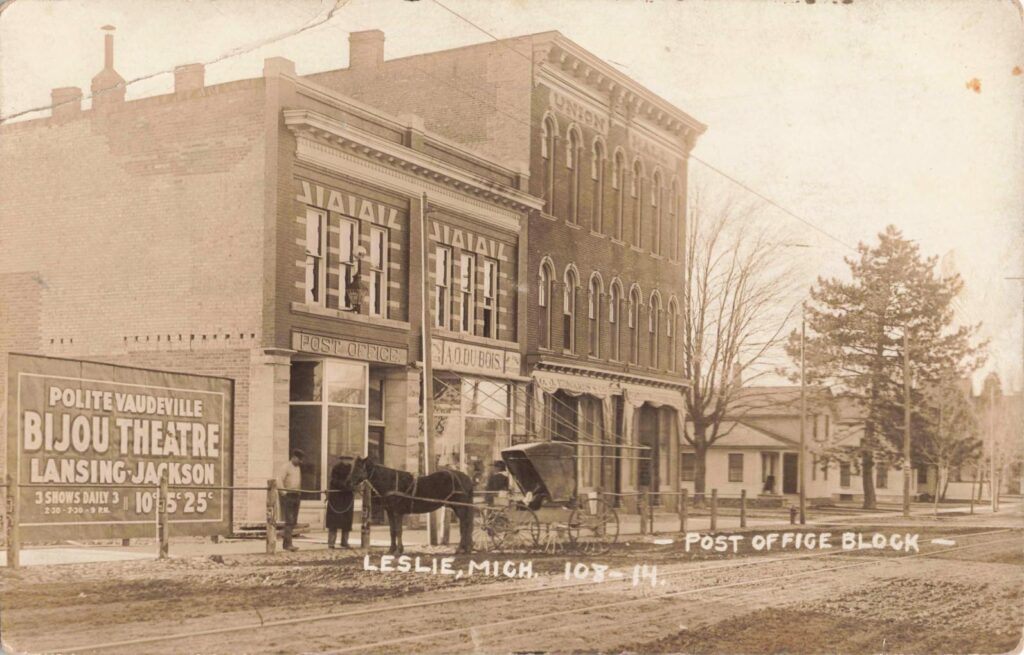
The physical layout of Leslie still reflects its past.
Brick storefronts line sections of Main Street. Older civic buildings remain in place. Residential areas show patterns consistent with early 20th-century growth.
Even where buildings have been altered, their placement tells a story. The spacing of structures, the width of streets, and the orientation of storefronts all point back to a time when rail and streetcar traffic shaped daily movement.
Unlike towns that lost large portions of their historic core, Leslie retained much of its built environment.
The Long View
Leslie’s history does not follow a dramatic rise-and-fall pattern. It is more measured.
The town grew steadily with the arrival of railroads. It expanded quickly during the interurban era. It adjusted as automobiles took over. And it continued as a local center after its role as a transit hub declined.
That pattern reflects a broader trend across Michigan.
Many communities experienced rapid change in the early 20th century. Not all managed to stabilize afterward. Leslie did, in part because it did not rely on a single industry or moment.
It remained tied to agriculture, local commerce, and regional connections, even as those connections shifted.
Why Leslie Still Matters
In the history of Leslie Michigan offers a clear example of how transportation shapes a town—and how a town responds when that system changes. For a brief period, it stood at the center of movement in Mid-Michigan. Railroads and electric streetcars made it accessible, active, and outward-facing.
When those systems declined, Leslie did not attempt to recreate that moment. It adjusted to a new reality. That decision—whether intentional or gradual—allowed the town to maintain continuity.
Today, Leslie’s streets, buildings, and layout provide a record of that history. Not through grand monuments, but through everyday structures that remain in use.
It is a quieter story than many. But it is no less important.
Sources Cited For the History of Leslie Michigan
“Leslie, MI | Official Website.” City of Leslie, City of Leslie, n.d. Accessed 11 Apr. 2026.
“David V. Tinder Collection of Michigan Photography.” University of Michigan Library Digital Collections, University of Michigan, n.d. Accessed 11 Apr. 2026.
“Chapter XI: Leslie Township.” Pioneer History of Ingham County, Ingham County Historical Commission, n.d. Accessed 11 Apr. 2026.
“Pioneer History.” Ingham County, Michigan, Ingham County Historical Commission, n.d. Accessed 11 Apr. 2026.
“Welcome to MichiganRailroads.com.” MichiganRailroads.com, n.d. Accessed 11 Apr. 2026.
“Michigan History Center.” State of Michigan, Michigan Department of Natural Resources, n.d. Accessed 11 Apr. 2026.
“Home.” Library of Congress, Library of Congress, n.d. Accessed 11 Apr. 2026.
“NPS.gov Homepage.” National Park Service, U.S. Department of the Interior, n.d. Accessed 11 Apr. 2026.
“Pure Michigan | Official Travel & Tourism Website for Michigan.” Pure Michigan, Travel Michigan, n.d. Accessed 11 Apr. 2026.
Related Posts