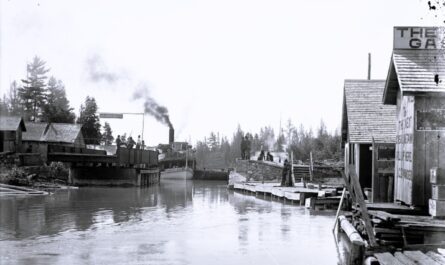
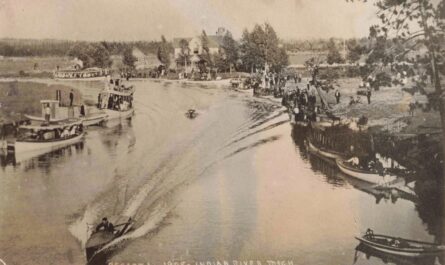
The history of Escanaba at the turn of the 20th century is dominated by iron ore. In the 1890s, this port on Little Bay de Noc led the world in iron ore shipments. Rail lines from Michigan’s rich iron ranges converged here – from the Marquette Range to the northeast and the Menominee Range to the west – carrying hopper cars loaded with ore to a bustling harbor. At one time, six giant wooden ore docks lined Escanaba’s waterfront, their chutes pouring reddish iron ore into the hulls of waiting ships. Schooners, steamers, and even distinctive “whaleback” barges crowded the bay, a daily armada hauling U.P. iron southward to the nation’s steel mills. The Chicago & North Western Railway maintained a sprawling railyard, where the clang of ore cars and the scream of steam locomotives formed the city’s industrial heartbeat.
Video


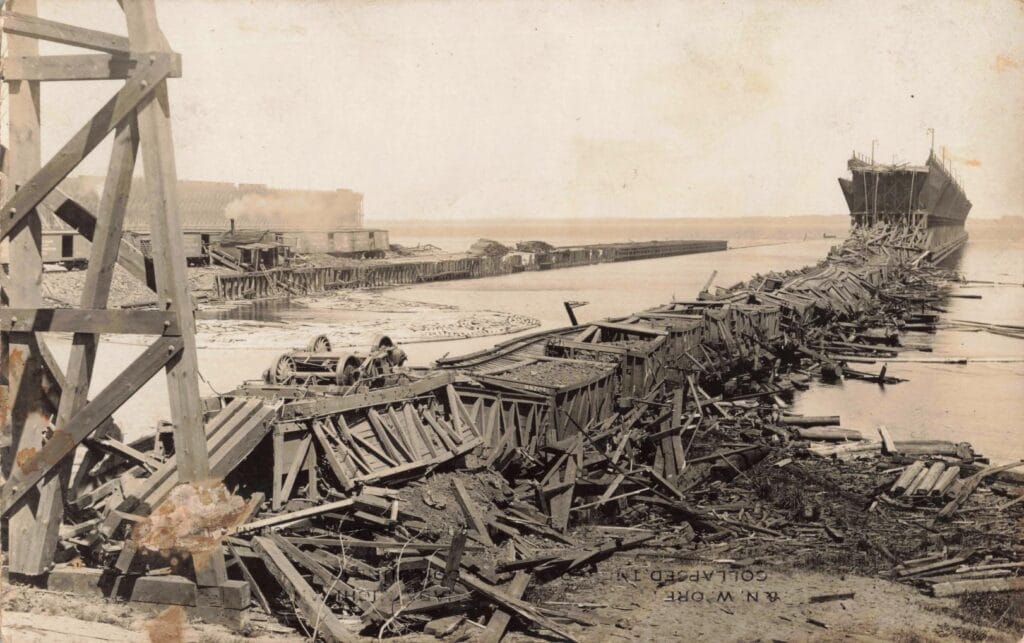
Yet with such volume came occasional calamity. On the morning of June 17, 1909, residents awoke to a thunderous crash – Ore Dock No. 5 had collapsed under the weight of 28 loaded ore cars. The wooden trestles gave way, sending timber, iron, and railcars plunging into the water below. The roar of the collapse “was reported to be heard over a mile away,” one account noted. Remarkably, despite the dramatic wreckage strewn along the shore, no fatalities were recorded in that incident.
The dock, built in 1891, was so vital that crews rebuilt it the following year, and ore shipments resumed. This resilience underscored Escanaba’s importance: even a disaster could only pause, not end, the flow of ore. Year after year, millions of tons of iron ore left Escanaba’s docks, especially in boom times like World War I, when industrial demand surged. By 1940, the port remained the lone iron ore shipping point on Lake Michigan – a status it held proudly until the mid-20th century.
From Timber to Pulp – Escanaba’s Lumber Legacy

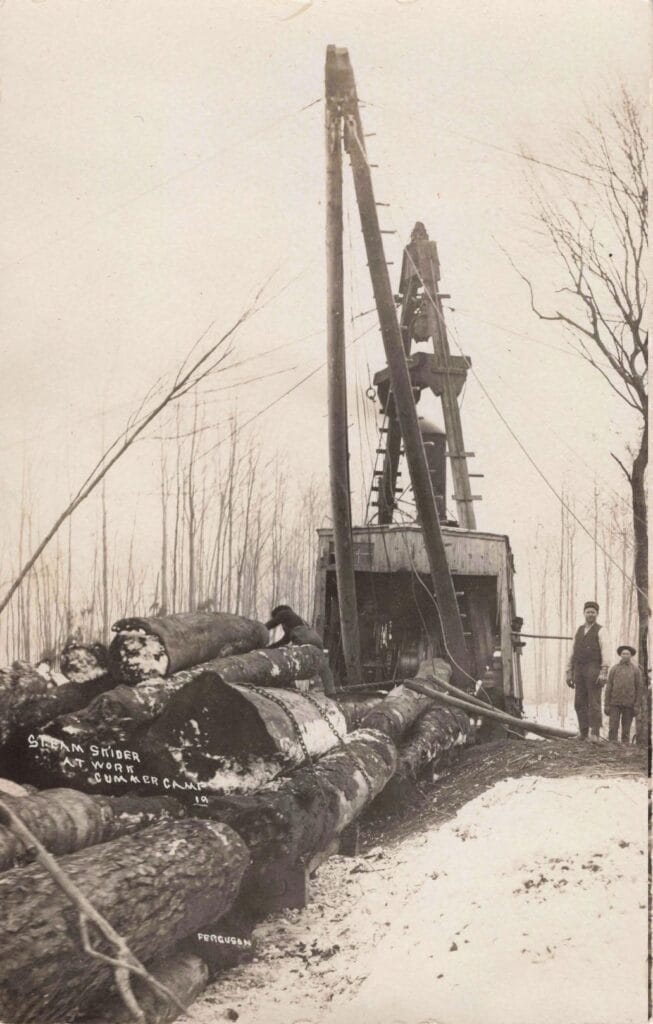
Long before iron ruled, Escanaba’s first fortune was in lumber. The dense pine forests of the Upper Peninsula drew lumbermen who built sawmills along local rivers as early as the 1840s. In the late 19th century, men like Nelson Ludington (for whom Ludington Street is named) ran massive timber operations, floating logs downriver and cutting boards that were shipped out by schooner and rail. By 1888, a massive sawmill at nearby Wells cut pine in prodigious quantities. The wealth from timber not only built business empires but also hotels and institutions in town. As the virgin forests receded, some lumber barons pivoted to new ventures – one being William Bonifas, a Luxembourg-born lumberjack turned timber magnate. Bonifas and his Irish wife, Catherine, invested their logging profits back into Escanaba’s future. They founded the William Bonifas Logging Company in the 1880s and eventually sold it in 1927 for a hefty sum. This timber wealth later funded civic landmarks, from a new church

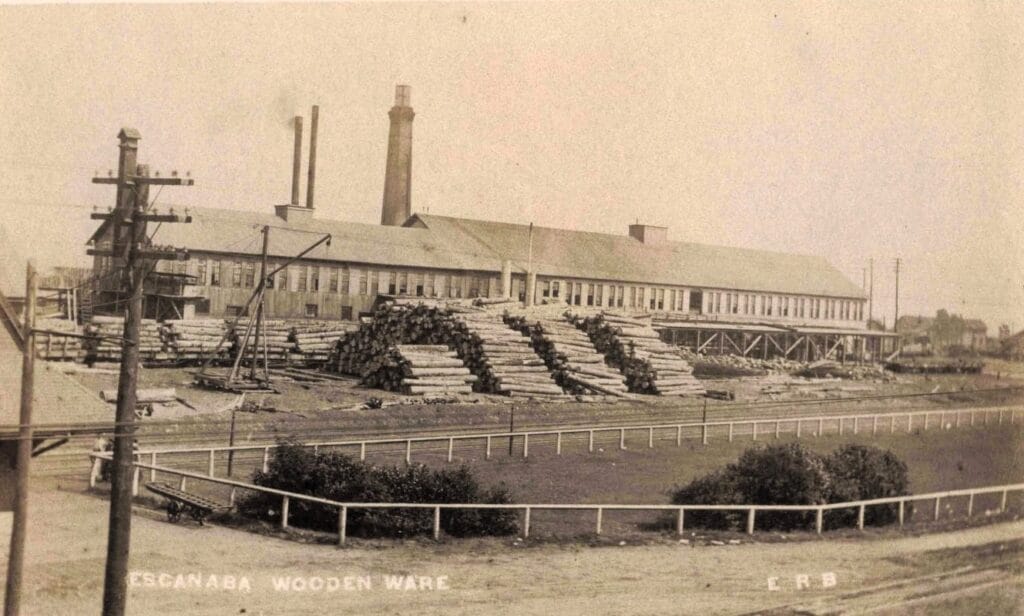
Escanaba Wooden Ware Company was one of the many industries that grew out of the Upper Peninsula’s lumber economy in the early 1900s. The photo shows long stacks of cut logs staged outside the factory, ready to be milled into everyday wooden products such as boxes, barrels, and shipping containers. Facilities like this turned raw timber into finished goods, providing steady jobs and helping Escanaba move beyond simple log export toward manufacturing tied to rail and lake transport.
Ludington Street: Heart of a Growing City

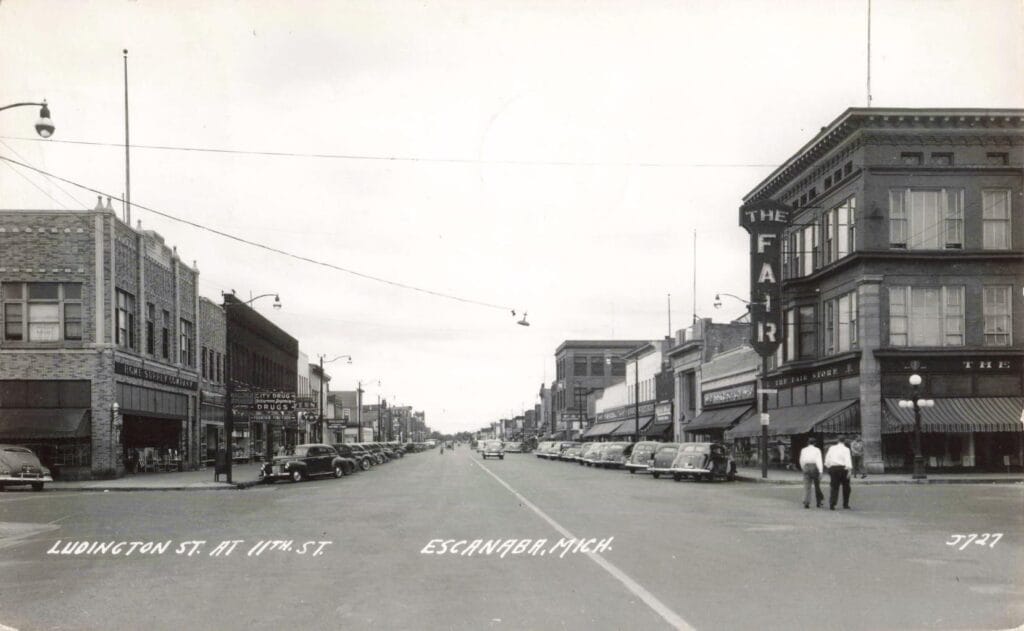
If the railyards and docks were Escanaba’s muscles, Ludington Street was its heart. This broad avenue, running straight from the port into downtown, became a showcase of turn-of-the-century prosperity. By 1900, brick commercial blocks and hotels stood shoulder-to-shoulder along Ludington Street, their ground floors home to outfitters, grocers, banks, and saloons. An electric streetcar system even debuted in 1891, with trolleys soon trundling down Ludington Street and connecting Escanaba to the neighboring town of Gladstone– a surprising urban amenity in what outsiders saw as a remote lumber port. Photographs from 1906 show Ludington Street bustling with awnings and shopfronts, and faint lines of streetcar tracks running down the center. Overhead, new electric lines and telephone poles hint at modern connectivity, even as horse-drawn wagons still clatter on the dusty streets below.

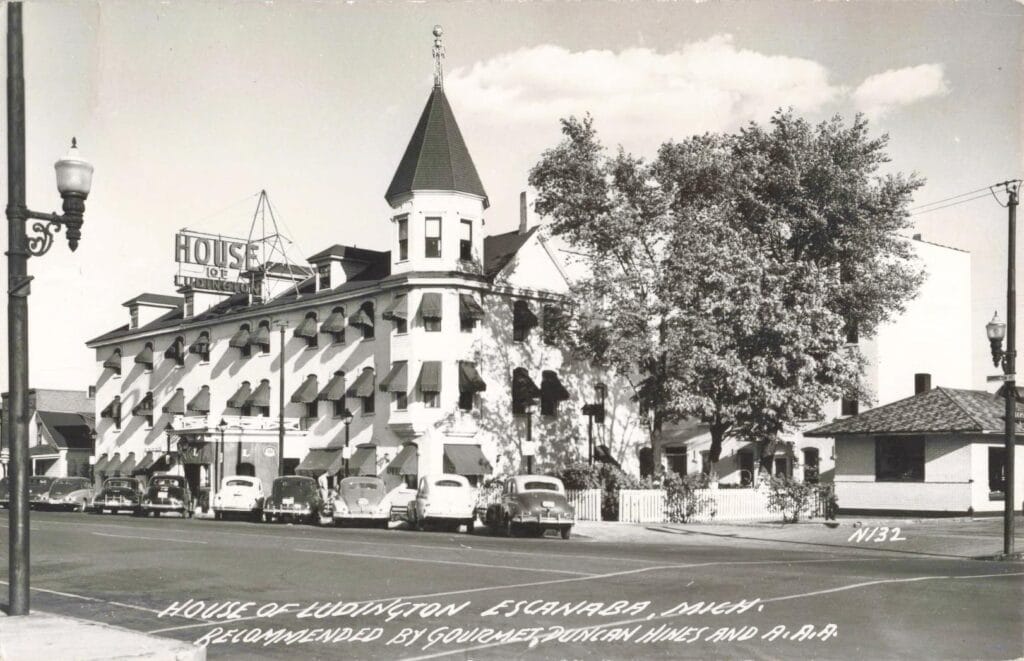
Anchoring the downtown was the House of Ludington Hotel, an elegant Queen Anne-style inn that welcomed rail and steamer passengers in style. Initially built in 1864 as the Gaynor House, it was renamed in 1871 to honor Nelson Ludington, the lumber baron. By the 1890s, the hotel was advertised as the largest in the city, boasting luxuries like baths, steam heat, and electric call bells – all for $2.00 a day. Such amenities, cutting-edge at the time, underscored Escanaba’s transition from frontier outpost to modern city. The House of Ludington’s reputation grew with the town; a 1913 survey showed it had 90 guest rooms, and for decades it remained “the place to stay” in Escanaba. Well-heeled lumber executives, ore buyers, and even tourists bound for the nearby forests or fishing grounds mingled in its lobby. By the 1940s, under proprietor Pat Hayes, the hotel’s restaurant had earned a fame rivaling the Grand Hotel on Mackinac Island – a source of local pride. Even as times changed and automobiles replaced horses on Ludington Street, the House of Ludington stood as a living link to Escanaba’s Gilded Age, its turreted tower and broad verandas a familiar sight for generations.
Across Ludington Street, other businesses thrived. Department stores like The Fair Store and Savings Bank offered everything from groceries to banking under one roof, even promoting Green Trading Stamps to entice customers. Newspaper headlines from the era tell of a downtown alive with commerce: theaters like the Delft Opera House opened (1913) to bring plays and later movies to town, and by the 1930s, the Michigan Theater showcased Art Deco styling and talking pictures.

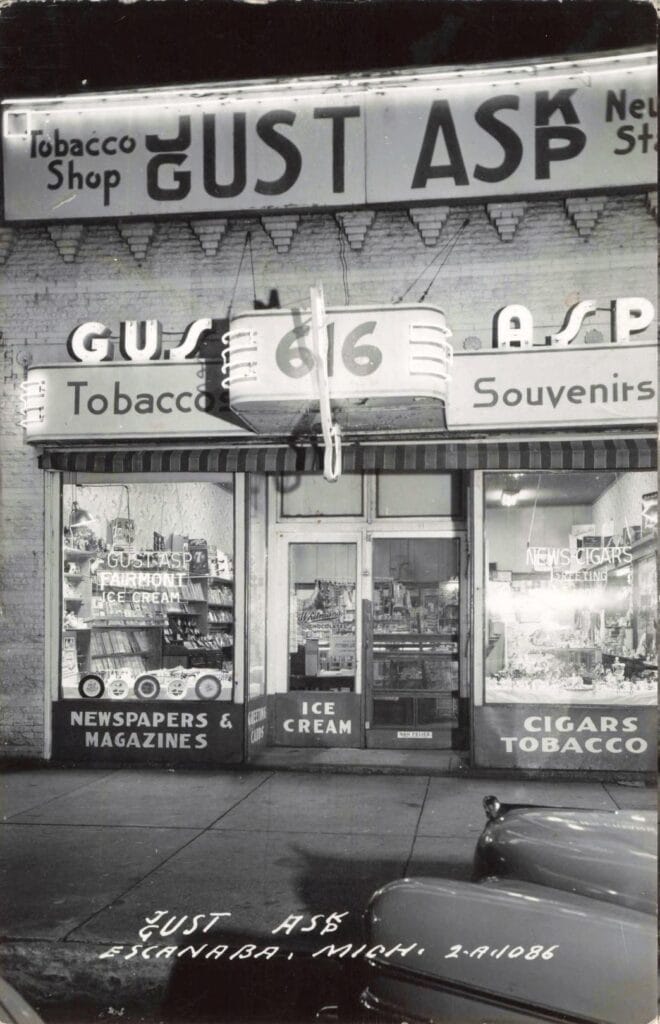
In the 1930s, a flashy neon sign appeared on Ludington Street that read “Just Ask – Gust Asp.” This belonged to entrepreneur Gust Asp, who turned a 1890s tobacco shop into a prominent newsstand and souvenir shop. Locals knew if you “just asked” Gust Asp, you could find any local or national newspaper – he was that well-connected. Figures like Asp became local legends, embodying Escanaba’s small-town entrepreneurial spirit. By 1940, Ludington Street was a blend of old and new: horse watering troughs had given way to parking spaces, and hitching posts to neon-lit marquees, but the street remained the communal gathering place, especially on Saturday nights when farmers and miners came to town and the sidewalks filled with people catching up on news.
Life on the Waterfront: Fishing, Shipping, and Smelt

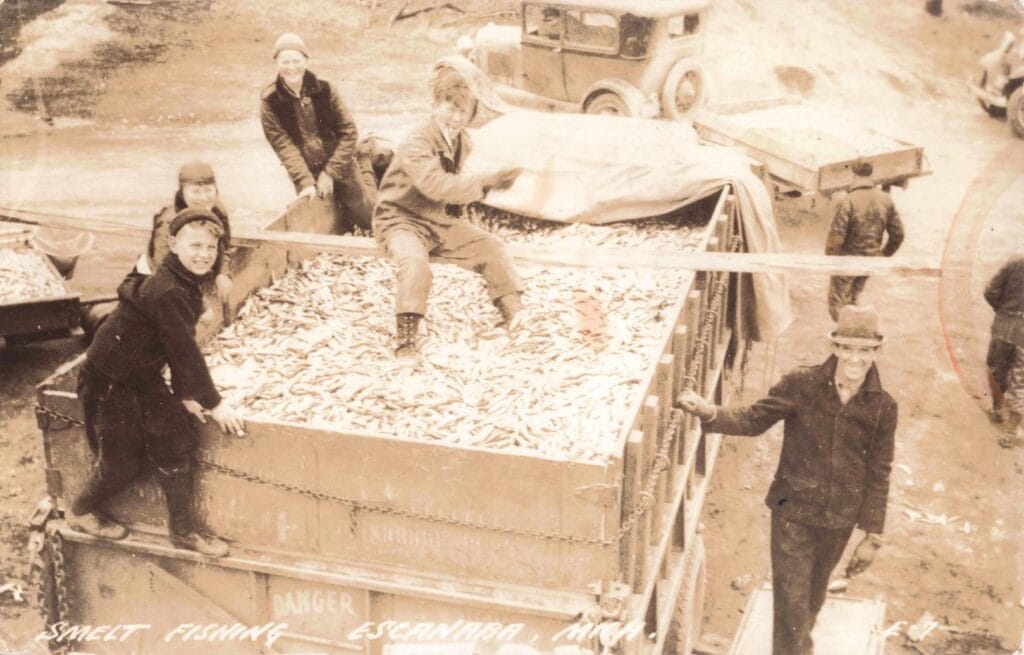
While iron ore carriers dominated the deepwater docks, Escanaba’s waterfront sustained another vital industry: commercial fishing. For generations, local fishermen set out onto Lake Michigan and the adjacent bays, harvesting whitefish, trout, and perch. In the late 1800s, Danish immigrants Hans Hansen and Peter Jensen established one of Escanaba’s most essential fisheries near the courthouse on the north shore.
Harnessing experience from the North Atlantic, Hansen and Jensen bought out an older fishery (Booth & Sons) and began buying fish wholesale from many local crews. They packed the fresh catch in ice and loaded it onto railway express cars bound for Chicago and New York – meaning a trout pulled from Bay de Noc in the morning might be served on a Chicago dinner table a day or two later. In an era before refrigeration, this was a minor marvel of logistics.
Originally, the fish were caught using traditional Mackinaw sailboats, but by the early 1900s, gasoline-powered tugs took over. In fact, Hansen and Jensen’s operation was progressive in more ways than one: they installed Escanaba’s very first gasoline pump at their dock to fuel those new motorized boats. This little detail – a fish company creating the town’s first gas station – nicely illustrates Escanaba’s knack for adaptation. The fishery prospered through the 1910s, and the smells of fish sheds and smokehouses mingled with the coal smoke of ore freighters along Escanaba’s shoreline. By the 1930s, Great Lakes commercial fishing was declining in many areas, but Escanaba’s fishermen were buoyed by one tiny, silver-scaled newcomer: the smelt.

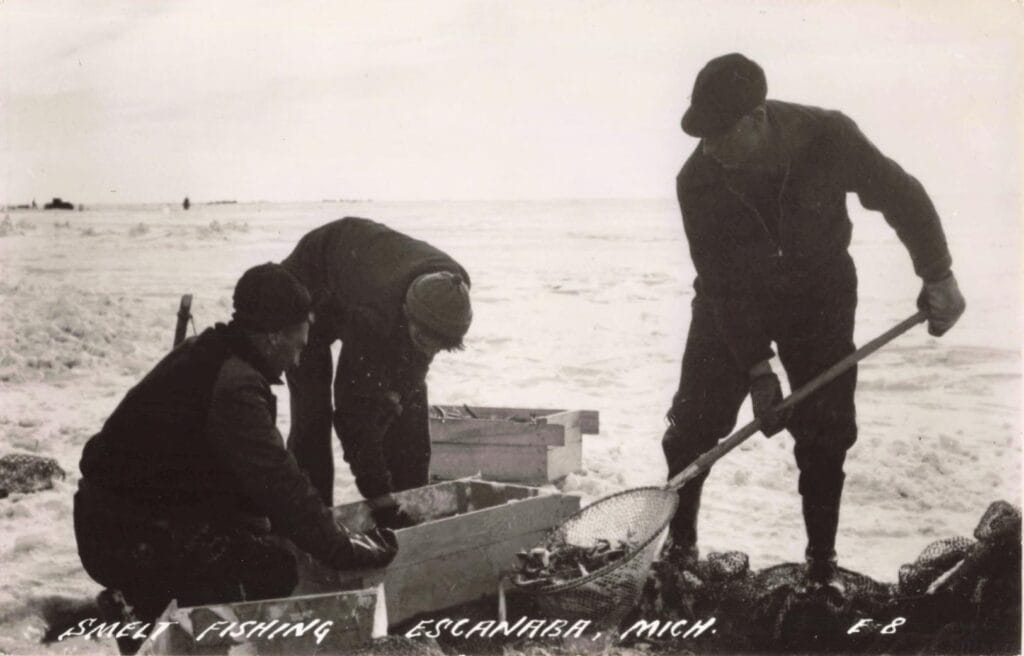
Smelt fishing became a local sensation in the 1930s – something many older Michiganders still remember with a smile. Interestingly, the rainbow smelt is not native to Lake Michigan. The little fish were introduced to a lake in lower Michigan around 1912 and accidentally made their way into Lake Michigan; by 1926, smelt had spread into Green Bay and the upper Great Lakes. They arrived in enormous numbers. Each spring, as ice melted, millions of these silvery five-inch fish would surge from Lake Michigan into the rivers and streams around Escanaba to spawn. The community quickly turned this natural phenomenon into an annual Smelt Jamboree by the mid-1930s.
On crisp April nights, families gathered along the shores and under bridges with nets and wash tubs. Escanaba’s smelt runs were so thick that one 1934 report claimed two lucky (and tireless) fishermen hauled in 4,200 pounds of smelt in under five hours. In 1938, area fishermen caught over 1,000 tons of smelt– an almost unbelievable bounty that helped feed both people and even pets (excess smelt were canned as cat food in nearby Gladstone).
For a community weathering the tail end of the Depression, free buckets of smelt were a welcome boost. But just as important was the merriment: Escanaba and neighboring towns held smelt carnivals complete with a crowned Smelt King and Queen, parades, music, and even playful stunts like greased-pig contests or smelt wrestling matches in giant piles of fish. Special excursion trains brought curious visitors from Chicago and Milwaukee to join the fun. For a week each spring, the region cast off its worries and celebrated the humble smelt – a surprise gift from nature that became a beloved local tradition. The sight of countless townsfolk on the water’s edge with lanterns and dip nets, laughing and scooping up glittering fish, remains one of Escanaba’s most nostalgic early-20th-century memories.
Community and Culture: From Fairgrounds to the Bonifas Auditorium
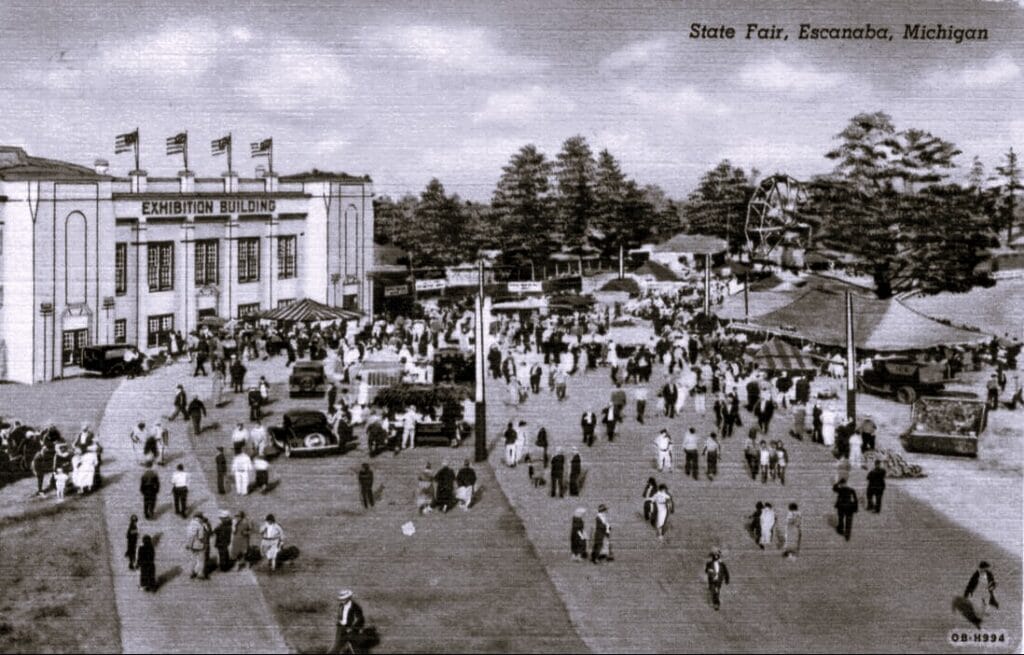
Escanaba in 1890 was a young, rough-and-tumble town; by 1940, it had matured into a close-knit city with a rich civic life. One milestone in that evolution was the launch of the Upper Peninsula State Fair. On September 17, 1928, Escanaba opened its fairgrounds to host the very first U.P. State Fair, an event created by a state law in 1927 to showcase the agriculture and industry of Michigan’s Upper Peninsula. For an admission price of 50¢ (25¢ in evenings), visitors poured in to see prize livestock, giant pumpkins, lumberjack exhibitions, and the latest farm equipment.
The fairgrounds, built on 120 acres on the edge of town, buzzed with activity and quickly became a source of regional pride. Here was proof that Escanaba had become a true hub of the U.P.: capable of throwing a grand celebration of all things Yooper. The fair became an annual August tradition (paused only during WWII) and by the late 1930s drew tens of thousands of attendees from across the peninsula. The fair’s signature events – from logger sports to harness races – reflected the character of Escanaba’s people: hardworking, a bit competitive, but always ready to gather as a community for some fun.

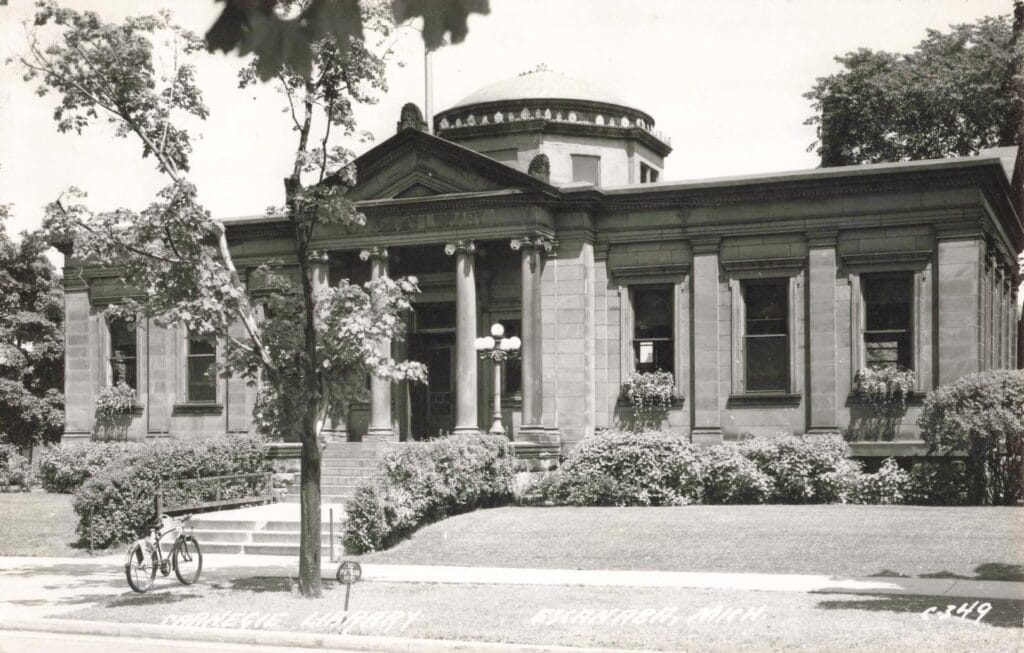
Another point of civic pride was Escanaba’s investment in education, arts, and architecture. In 1902, a handsome Carnegie Library opened in town – one of many funded by steel magnate Andrew Carnegie, built of red sandstone and topped with a domed cupola. A new county courthouse and a grand stone post office soon followed, each reflecting confidence that Escanaba’s boom was built to last.

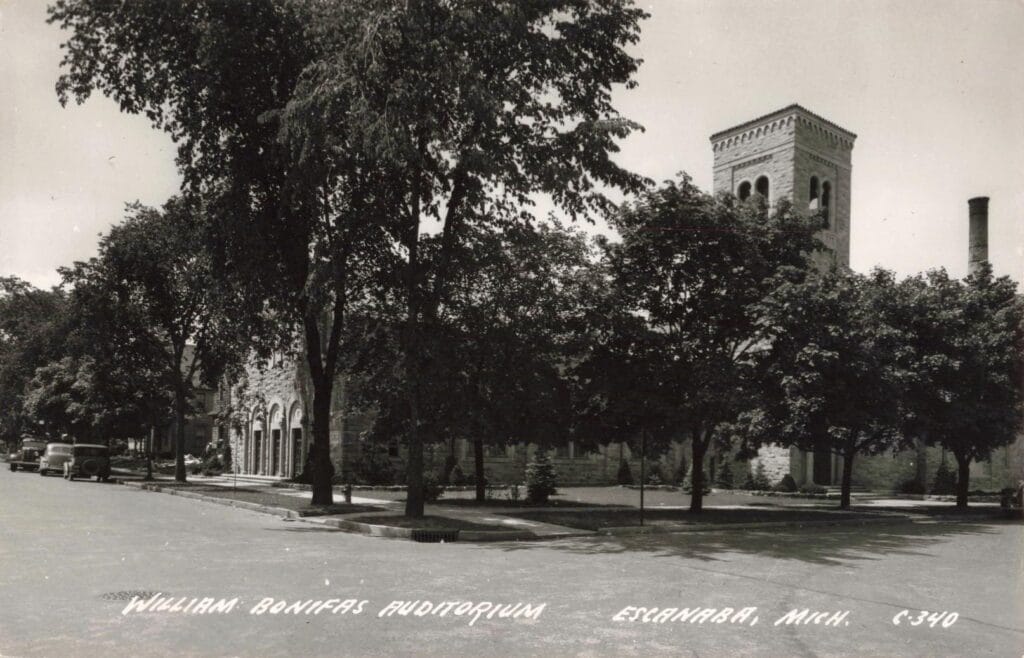
But perhaps no building symbolizes Escanaba’s community spirit between 1890 and 1940 better than the William Bonifas Auditorium. Completed in 1938 and faced with golden Kasota limestone, this auditorium (with attached gymnasium) was funded by the aging Catherine Bonifas as a memorial to her late husband, “Big Bill”. William Bonifas had died just before he could see it finished, but he knew it would serve the St. Joseph’s parochial school and the broader community. The Bonifas Auditorium quickly became the cultural center of Escanaba – a place for school assemblies, basketball games, town meetings, concerts, and the occasional traveling theater show. It was said that no expense was spared in its construction, and its fine acoustics and 800-seat hall were unlike anything previously seen in the city. For a town built on iron and timber, the Bonifas Auditorium represented an embrace of the arts and education. In later years, it would be repurposed as the Bonifas Fine Arts Center, but even in 1940, its dual identity was clear: by day a school gym, by night a stage for community theater and music.
Escanaba’s cultural growth owed much to people like the Bonifases. Catherine Bonifas’s philanthropy in the 1930s and ’40s funded not only the auditorium but also scholarships, a technical school on Ludington Street, and even a new high school. Their generosity earned recognition from the Pope and left a lasting legacy. Meanwhile, other residents played their parts in community life – church picnics, school bands, socials at the Elks Lodge, and Fourth of July celebrations in Ludington Park all wove the social fabric. Newspapers like the Escanaba Daily Press (founded as the Morning Press in 1909 with Bonifas’ support) kept citizens informed and even boasted of their city’s achievements.
By 1940, Escanaba’s population had grown to nearly 15,000 from about 3,000 in 1880, and the city had fully come of age. The sights and sounds of those decades linger in memory: the silhouetted ore boats slipping out at dusk loaded with iron; the rhythmic clack-clack of railcars being marshaled in the yards; lumberjacks telling tales in hotel lobbies and saloons; children licking cones at the fair; the laughter of families night-fishing for smelt on a chilly April eve; and the proud tones of a high school orchestra playing on the Bonifas Auditorium stage. Escanaba’s historical journey from 1890 to 1940 is a tapestry of industry and community. It’s the story of a small Lake Michigan port that found itself at the nexus of iron, timber, rails, and waves – and that, in response, built a city both rough-edged and remarkably cultured for its size. As one contemporary observer noted in 1948, the name of Bonifas – and by extension Escanaba – “will live long in the annals of Michigan history, not alone because of the success achieved…but because of the many philanthropies” and communal achievements that success made possible. In Escanaba, the era of 1890–1940 indeed left a legacy of hard work, resilience, and shared pride that still echoes in its streets and shores today.
Sources for the History of Escanaba Michigan
Local archives and historical societies, including the Delta County Historical Society and Escanaba Public Library, were invaluable in compiling this narrative. Key references include the Escanaba Daily Press archives, the Delta County Historical Society’s photograph collection, the Michigan Railroad History database, and publications such as Michigan History Magazine. Notable sources are cited in text for specific facts and quotations.