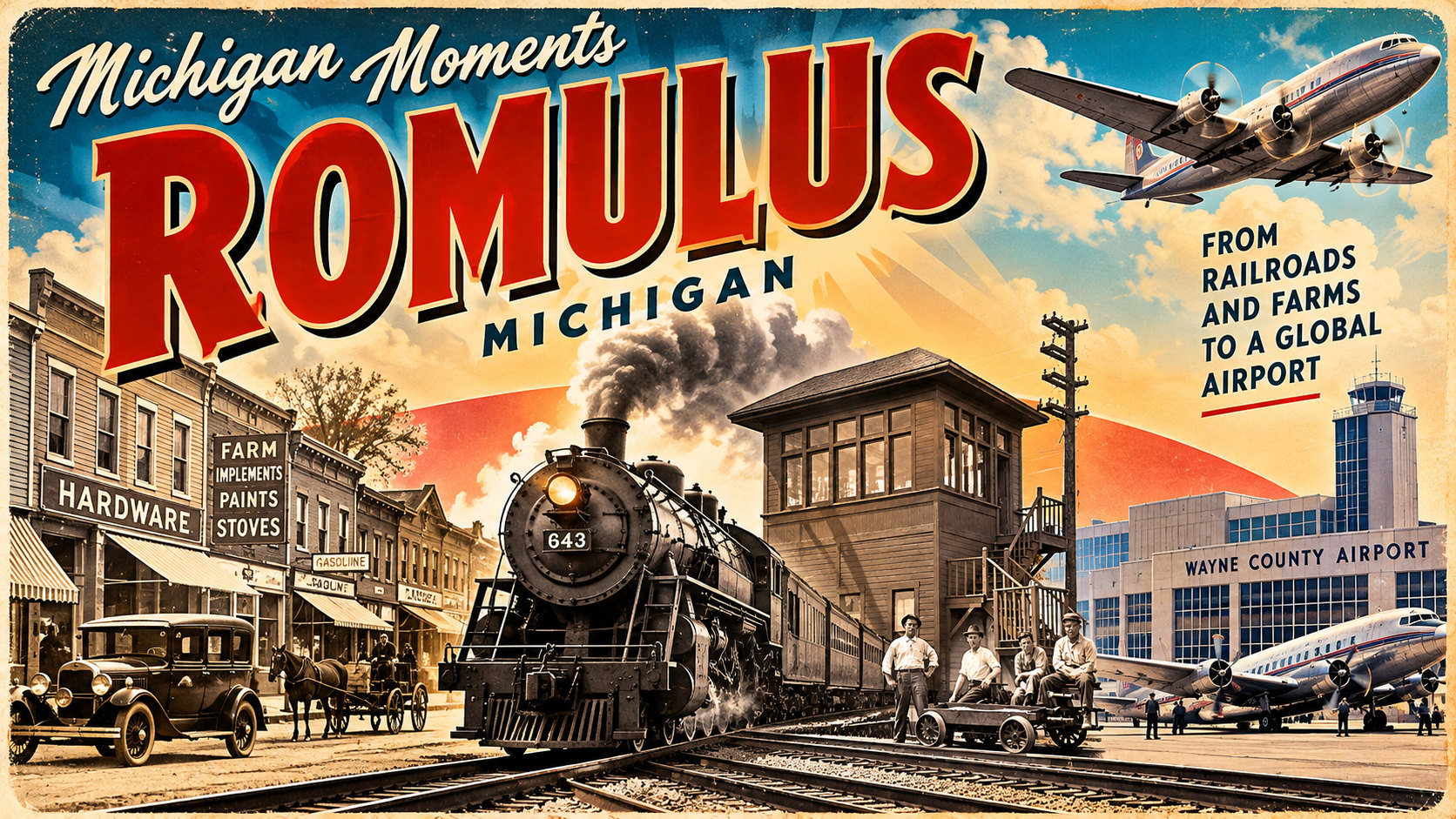


Long before jet aircraft filled the skies over Wayne County, Romulus was a railroad junction surrounded by farms. Early postcards show the merchants, railroad workers, and families who built a community now best known for Detroit Metropolitan Airport.

History of Romulus, Michigan Begins at a Railroad Crossing
In the early 1900s, the railroad junction in Romulus, Michigan, was busy. Two major railroads crossed here, and a wooden tower stood beside the tracks. From its upper windows, an operator controlled the signals and switches that allowed trains to pass safely through the intersection.

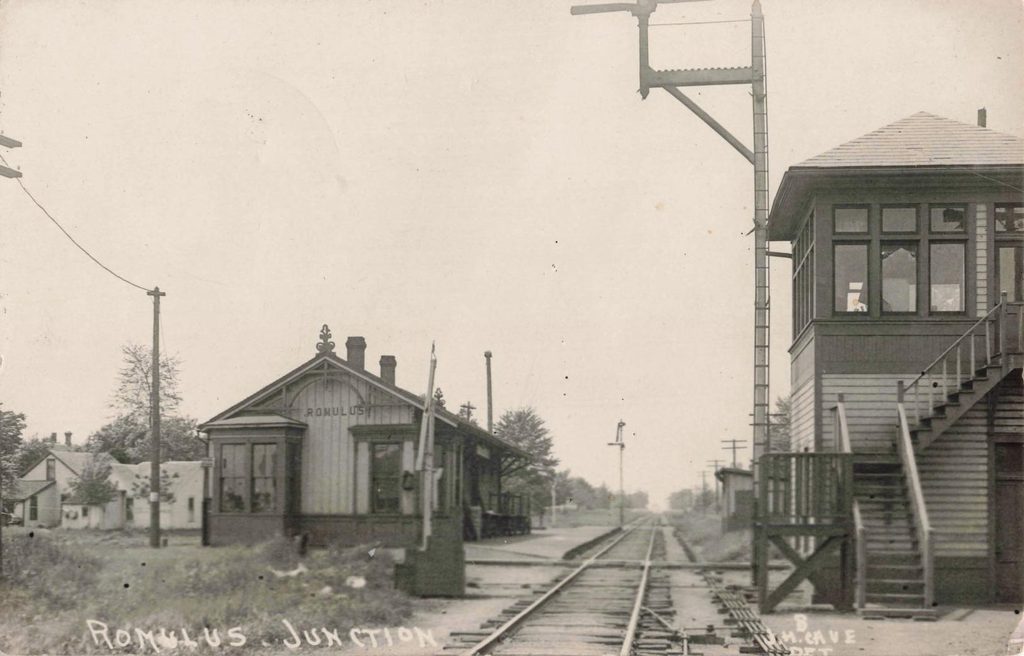
Nearby stood a passenger station, freight facilities, and the beginnings of a substantial business district. Farmers brought goods to town, merchants received supplies by rail, and passengers traveled between Detroit and communities across Michigan.
Today, Romulus is closely associated with Detroit Metropolitan Airport. But long before the first airplane landed here, the community had already become a transportation center. Farms and a railroad junction began its development and gave the village an advantage over its neighbors.
The Families Who Settled Romulus
The earliest European American settlers arrived in western Wayne County during the 1820s. County records identify Samuel McMath, who came from New York in 1827, as an early settler in the area that became the village of Romulus. He began improving his property and planned to bring his family west, but died before he could.
Other families followed. Solomon Whitaker and brothers Charles and Joseph Pulcifer arrived in 1830. Three years later, Jenks Pullen settled nearby with his six sons. Their community became known as Pullen’s Corners, near the intersection later called Five Points.
Romulus Township was officially organized March 17, 1835, two years before Michigan became a state. The first township meeting took place the following month at Joseph T. Pullen’s home.
The township even changed its name early on. In 1845, officials renamed it Wayne. Three years later, they restored the name Romulus.
Farming remained the principal occupation for many local families. They cultivated grain, raised livestock and worked fields across the surrounding township. Small businesses gradually developed to serve those farms, supplying equipment and household goods.
Travel remained difficult on unimproved roads, especially during wet weather. The arrival of railroads gave farmers what they had previously lacked: a dependable connection to distant markets.
Two Railroads Put Romulus on the Map
The Wabash Railroad crossed Romulus on an east-west route connecting Detroit with communities farther west. The Pere Marquette operated a north-south line connecting Toledo with communities toward Saginaw and Ludington.
The railroads intersected at Romulus, creating a junction that required special operating arrangements. A union station served the area, while an interlocking tower controlled the switches and signals that protected the crossing.
Railroad records identify a station agent working at Romulus in 1898. Connecting tracks also allowed locomotives to move between the two railroads.
One particularly interesting surviving view shows four men gathered around a small rail vehicle beside the control tower. The men appear to be railroad workers, though their names and exact duties are not established.

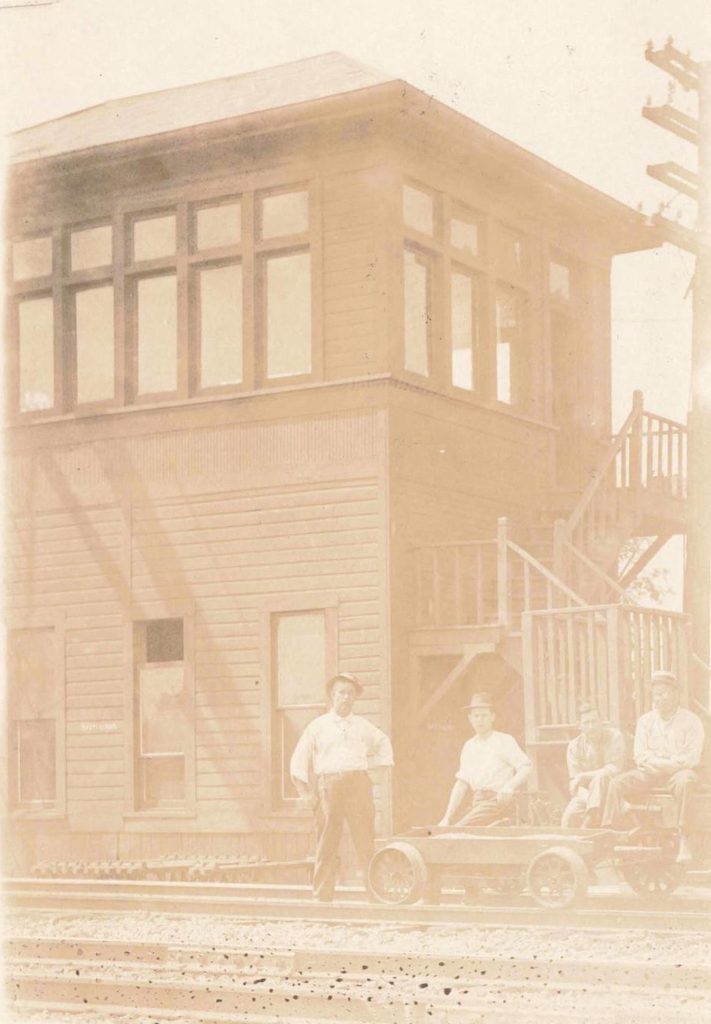
The railroad crossing helped support local commerce. Farmers could ship produce to larger markets, while businesses could receive manufactured equipment and building materials more efficiently.
Romulus was still a small farming community, but its railroad connections brought activity that many neighboring villages lacked.
Main Street: Hardware Stores, Horses and Early Automobiles
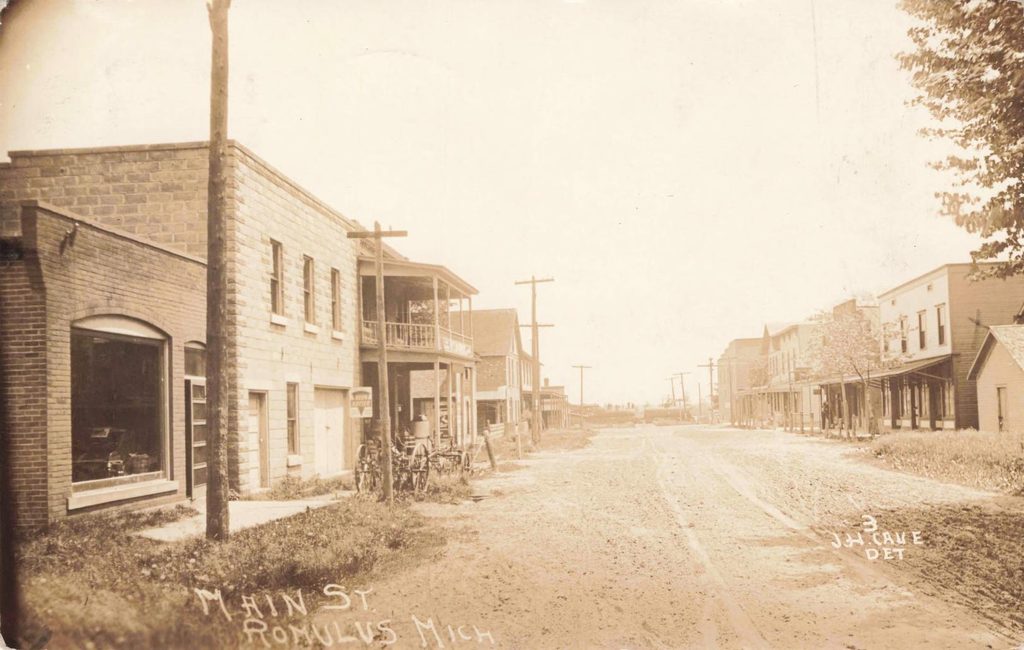
The surviving views of downtown Romulus show an established commercial district. Brick and wood buildings stood along broad streets. Shade trees lined the sidewalks, while utility poles carried the wires of an increasingly connected community.
One early Main Street view shows storefronts stretching into the distance along an unpaved road. The buildings are modest, but several are substantial enough to suggest established businesses rather than temporary frontier structures.

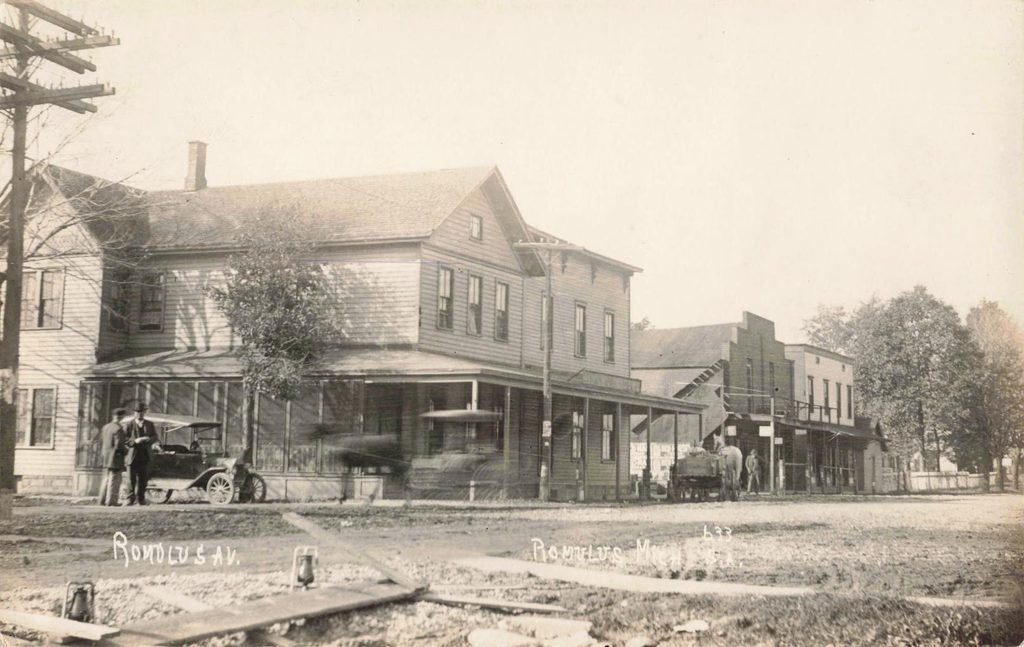
Another view captures a moment when transportation was changing. An early automobile is parked beside a large wooden building, while a horse-drawn vehicle stands farther along the street.
For several decades, horses and motor vehicles shared Michigan roads. Farmers might still depend on horses for fieldwork while using automobiles for trips into town. Local merchants began adapting their businesses to serve both.

The McBride Block and Kingsley Businesses
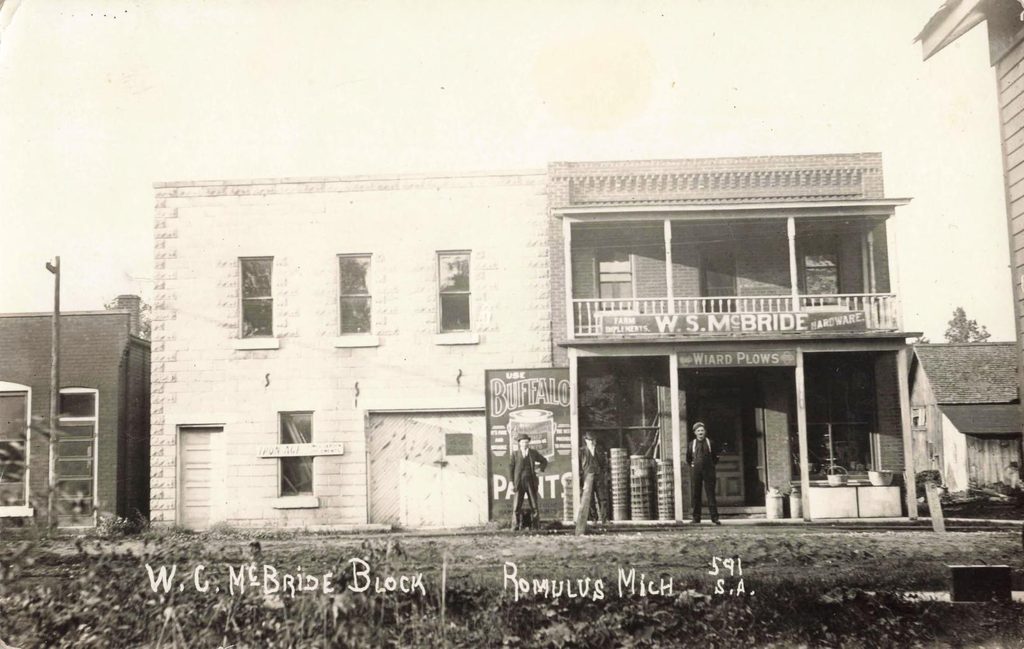
Among the recognizable commercial properties was the McBride Block. A 1915 postcard shows a substantial building housing a hardware business. Signs advertise farm implements, Wiard plows, and Buffalo paint.
Three men stand outside the storefront. Their identities are uncertain, but their surroundings reveal much about the business. The store advertised equipment and supplies intended for local farmers.

Look Closer: What Were Wiard Plows?
The Wiard Plow Company manufactured agricultural equipment farmers used in the late 19th and early 20th centuries. The advertisement on the McBride Block reminds us that local merchants sold equipment made by larger manufacturers. We have not established the precise models this Romulus dealer offered.
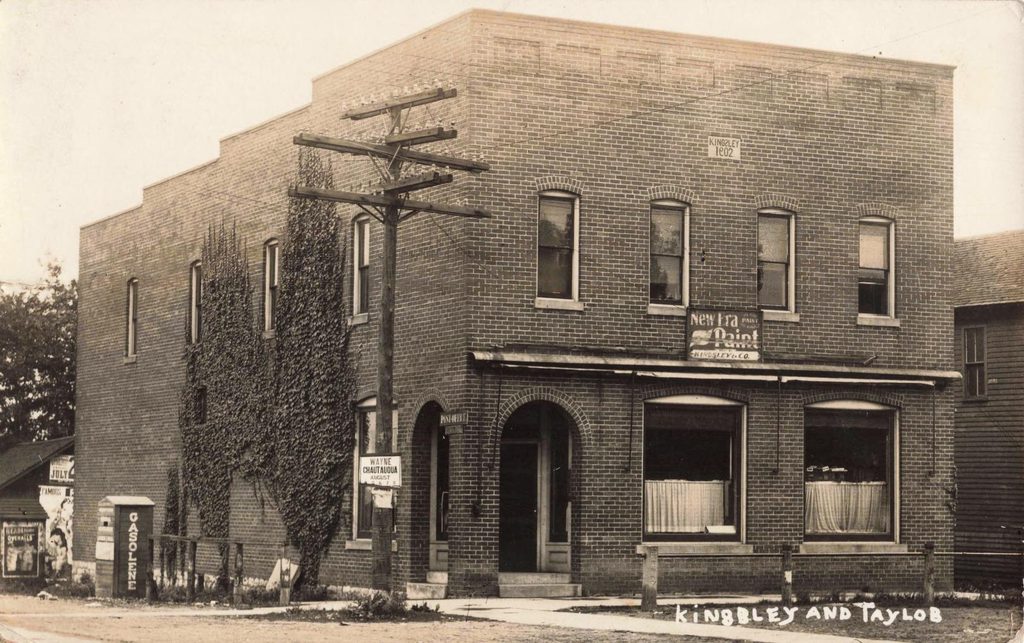
Another substantial commercial property was the Kingsley and Taylor building. Its brick facade displays the name Kingsley and the year 1902.
Signs advertise New Era paint, gasoline, and the Wayne Chautauqua. The Chautauqua movement brought educational programs and entertainment to communities across the country. Its appearance in this scene reminds us of the cultural activities available to small-town residents.

Seestedt’s Foundry: Industry in a Farming Community
Romulus was known for agriculture, but its economy also included industry. A remarkable 1913 postcard identifies a business called Seestedt’s Foundry.
The view shows several industrial buildings, smokestacks, and heavy equipment. A steam-powered traction engine stands near the buildings, while a large piece of wheeled machinery occupies the foreground.

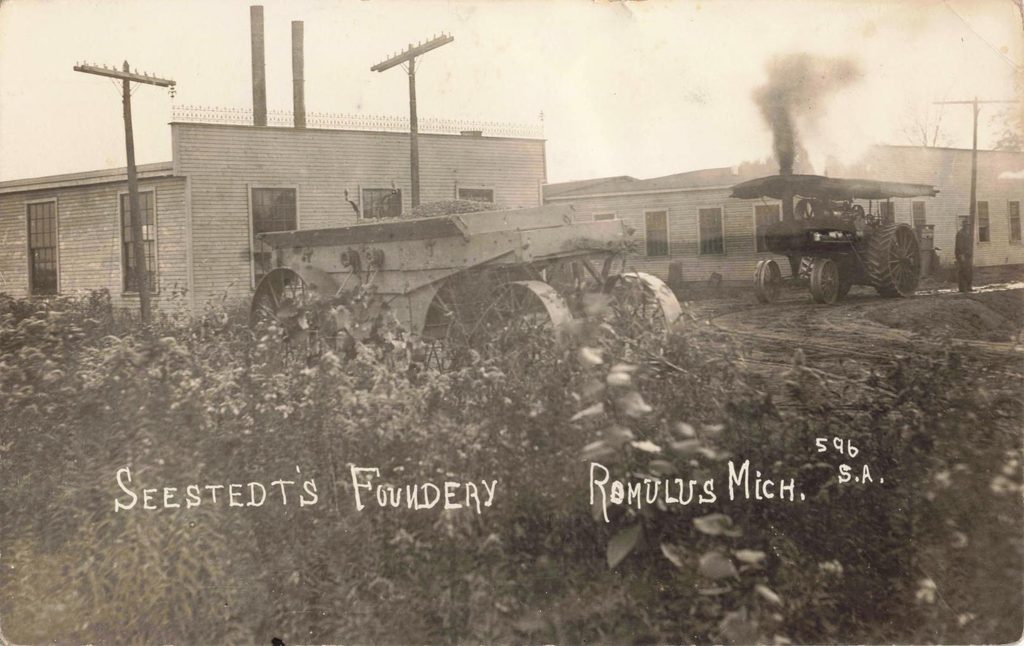
Steam traction engines were important machines during the transition from horse-powered farming to mechanized agriculture. They could operate heavy equipment, including grain-threshing machinery.
The exact products Seestedt’s Foundry manufactured or repaired require additional research. Nevertheless, the postcard documents an industrial operation in a community often remembered primarily for farming.
Another early Romulus scene shows a Brown Hoist machine working beside railroad cars and piles of bulk material. Its precise date and purpose remain uncertain, but it provides additional evidence of mechanized industrial work connected with the railroad.
Schools, Churches and the Families of Romulus
Beyond Main Street, schools and churches helped maintain community life. Families living on scattered farms relied on these institutions for education and regular gatherings.
Romulus established a one-room schoolhouse in 1839. That original building survives today as the Romulus Historical Museum.
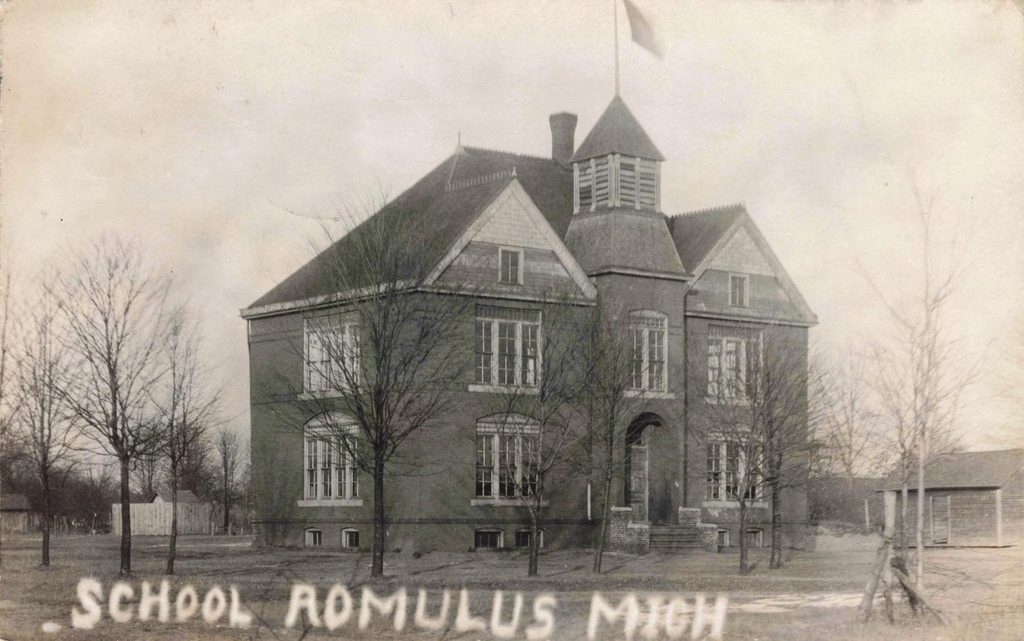
By 1907, the community also had a substantially larger school building. An early postcard shows a two-story structure with large windows and a central tower.

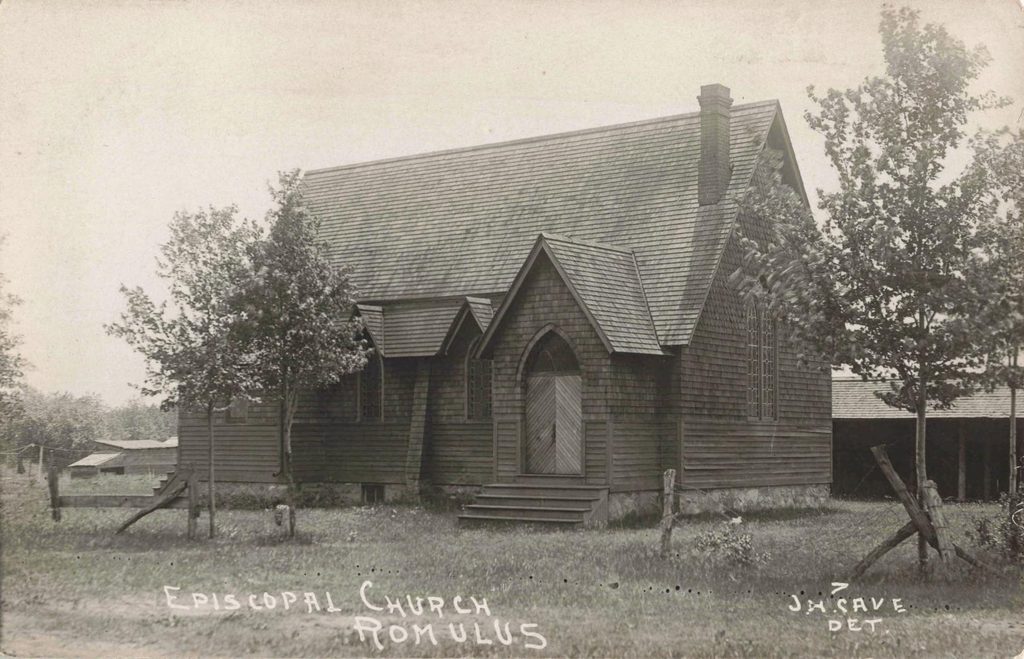
Religious congregations were another part of community life. Surviving postcards record both Episcopal and Methodist Episcopal churches in Romulus.
One view shows a modest wooden Episcopal church with a steep roof and pointed entrance. Its simple appearance contrasts with the larger commercial buildings developing downtown.

Romulus also has documented connections with the Underground Railroad. The city’s historical archives contain written and physical evidence associated with the movement, along with records of early African American families.
The surviving documents provide an important starting point for understanding this history. However, individual claims about specific Underground Railroad buildings require careful verification.
The Samuel Kingsley House, built in 1855, survives as a preserved residence. The city’s published museum information identifies it as an important example of early local life but does not establish that the house itself served as an Underground Railroad station.
In 1930, Airplanes Arrived in Romulus
By the late 1920s, another transportation technology began changing Wayne County.

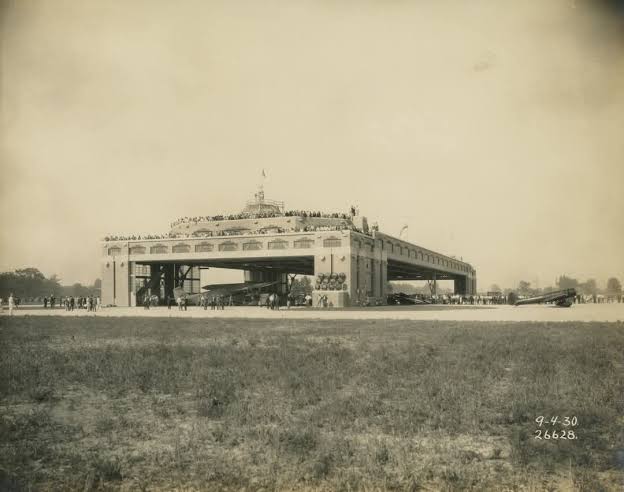
Commercial aviation was expanding, and county officials wanted an airport that could serve the Detroit region. They selected property near Middlebelt and Wick roads in Romulus.
Construction began with a groundbreaking in April 1929. On Sept. 4, 1930, Wayne County Airport officially opened.
The new airport was modest compared with today’s Detroit Metropolitan Airport. It did not immediately replace the farming and railroad activities that had supported Romulus for generations.
Its opening also came at a difficult time. The stock market had crashed less than a year earlier, and the United States was entering the Great Depression.
For Romulus residents, the airport introduced a new transportation industry whose importance would not become apparent for decades.
You can view historical images and an airport timeline on the Wayne County Airport Authority website.
World War II Changes the Airport’s Purpose
In 1940, the U.S. Army assumed control of Wayne County Airport and developed the property for military operations. They built additional hangars, runways, and other facilities, and the airport became known as Romulus Army Air Field.
During World War II, the field supported the movement of military aircraft. In 1943, 107 Women Airforce Service Pilots were assigned to Romulus Army Air Field.
These women helped ferry military aircraft across the United States. Their work became an important chapter in the airport’s history.
After the war, aviation continued expanding. Wayne County Airport was renamed Detroit-Wayne Major Airport in 1947. In 1958, it became Detroit Metropolitan Wayne County Airport.
By June 1966, the remaining scheduled passenger airlines operating at nearby Willow Run Airport had transferred to Detroit Metropolitan. Romulus was becoming the principal passenger aviation center for southeastern Michigan.
What Remains of the Original Railroad Town?
The railroad junction continued operating as the airport expanded. However, the passenger station and interlocking tower eventually disappeared.
A later view taken in 1969 shows the Wabash depot beside the railroad crossing. Although it belongs to a different period from the earlier postcards, it records the survival of a building associated with the community’s railroad years.

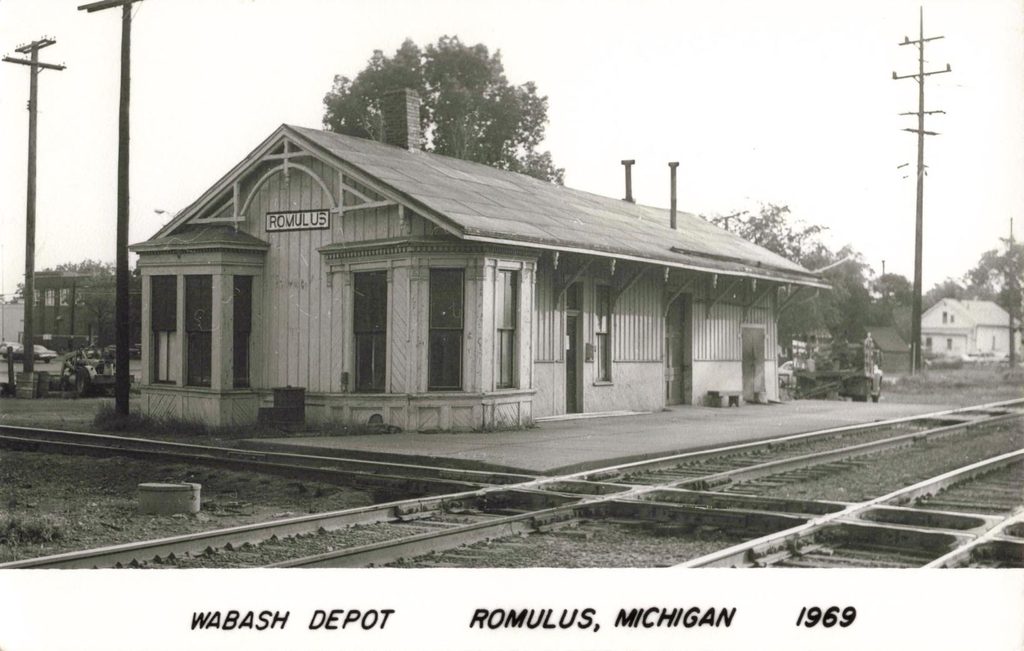
One railroad building survived. The Wabash Freight House, built around the beginning of the 20th century, once stood beside connecting tracks between the Wabash and Pere Marquette lines.
Local preservation efforts saved the building from demolition. Volunteers relocated it to Romulus Historical Park on Nov. 3, 2004, and dedicated it after restoration on July 13, 2005.
The park also preserves the original 1839 schoolhouse and the Samuel Kingsley House. Together, these buildings provide a physical connection with the community’s early years.
Romulus incorporated as a city in 1970. The airport continued to expand, bringing new industries and development to an area once largely occupied by farms.
Romulus, Michigan, has a history closely tied to transportation, but it began long before aviation. Early residents farmed, built businesses, and worked at a railroad junction that connected the community to the wider economy.
Today, airplanes pass over the city throughout the day. Beneath their flight paths, the old railroad crossing remains, along with a few preserved buildings that recall the community that existed before the airport.
Romulus History Timeline
Romulus, Michigan: Historical Timeline (1827–1970)
From its earliest pioneer settlements to the arrival of commercial aviation, Romulus experienced major changes in transportation, business and community life. Click below to view important dates in the city’s history.
View the Romulus Historical Timeline (1827–1970)
- 1827: Samuel McMath arrives in the area that becomes the village of Romulus.
- 1833: Jenks Pullen and his sons establish a settlement later called Pullen’s Corners.
- 1835: Romulus Township is officially organized on March 17.
- 1839: The community builds its original one-room schoolhouse.
- 1848: The township returns to the name Romulus after briefly being called Wayne.
- 1855: The Samuel Kingsley House is built.
- 1898: Railroad records identify a station agent working at Romulus Junction.
- 1902: The year appearing on the Kingsley commercial building.
- 1907: A surviving postcard documents the larger Romulus school building.
- 1913: Seestedt’s Foundry is recorded in a historical postcard showing industrial machinery.
- 1915: A postcard records the W.C. McBride Block and its hardware business.
- 1929: Construction begins on Wayne County Airport in April.
- 1930: Wayne County Airport officially opens on Sept. 4.
- 1940: The U.S. Army assumes control of the airport for military operations.
- 1943: Women Airforce Service Pilots are assigned to Romulus Army Air Field.
- 1958: The airport receives the name Detroit Metropolitan Wayne County Airport.
- 1970: Romulus officially incorporates as a city.
Frequently Asked Questions About Romulus History
When was Romulus, Michigan, founded?
The area was settled beginning in the 1820s. Romulus Township was officially organized March 17, 1835. The community incorporated as a city in 1970
Which railroads served Romulus?
The Wabash and Pere Marquette railroads crossed in Romulus, creating an important railroad junction. The crossing supported passenger travel and freight transportation.
When did Detroit Metropolitan Airport open?
The airport opened as Wayne County Airport on Sept. 4, 1930. Construction began in April 1929. It became a major passenger aviation center over several decades
Where can visitors see historic Romulus buildings?
Romulus Historical Park is located at 11120 Hunt St. in downtown Romulus. The park includes the original 1839 schoolhouse, the Samuel Kingsley House, and a restored Wabash Railroad freight building. Visitors should check current museum hours before traveling.
Help Preserve the History of Romulus, Michigan
Do you recognize a business, building, or family appearing in these early Romulus images? Perhaps you remember the railroad depot or have photographs of Main Street before the airport expanded.
Share your memories or historical information in the comments. Names, dates and family stories can help provide additional context for these surviving images.
📚 Works Cited
City of Romulus. “Downtown Historical Park.” City of Romulus.
MichiganRailroads.com. “Romulus, MI.” MichiganRailroads.com.
University of Michigan Library. “School Romulus Mich.” David V. Tinder Collection of Michigan Photography, William L. Clements Library, 1907.
University of Michigan Library. “Seestedt’s Foundery Romulus Mich 596 S.A.” David V. Tinder Collection of Michigan Photography, William L. Clements Library, 1913.
University of Michigan Library. “W. C. McBride Block Romulus Mich. 591 S.A.” David V. Tinder Collection of Michigan Photography, William L. Clements Library, 1915.
University of Michigan Library. “Wabash Depot Romulus, Mich.” David V. Tinder Collection of Michigan Photography, William L. Clements Library, 1969.
Wayne County Airport Authority. “Airport History.” Detroit Metropolitan Wayne County Airport.
Wayne County, Michigan. “Romulus.” Wayne County Government.