 by
by At the Black River in Cheboygan County, Tower once operated like a compact industrial center. Mills converted northern hardwood into handles, staves, and lumber while railroad branches reached miles into the timber. A remarkable set of early postcards records the town just before the fire and the falling timber supplies that changed its future.
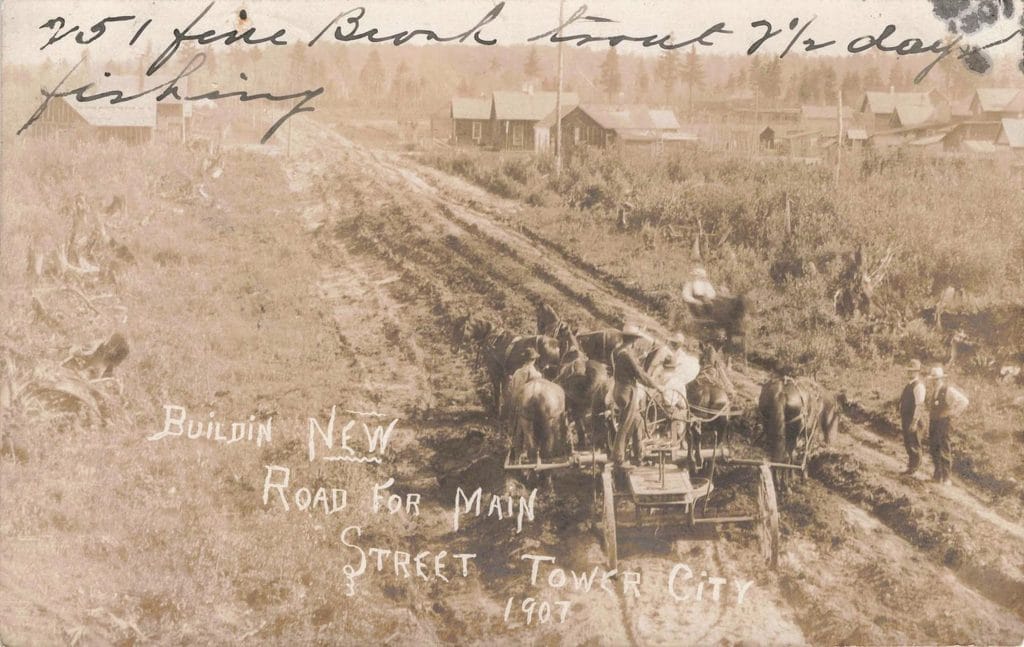
A 1907 postcard from Tower shows several teams of horses standing in a broad scar of churned earth. Men are working nearby. Someone wrote across the image, “Building New Road for Main Street Tower City 1907.”
Calling the place “Tower City” may have been a little ambitious. Tower was still a small village in northern Michigan. But for a few years, ambition ran rampant.
Other surviving images show immense piles of snow-covered hardwood logs. Workers pose beside mills that look almost new. Two men stand inside a handle factory surrounded by hundreds of smooth wooden shafts. A railway crew poses beside a caboose on a narrow-gauge logging line.
These photographs from the University of Michigan’s David V. Tinder Collection capture Tower during the brief period when money, machinery, and people poured into a place that had barely existed a decade earlier.
The history of Tower, Michigan, is not simply another story about a vanished lumber town. Tower became a manufacturing center with its own newspaper and theater. It suffered a deadly hotel fire before the much larger 1911 fires. Later, the same river that helped support industry threatened the community during a major 1922 flood.
For a while, nearly everything in Tower depended on wood.
Table of Contents
Podcast: The History of Tower, Michigan (1900–1950)
Watch: Tower Michigan History: The Lumber Town That Built, Burned and Endured
Tower Was Named for a Michigan Army Nurse
Tower began as a lumber settlement along the Black River in Forest Township. A post office opened in 1899, and the village was platted that May.
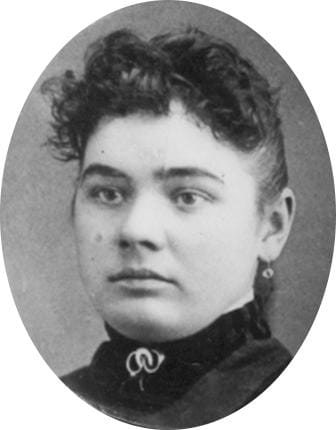
The village was named for Ellen May Tower, whose family moved to the Onaway area during the 1880s. Tower trained as a nurse at Detroit’s Grace Hospital and volunteered for Army service during the Spanish-American War. She cared for sick and wounded soldiers at Camp Wikoff in New York before volunteering for duty in Puerto Rico.
She died there of typhoid fever on Dec. 9, 1898, at age 30. Her body was returned to Michigan, where thousands attended her funeral in Byron. The state historical marker honoring Tower says the Owosso Evening Argus described it as Michigan’s first military funeral for a woman. The community was named for her the following year.
The name gave the settlement a permanent connection to a woman whose life had little to do with logging. Nearly everything else about early Tower, however, revolved around timber.
The Railroad Came for the Trees
The Detroit & Mackinac Railway was critical to Tower from the beginning.
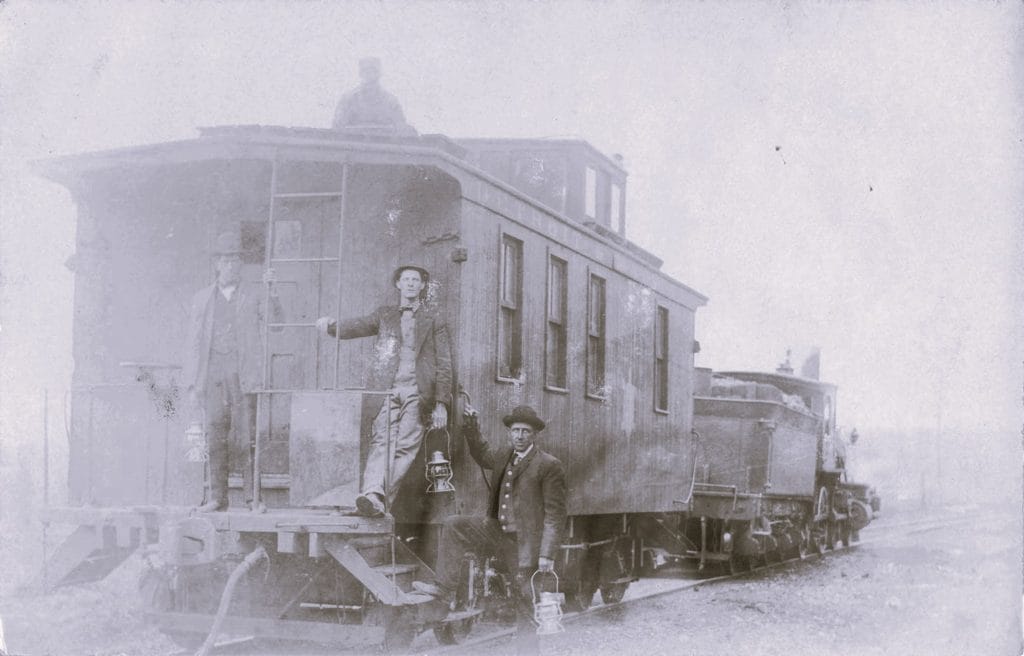
A company report from 1901 is unusually direct about why. At the time, Tower was the temporary end of the railroad’s main line. From there, two branches reached into timber country. The Cleveland Branch was built to help the Cleveland Saw Mill & Lumber Co. remove timber, while the Indian River Branch was extended another 7½ miles to reach additional forest products.
The railroad described a “vast quantity” of mixed timber around Tower.
This helps explain one of the more striking Tinder postcards. Three railroad men stand beside a small caboose while a steam locomotive waits behind them. The University of Michigan transcription identifies it as a narrow-gauge line that went from Tower to the end of the Cleveland Branch.
The image makes the economics of Tower clear. The railroad did not merely connect residents with other towns. Track went into the woods because timber was the freight.
A 1912 Michigan Supreme Court case involving the Detroit & Mackinac Railway later described the system in remarkable detail. The Cleveland Branch extended 11.5 miles from Tower, while other branches reached additional timber. Once they exhausted the trees along some routes, they could pull up the rails and use them elsewhere.
That was both the strength and the weakness of Tower’s economy. The railroad could quickly reach new timber. Once that timber disappeared, it could leave just as quickly.
Tower Became a Factory Town
Logging alone does not explain Tower’s rapid growth. The town made money by processing wood before shipping it away.
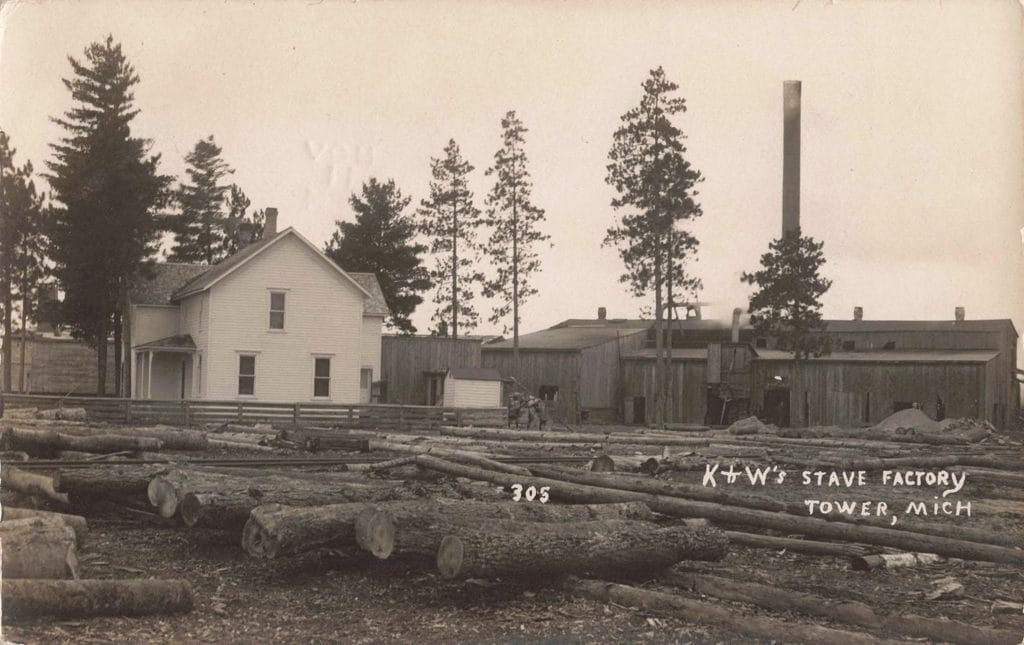
One of its major operations was Keys & Worboys, a company involved in the stave and cooperage business. In 1904, the firm purchased an existing Tower mill and rebuilt much of the operation with new engines and woodworking machinery.
A 1905 biographical history described its Tower operation as producing 40,000 staves a day, plus 3,000 sets of barrel heading and 20,000 board feet of lumber. Charles McGinnis served as the local manager.
The Tinder collection includes a postcard plainly labeled “K & W Stave Factory Tower, Mich.” Logs cover the foreground while the long factory building and smokestack rise behind them.
Other postcards show construction of a new Keys & Worboys mill in 1907 and a Forest Lumber Co. mill being framed. Men balance high on exposed roof timbers with little visible protection. Nearby photographs show huge stocks of logs waiting to be processed.
These were substantial industrial operations, not temporary saws thrown beside a logging camp.
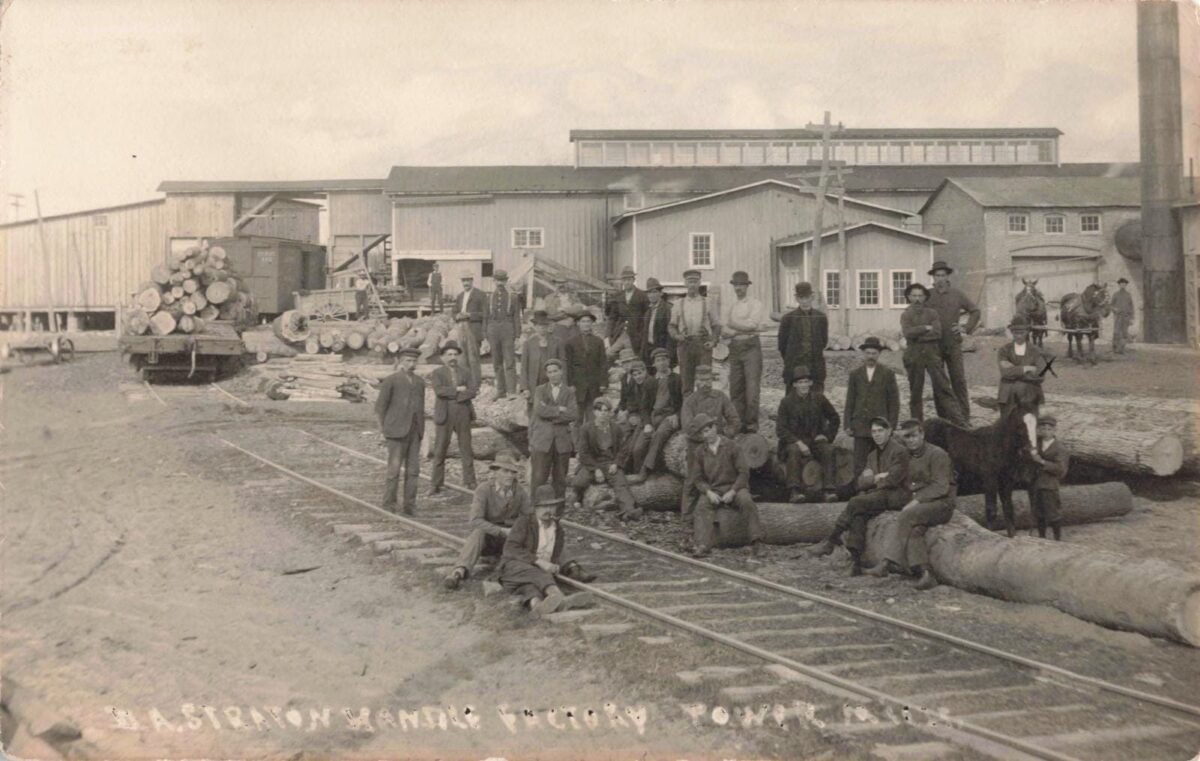
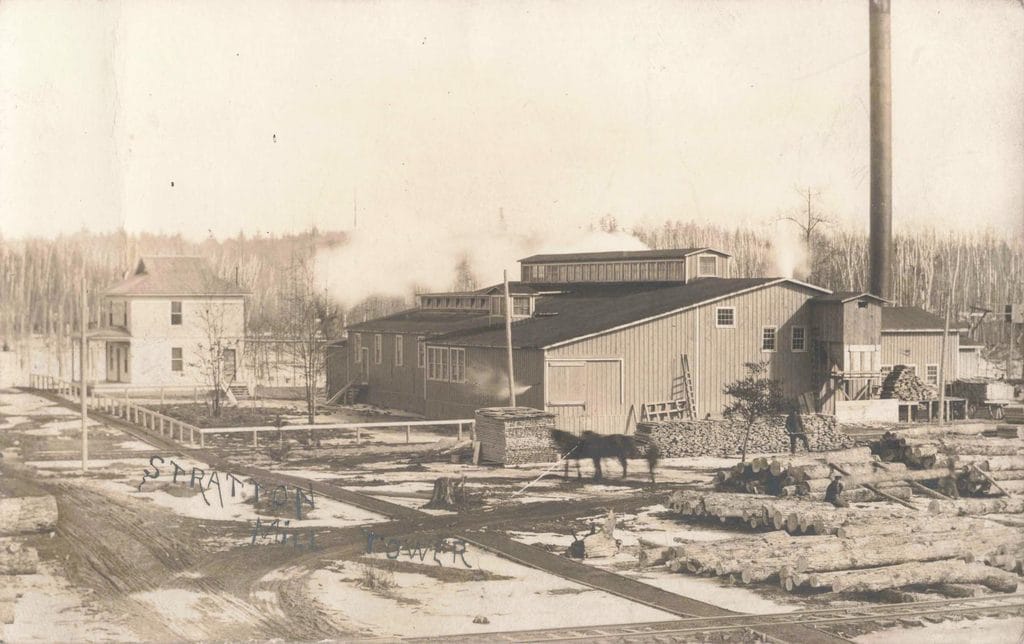
Inside the Stratton Handle Factory
Perhaps the most personal image from early Tower shows two men surrounded by wooden handles.
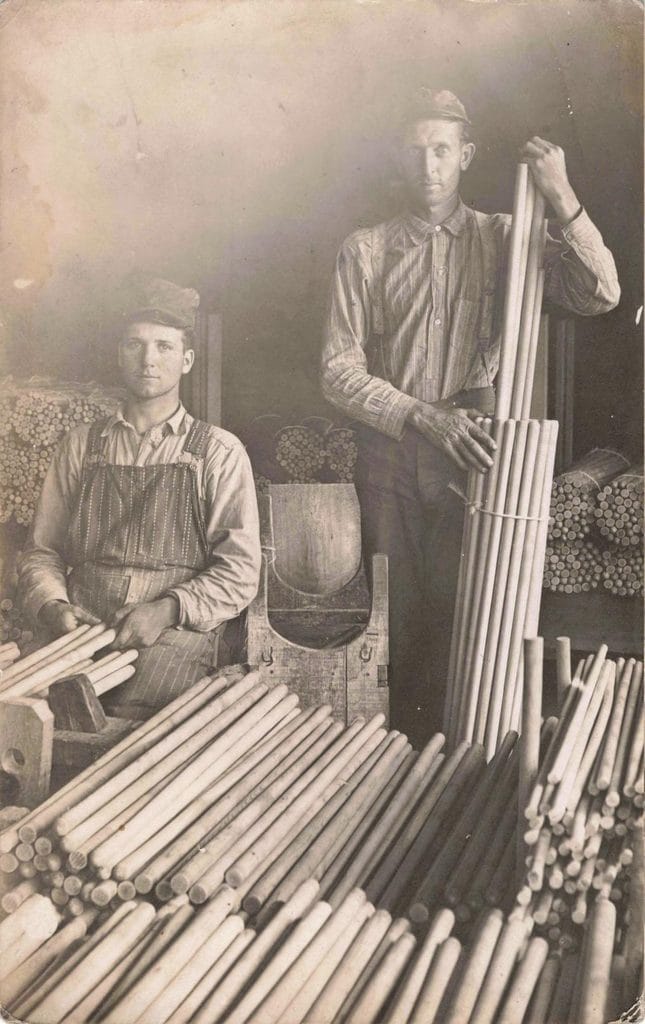
One worker sits in an apron holding several newly turned pieces. Another stands beside a tall bundle. Behind them, stacks hold hundreds more.
The men worked in DeForest A. Stratton’s handle factory.
Stratton arrived in Tower in 1905 after years in northern Michigan’s hardwood business. His new operation included a two-story main building measuring 120 by 60 feet, an office and a brick-and-cement boiler room. Contemporary accounts said the plant could produce 25,000 handles per day while employing about 30 men. Stratton also began building houses for workers and controlled hardwood acreage to supply the factory.
The University of Michigan identifies another postcard in the collection as the D.A. Stratton Handle Factory, with a handwritten note calling the view the “back yard” of the mill.
That factory helps explain why Tower’s photographs look different from stereotypical lumber-camp images. Logs arrived as raw material, but much of what left Tower was manufactured merchandise.
A tree entering town might leave as a broom handle.
What Did Daily Life Look Like in Tower?
By 1910, the R.L. Polk directory estimated Tower’s population at 800 and described a community with telephone and telegraph connections. It listed a bank, a hotel, and a graded school. Several churches served the community.
The directory becomes more interesting when read as a snapshot of daily life.
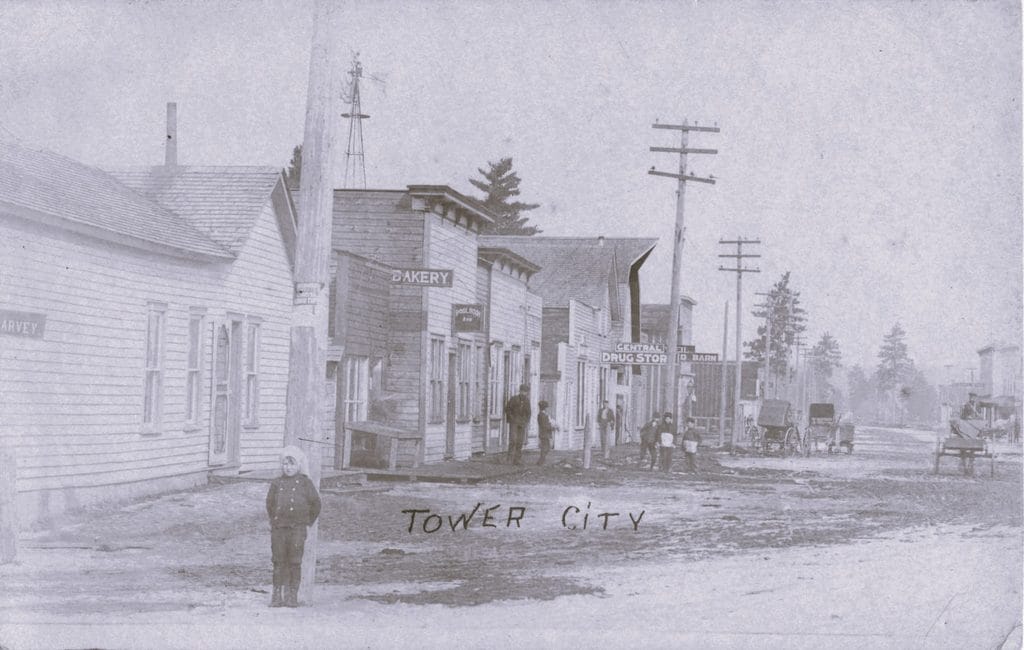
Edward M. Crannell operated a barber shop, restaurant and livery business. John J. Kelly sold drugs. James A. Kelley was postmaster. The Fitzpatrick brothers operated a shingle mill. Malcolm McNeil ran a livery operation, while various residents worked as sawyers, woodsmen and stave cutters.
Tower even had a Star Theatre, operated by members of the Pollard family and George Hunt.
For a small timber town, that is an important detail. Workers could leave a mill, get a haircut, eat a meal, and later see a show without leaving Tower.
The community also supported newspapers. The Library of Michigan records the Tower Press from 1905 through 1906 and the Cheboygan County Era from 1907 through 1909.
A local history says seven saloons once operated in town. The Polk directory confirms several saloon operators were doing business in 1910.
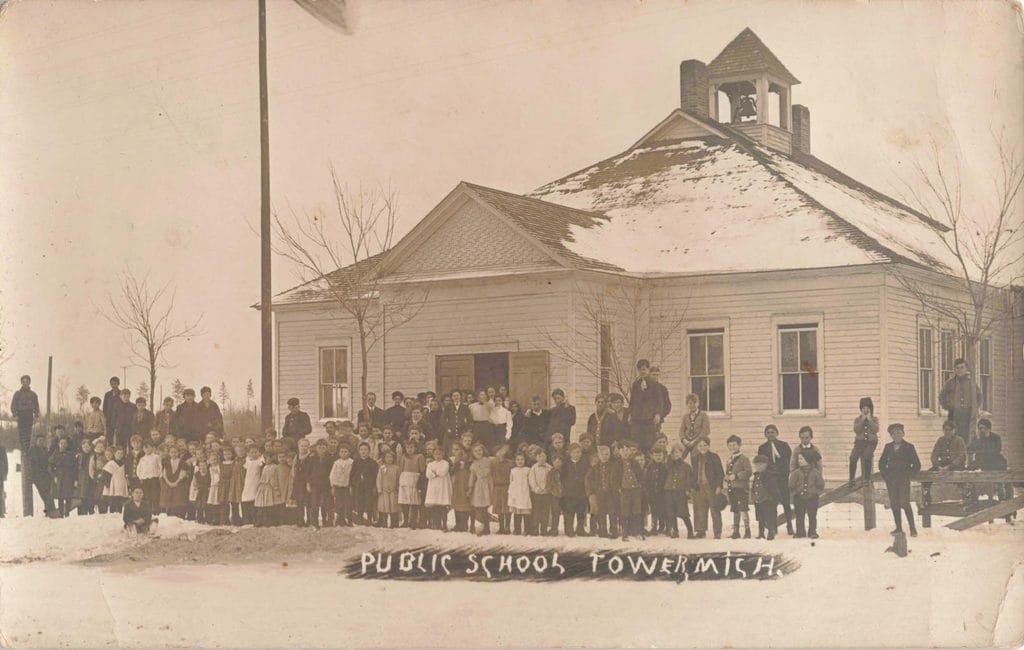
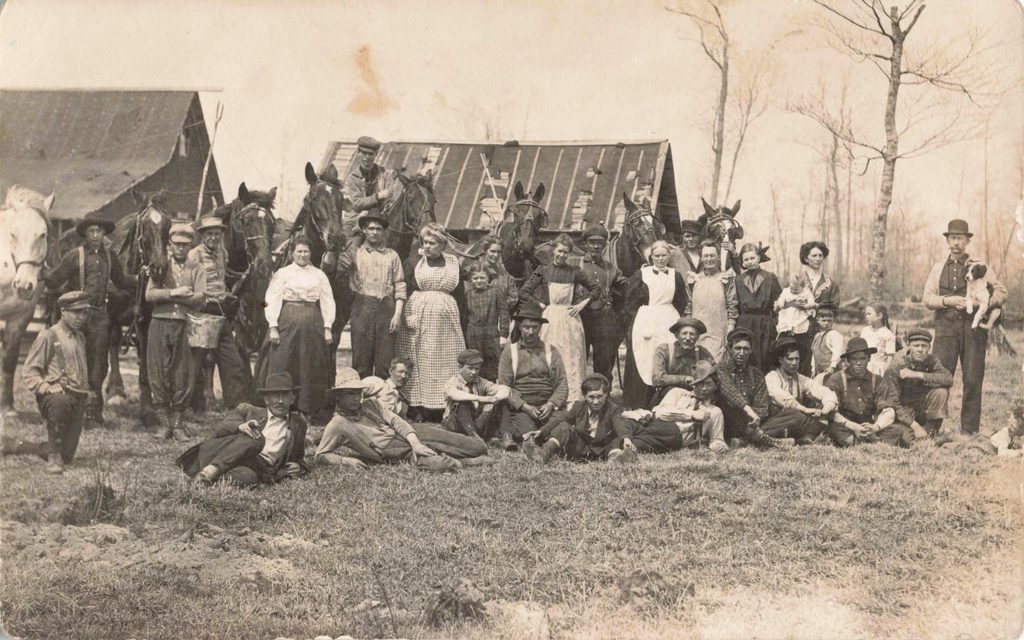
One attached postcard shows Tower’s public school with a large group of children and adults standing outside. It is perhaps the clearest evidence that Tower was no longer merely a work camp. Families had settled there.
A Postcard From Jan. 12, 1911
Another Tinder photograph deserves a long look.
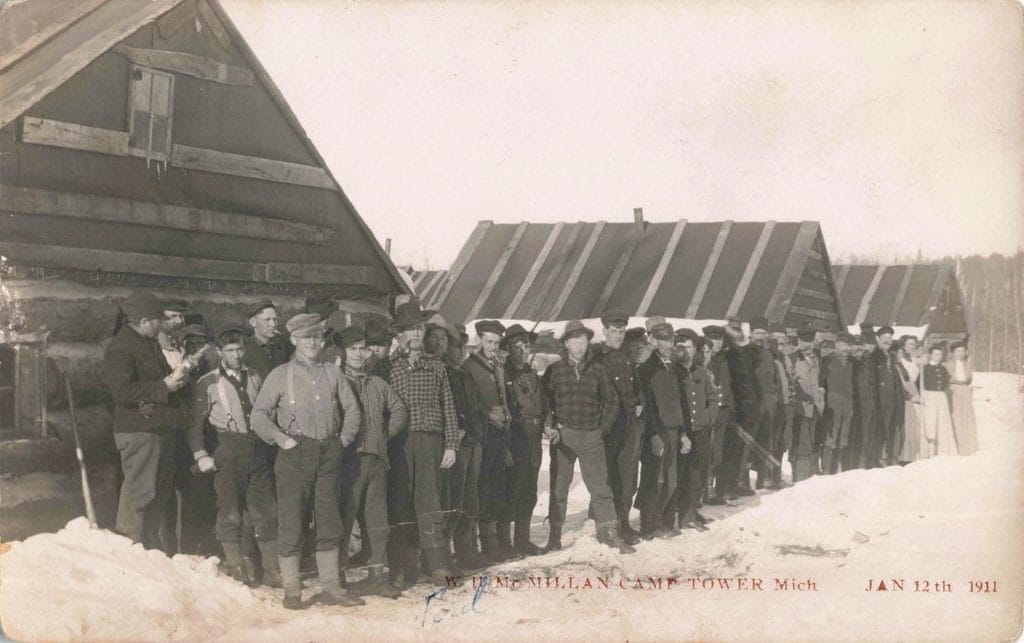
It shows scores of men outside rows of rough camp buildings in deep snow. The postcard is titled “W. U. McMillan Camp Tower Mich Jan 12th” and is dated 1911.
The men’s clothing tells part of the story. Heavy coats and boots dominate the scene. These men worked in a winter logging camp, where horses remained central to hauling timber from the woods.
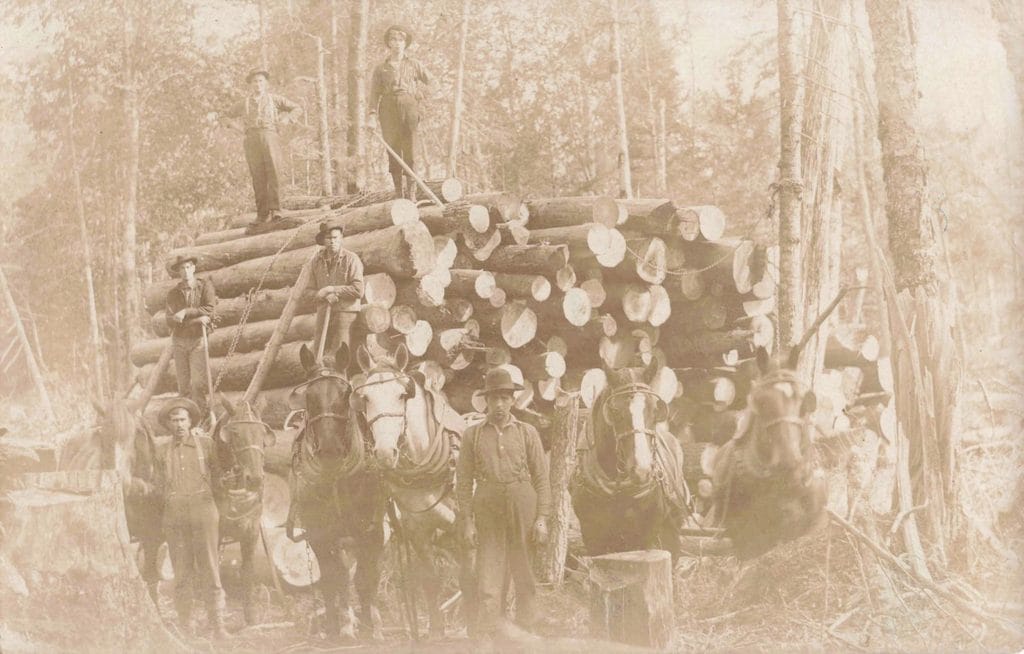
Another photograph shows men standing atop an enormous pile of logs with work horses below. The scale is hard to judge until you notice the people. Logs are piled far over their heads.
That winter of 1911 may have looked like proof that Tower’s lumber business still had years ahead of it.
By summer, that assumption would look far less certain.
Tower Had Already Seen a Deadly Fire
The famous fire in Tower occurred in July 1911, but one of the newly reviewed photographs corrects an important detail in the visual record.
A damaged storefront surrounded by children and adults carries a handwritten caption:
“After the Fire Feb 20-09 Tower Mich 2 Men Burned.”
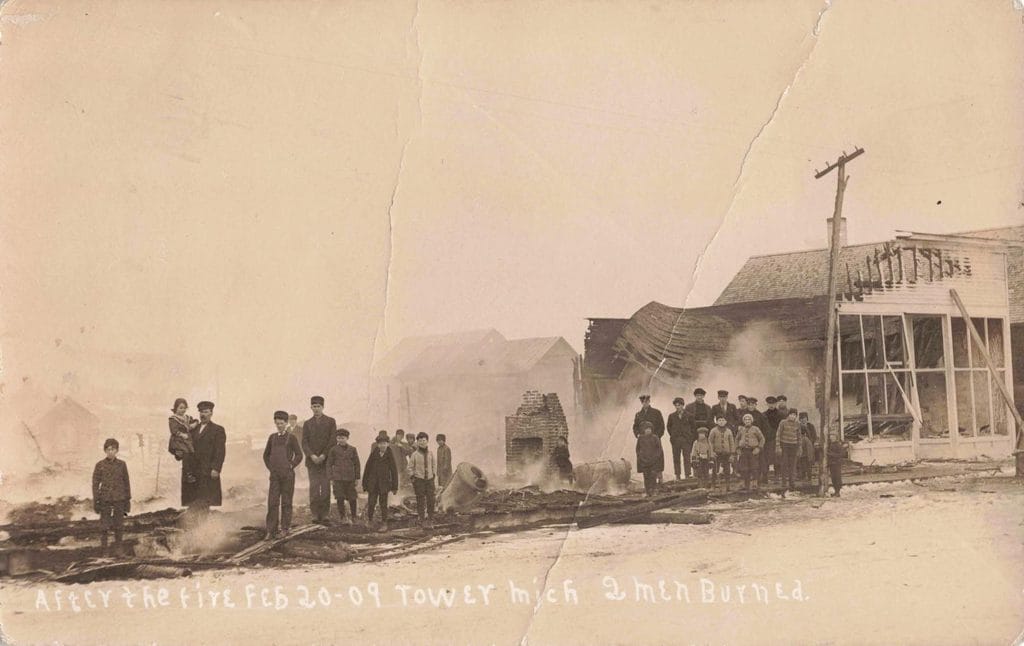
This image is sometimes easy to mistake for the aftermath of the 1911 disaster. It is not.
The Tinder Collection dates the postcard to 1909. A contemporary newspaper report says Duffy La France and Peter Eno died when the Hotel Finan at Tower was destroyed by fire.
The photograph is sobering. People stand among smoking remains, with a brick chimney as one of the few recognizable pieces left.
Tower had learned how quickly a wooden town could burn two years before its most damaging fire.
Black Tuesday Comes to Tower
July 11, 1911, became one of the worst fire days in northern Michigan history.
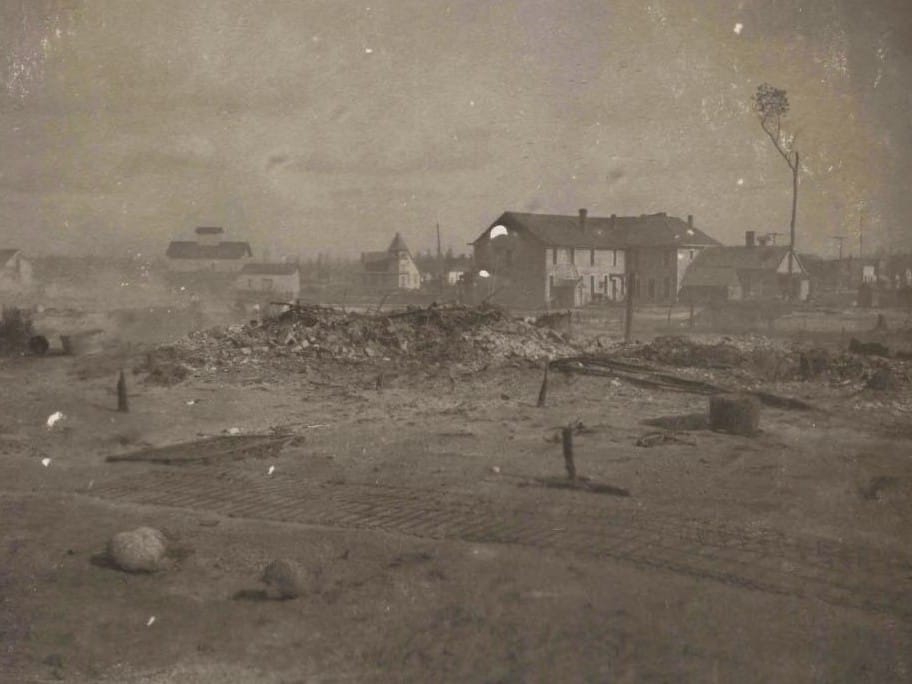
Extreme heat had dried logging slash and forest debris throughout the region. Fires were burning at scattered locations across northern Michigan. Tower was among several communities hit that day; the burning at Tower should not be pictured as one continuous fire traveling more than 100 miles north from Oscoda.
The local account of what happened contains a strange detail.
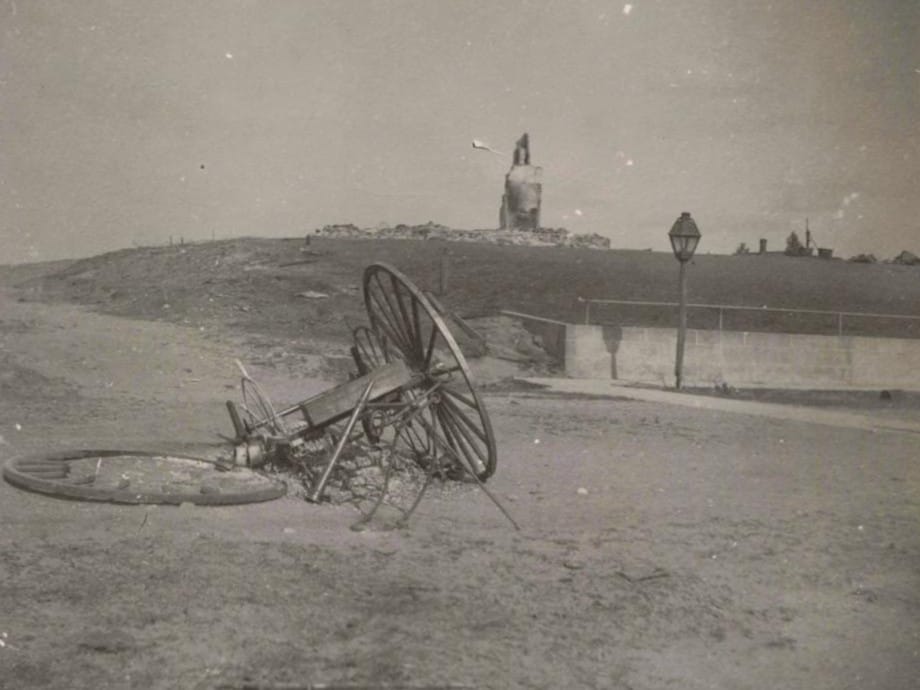
According to the history compiled by Cheboygan County MIGenWeb from contemporary accounts, about half of Tower’s population took the morning train to Cheboygan to attend a circus. As conditions worsened, much of the remaining population fled toward Onaway by wagon, horseback, or on foot.
Deputy Game Fire Warden Ellsworth rode toward Tower through smoke and strong winds, meeting residents heading in the opposite direction.
Some men stayed.
They uncoupled railroad cars one at a time and moved them away from the fire. Eleven cars were reportedly saved. The Detroit & Mackinac lost its Tower depot and agent’s house along with 24 railroad cars. Fitzpatrick Brothers lost its shingle operation and inventory.
Charles McGinnis, whose name had appeared years earlier as a mill manager, was credited with helping save six cars of logs. A contemporary account later said that without men like him, “every vestige of Tower would have been nothing but an ash heap today.”
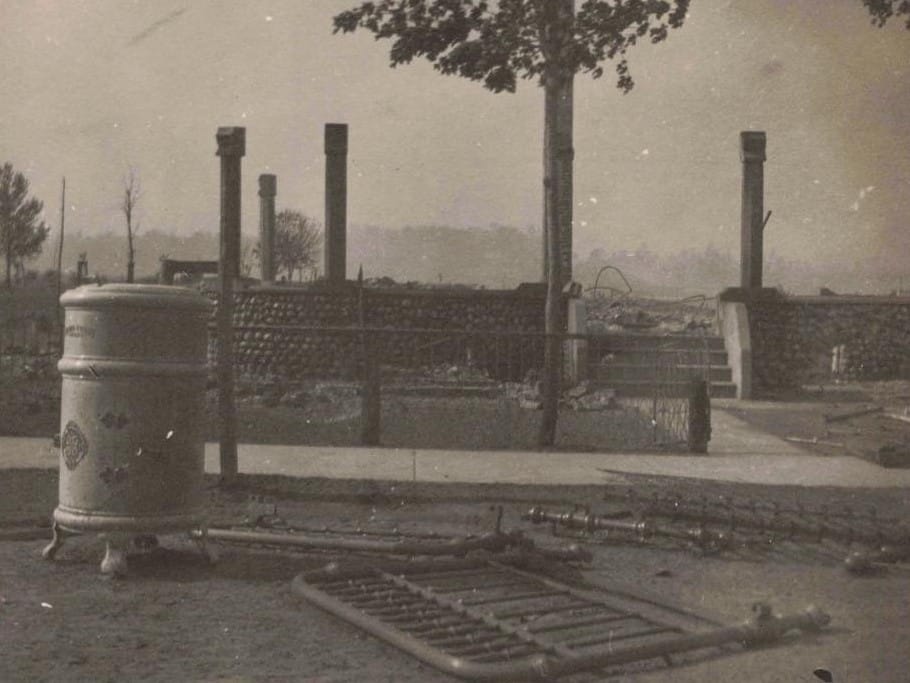
Other details make the account feel less like distant history. Village President M.D. Myers worked a water bucket. A bank cashier used a crowbar to release brakes on railroad cars. Ellsworth reportedly carried drinking water to exhausted firefighters after working with a shovel himself.
The cause is less certain. A later local history says the Onaway News suspected boys smoking cigarettes near the river, but the material reviewed does not establish that theory as fact. What is clear is that exceptionally hot, dry weather and combustible logging debris created dangerous conditions across the region.
Tower Did Not Vanish in 1911
The easiest ending would be to say the fire destroyed Tower and the town disappeared. The photographs say otherwise.
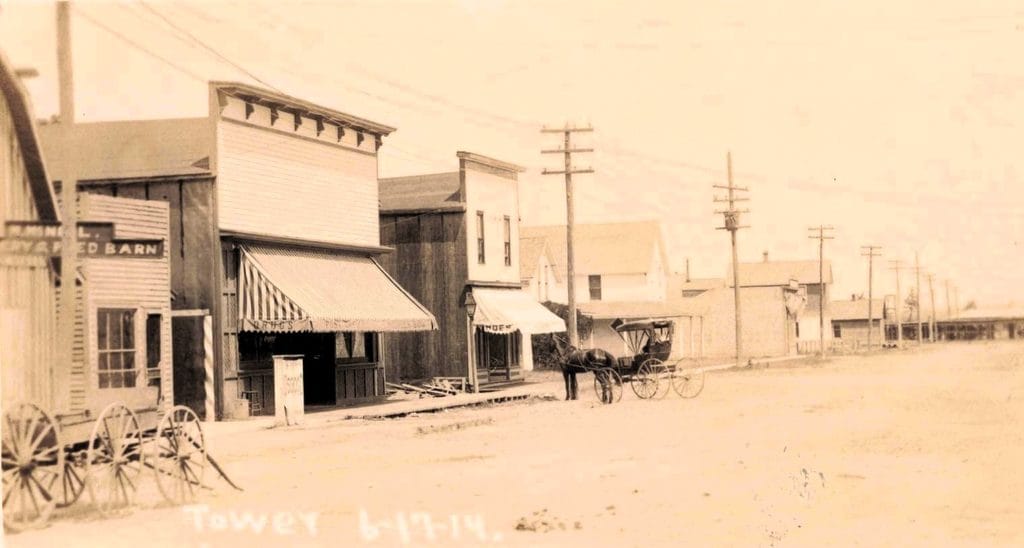
A street scene dated June 17, 1914, shows an active Tower three years after the fire. Horse-drawn rigs remain along the road. Storefronts still face the street.
The lumber economy was weakening. One major sign came in 1915. Records of the lumber settlement of Raco in the Upper Peninsula state that a sawmill purchased from the Forest Lumber Co. arrived there from Tower that year.
Machinery was following the timber north. The local Tower history places the population at about 300 by 1916, well below the 800 cited in the 1910 Polk directory. Smaller mills remained, but the previous decade’s extraordinary growth was over.
That shift is what makes the 1907 photographs so valuable. They were made near the high-water mark of Tower’s industrial years.
The Dam Photos Need a Closer Look
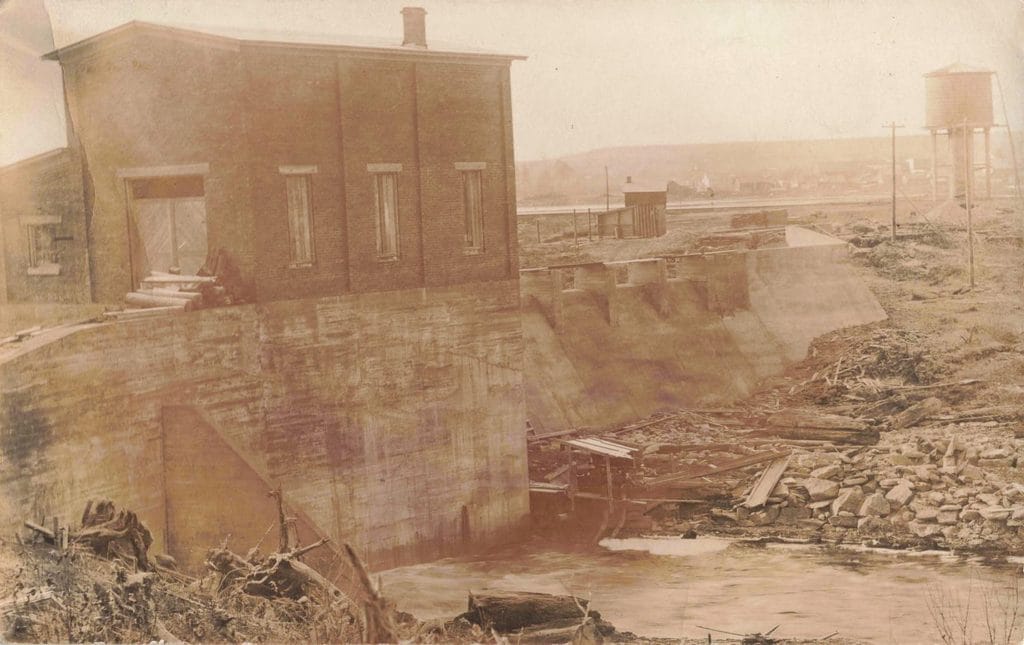
Several of the postcards show a dam, rushing water, and railroad structures along the Black River. Another Tinder image is cataloged with the handwritten identification “Tower Power house.”
There is an important date issue here.
Some early photographs appear to show water-control structures at Tower before the hydroelectric project. Michigan Department of Natural Resources records date construction of the present Tower Dam and powerhouse to 1917-18, with electrical operation beginning in 1918. The dam created the present Tower Pond and has a 20-foot head.
That means older postcards showing a dam or spillway should not automatically be described as the current hydroelectric Tower Dam. They likely document earlier mill-era water works or a predecessor structure.
The distinction is small but important in a historical article. By 1918, however, Tower had gained something very different from the temporary logging railways: infrastructure intended to stay after the lumber companies moved on.
In 1922, the Black River Turned Against the Town
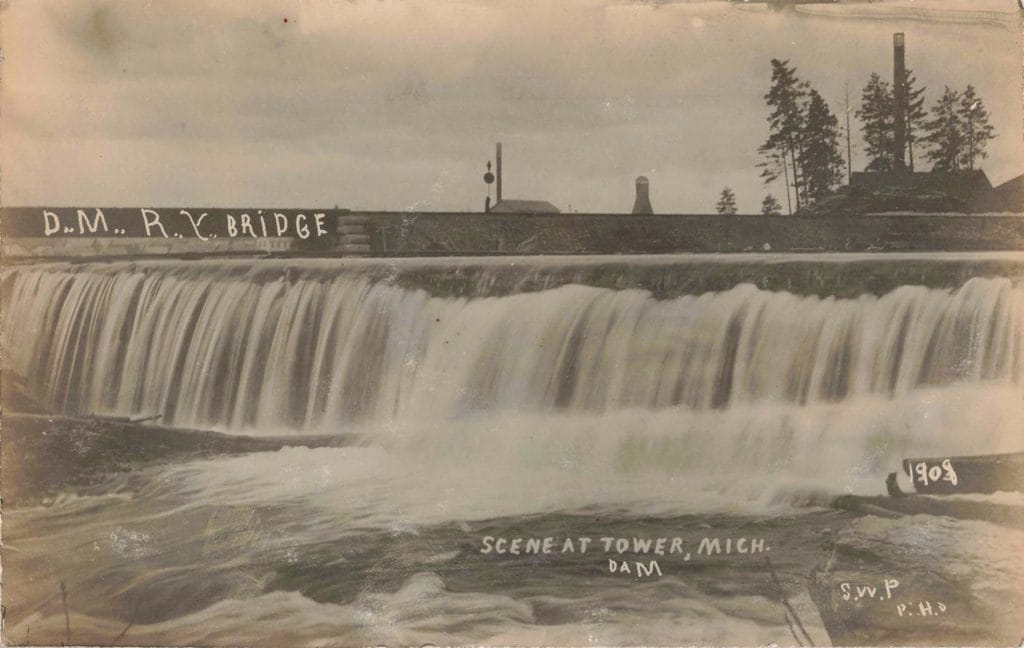
Four years after the hydroelectric plant began operation, Tower faced another emergency. Rapid snowmelt, combined with warm weather and rain in April 1922, caused the river to rise quickly. Water rose quickly along the Black River.
The Crawford Avalanche reported that residents initially regarded the rising water as an ordinary spring flood. That changed as buildings, fences, and large trees began moving downstream. About 500 feet of Detroit & Mackinac railway track was torn away, and a large water tower was wrecked. Work crews rushed to protect the dam.
The flood also produced its own human story.
Guy Stanton, 34, of Onaway, was swept away while helping at the dam and died. Claud Post nearly suffered the same fate before his brother Alfred pulled him from the water.
The dam held. Tower survived again, although the flood further damaged infrastructure serving a community whose industrial peak had already passed.
What These Tower Photographs Actually Show
Looking at these images more than a century later, it is easy to see only nostalgia: horses in snow, wooden storefronts and men standing beside steam machinery.
But the photographs record something more specific.
They show how quickly a northern Michigan town could be assembled around a natural resource. A railroad pushed into the forest. Mills followed the tracks. Houses appeared near the mills. A school filled with children. Newspapers began printing. Someone opened a movie theater.
Then the resource began running out. The narrow-gauge line in one postcard was built to reach timber. The sawmills shown under construction depended on timber. Stratton’s workers needed hardwood for their handles. Keys & Worboys needed wood for staves.
As the trees became harder to reach, they could load equipment onto railcars and move it elsewhere.
Yet Tower remained. The Black River still flows through the community. Tower Pond remains. The hydroelectric plant that followed the old lumber operations kept the town and the river connected long after the biggest log piles disappeared.
Perhaps the best representation of Tower Michigan history is that 1907 road-building postcard.
Several horse teams stand in the mud while men work on what somebody proudly called the new road for “Main Street Tower City.” They could not have known about the deadly hotel fire two years later. They could not have anticipated Black Tuesday in 1911 or the 1922 flood. At that moment, they were building a road because Tower appeared to be going somewhere.
And for a brief period in northern Michigan history, it was.
Works Cited for Tower Michigan History
- Detroit & Mackinac Railway Company. Annual Report of the Detroit and Mackinac Railway Company, 1901. Detroit & Mackinac Railway Company, 1901. Accessed 2 Oct. 2026.
- Genealogy Trails. Cheboygan County Michigan Genealogy and History: DeForest A. Stratton and Charles McGinnis Biographies. Material transcribed from Biographical History of Northern Michigan, B.F. Bowen & Co., 1905. Accessed 2 Oct. 2026.
- Haines, Deb. History of Tower. Cheboygan County MIGenWeb, based in part on Kevin Everingham’s The Everingham Family of Michigan. Accessed 2 Oct. 2026.
- Library of Michigan. Cheboygan County Newspaper Holdings. Michigan Department of Education. Accessed 2 Oct. 2026.
- Michigan Department of Natural Resources. Tower Pond Status of the Fishery Resource Report 2012-148. Michigan Department of Natural Resources, 2012. Accessed 2 Oct. 2026.
- R.L. Polk & Co. 1910 Directory of Indian River, Mackinaw City, Tower and Wolverine. R.L. Polk & Co., 1910. Cheboygan County MIGenWeb. Accessed 2 Oct. 2026.
- Crawford Avalanche. Tower Flood Report, 13 April 1922. Grayling, Michigan, 13 Apr. 1922. Accessed 2 Oct. 2026.
- University of Michigan Library Digital Collections. After the Fire, Feb 20-09, Towey, Mich., 2 Men Burned. David V. Tinder Collection of Michigan Photography, William L. Clements Library. Accessed 2 Oct. 2026.
- University of Michigan Library Digital Collections. D.A. Straton Handle Factory, Tower, Mich.. David V. Tinder Collection of Michigan Photography, William L. Clements Library. Accessed 2 Oct. 2026.
- University of Michigan Library Digital Collections. K & W Stave Factory Tower, Mich.. David V. Tinder Collection of Michigan Photography, William L. Clements Library. Accessed 2 Oct. 2026.
- University of Michigan Library Digital Collections. Tower Narrow-Gauge Railroad and Cleveland Branch. David V. Tinder Collection of Michigan Photography, William L. Clements Library. Accessed 2 Oct. 2026.
- University of Michigan Library Digital Collections. W. U. McMillan Camp Tower Mich Jan 12th. David V. Tinder Collection of Michigan Photography, William L. Clements Library, 1911. Accessed 2 Oct. 2026.
- University of Michigan Library Digital Collections. Tower Power House. David V. Tinder Collection of Michigan Photography, William L. Clements Library. Accessed 2 Oct. 2026.
- The Chatsworth Plaindealer. Report of the Hotel Finan Fire at Tower, Michigan. 26 Feb. 1909. Accessed 2 Oct. 2026.
- Historical Marker Database. Ellen May Tower — Spanish-American War Nurse. Text of Michigan Historical Marker L1619, erected 1989. Accessed 2 Oct. 2026.