 by
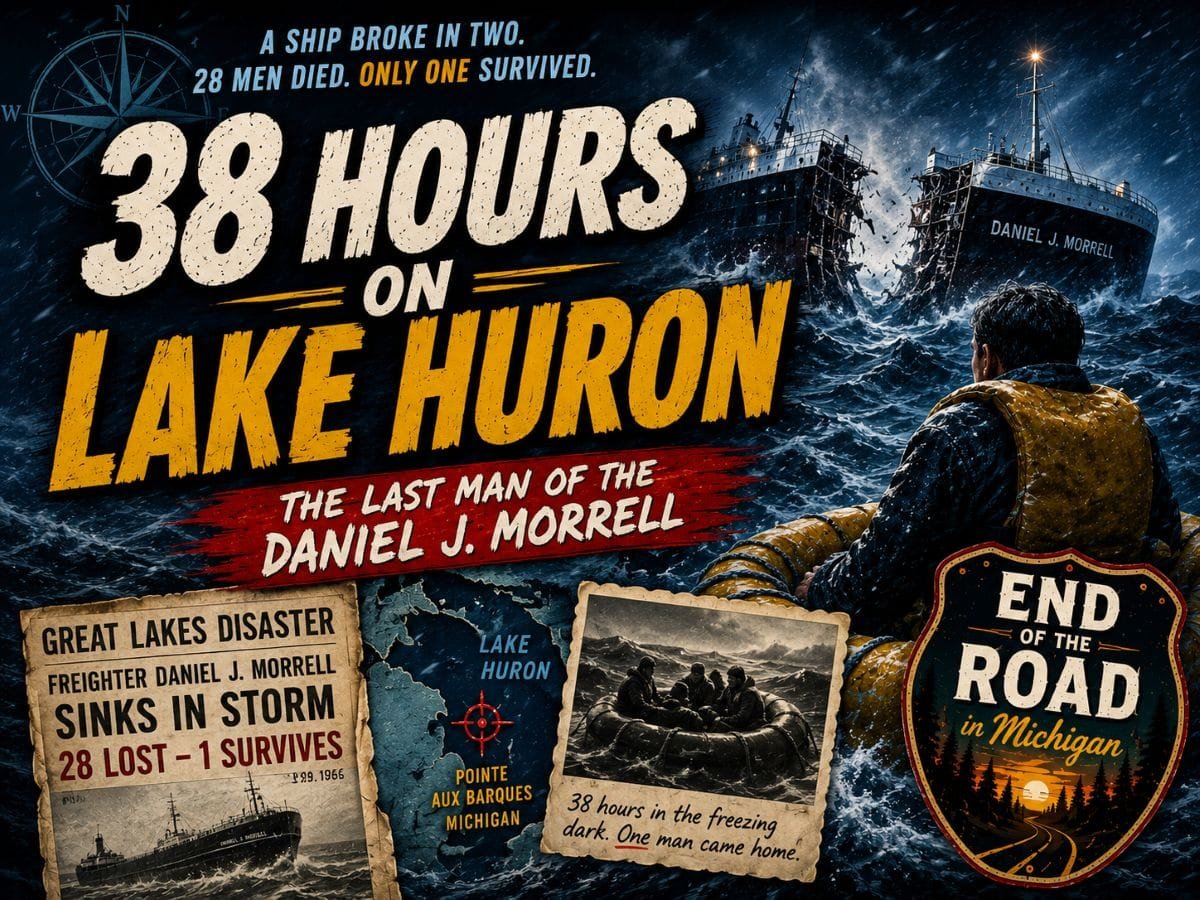
by The story of the sinking of the Daniel J. Morrell is of a Great Lakes freighter that broke apart in a November storm, leaving four sailors on a raft. Three died before help arrived. Dennis Hale survived to tell what happened.
The lights appeared through the snow and darkness like an answer to a prayer.
Four sailors huddled on a small life raft in Lake Huron. Their freighter had broken apart beneath them, throwing men and wreckage into the waves. Now another vessel seemed to be coming toward them.
Then they realized what they were seeing.
The lights belonged to the stern of their own ship. The rear half of the Daniel J. Morrell was still under power, its propeller turning as it moved through the storm without a bridge or captain. The runaway stern passed near the raft and struck the sinking bow before continuing north into the darkness.
It was one of the strangest scenes in Great Lakes history. It was also the beginning of a 38-hour fight for survival that left watchman Dennis Hale as the only living member of a 29-man crew.
Listen to the podcast:
38 Hours on Lake Huron: The Last Man of the Daniel J. Morrel
One more trip before winter
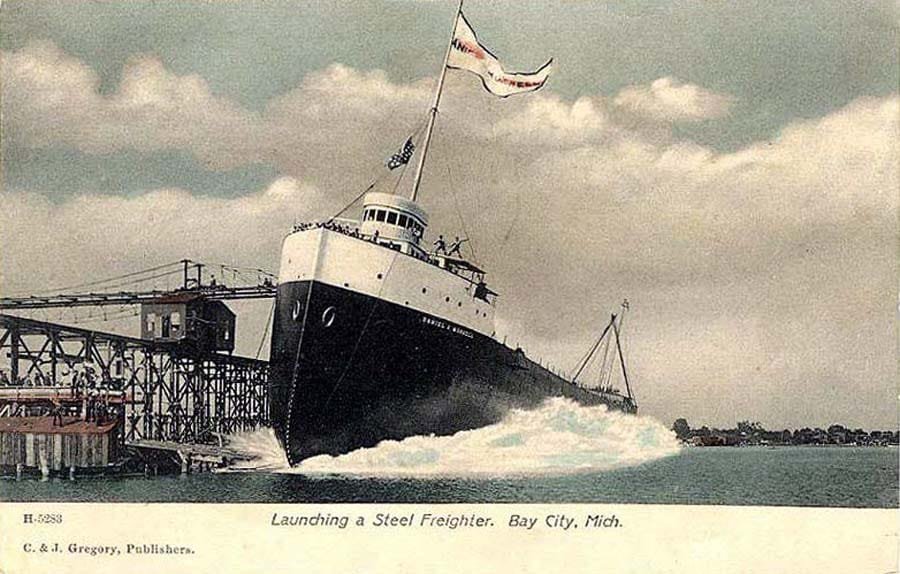
The Daniel J. Morrell was built in West Bay City in 1906, when long steel bulk carriers were changing Great Lakes shipping. The Coast Guard listed the vessel at 586.5 feet long, with a 58.2-foot beam. Cambria Steamship Co. owned the ship, while Bethlehem Steel operated it.
By 1966, the Morrell had been working the lakes for 60 years. Its riveted hull had carried coal, limestone, iron ore and taconite through millions of miles of waves, ice and seasonal temperature changes.
The freighter left Buffalo, New York, at 11 p.m. Nov. 26, bound for Taconite Harbor, Minnesota. It was traveling in ballast, without a cargo, on its 34th and final scheduled voyage of the season. The crew expected to collect one more load before the ship entered winter layup.
Dennis Hale joined the ship when it stopped for coal at Windsor, Ontario, on Nov. 28. The 26-year-old watchman had about three years of sailing experience and had spent roughly a year aboard the Morrell. He stood the 4-to-8 watch as the vessel entered Lake Huron.
By evening, the weather was getting worse.
Lake Huron turns violent
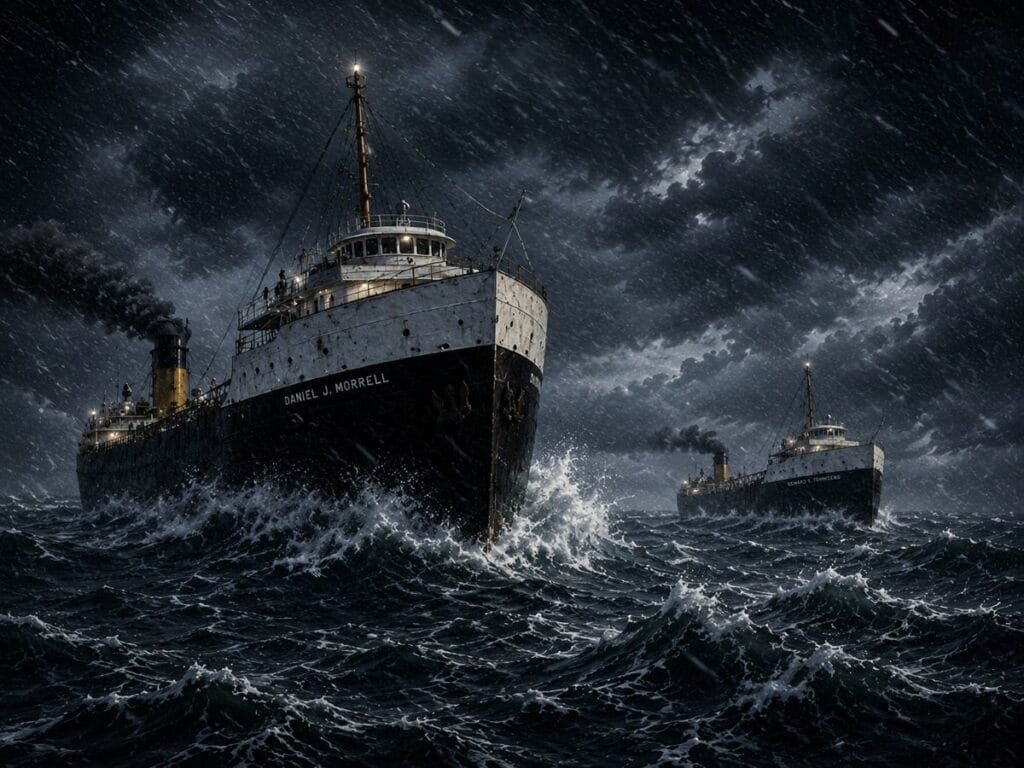
The official forecast called for gale-force winds, snow and rain. Recorded conditions near the wreck included seas of 20 to 25 feet, an air temperature near 33 degrees and water between 44 and 47 degrees. Winds reached 35 to 40 knots around the time of the sinking, with gusts measured as high as 57 knots — about 66 mph.
The Morrell was sailing near its sister ship, the Edward Y. Townsend. The two captains discussed the weather several times by radio, including whether they should seek protection in Thunder Bay or turn south toward the St. Clair River.
Capt. Thomas Connelly of the Townsend decided that turning in the rough sea might expose his lightly loaded ship to greater danger. Capt. Arthur Crawley of the Morrell indicated that he was steering toward Thunder Bay. Their final recorded conversation came at about 12:15 a.m. Nov. 29, when both vessels were struggling to hold their headings.
Crawley reported no structural problem, mechanical failure or emergency. He did not provide a revised itinerary or say that he planned to turn back.
That was the last known contact with the Daniel J. Morrell.
The sound of steel tearing
Hale had gone to bed around 9:30 p.m. His room was in the forward section of the ship, near the anchor windlass.
At about 2 a.m., a loud bang woke him. A few minutes later, another impact threw books from a shelf. The room was dark; the ship’s lighting had failed, and the general alarm began to ring.
Hale grabbed a life jacket and ran into the passageway. Looking aft, he could see lights on the stern. He also noticed that the middle of the ship appeared higher than the rear, a sign that the hull was bending upward.
He returned to his room for his pants but could not find them in the darkness. He put on a pea coat and went back outside wearing only underwear, the coat, and a life jacket.
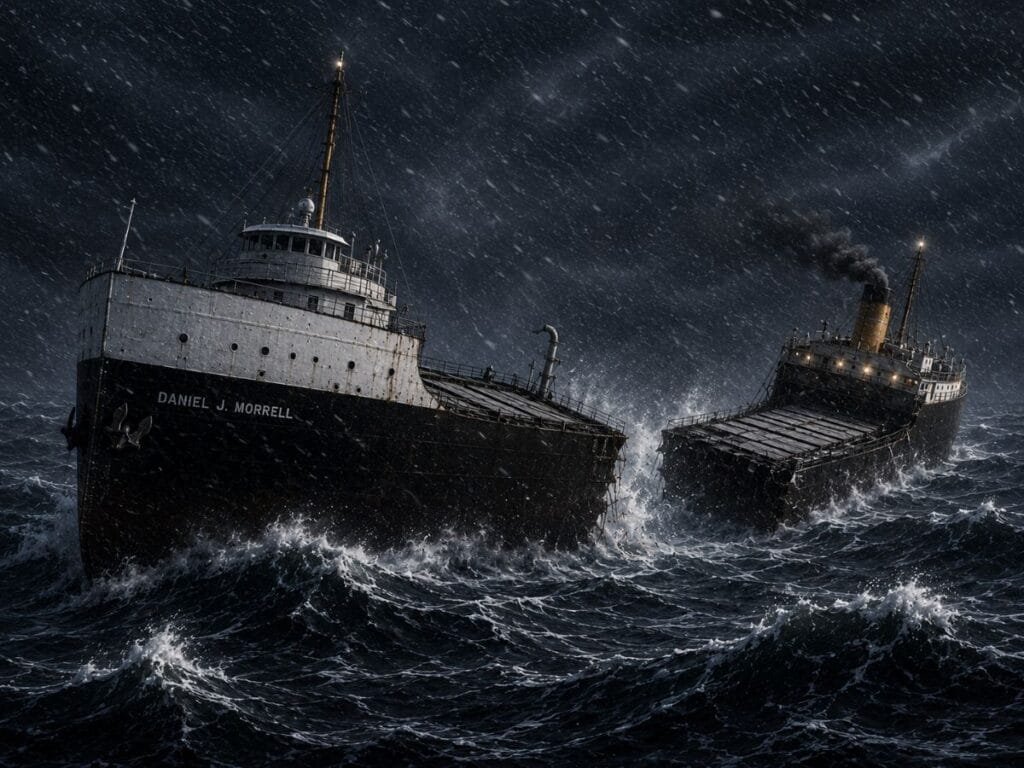
On deck, the ship was coming apart.
Hale later recalled sparks and a slow ripping sound as steel plates and structural members failed. In his StoryCorps interview, he compared the noise to paper being torn. He said only eight minutes passed between the general alarm and the moment he entered Lake Huron.
The Coast Guard reconstruction placed the initial crack near hatches 11 and 12. It moved across the deck until the ship separated. Steam escaped from broken piping, and the forward and rear sections twisted against each other in the waves.
There was no time to lower the lifeboats.
There was no orderly abandonment.
There was no distress call.
Four men reach the raft
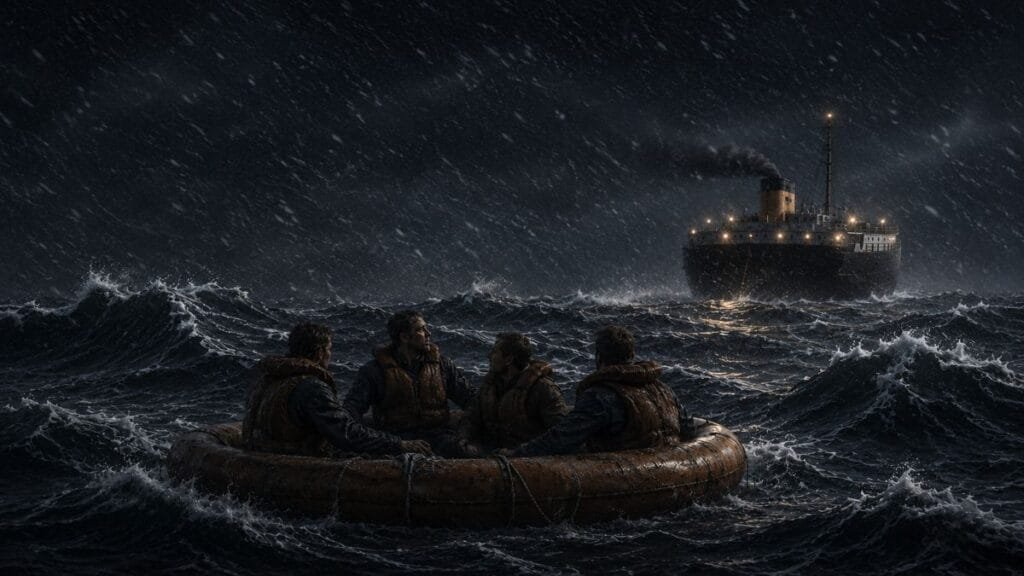
Several men gathered around a life raft on the forward deck. As the bow rolled and settled, the raft and its occupants were swept overboard.
Nobody remained aboard the raft when it hit the water.
Hale surfaced nearby and climbed onto it. Three other sailors also made it aboard: deckhands Arthur Stojek and John Cleary Jr., and wheelsman Charles Fosbender. Other men disappeared into the waves or went down with the ship.
The four sailors had escaped the sinking bow, but another threat was coming toward them.
The stern retained power after the break. Its lights remained visible as it continued moving, pushed by its engine and the storm. The rear section struck or repeatedly bumped the bow before the two halves separated for good.
Popular accounts often describe the men mistaking the stern for a rescue vessel. The Pointe aux Barques Maritime Museum preserves that version of Hale’s experience, including the horror of recognizing that the approaching lights belonged to the Morrell.
The bow soon sank.
The stern continued for several miles before it also went down.
The four men were left on the raft without shelter, food or radio contact.
Flares vanish into the storm
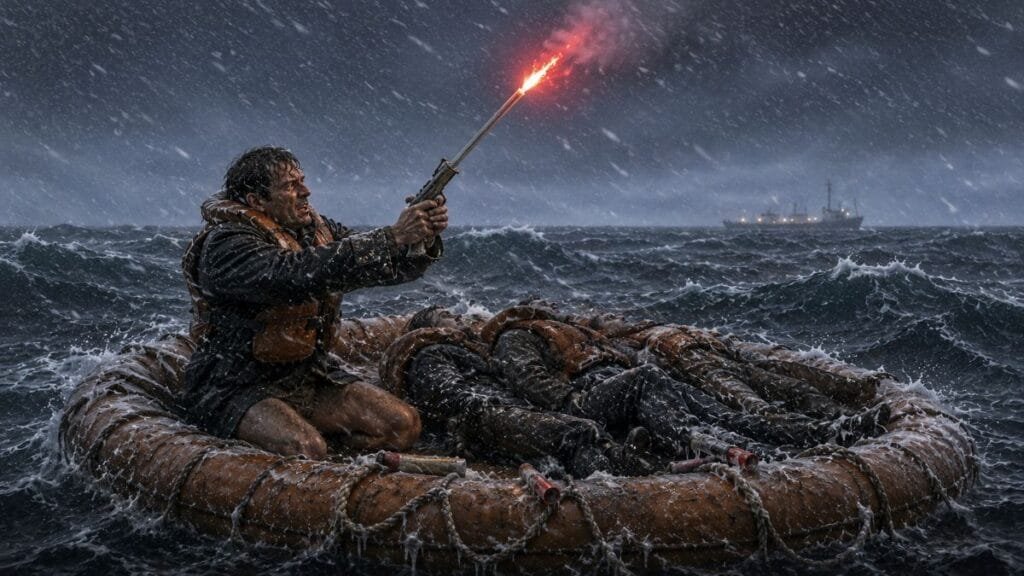
The raft carried distress flares, and Hale fired several during the first day. Wind carried two over the side. A signal pistol came apart after being fired several times, forcing him to hold its pieces together to launch the remaining flares.
No one responded.
The men had every reason to believe other vessels were nearby, but the weather blocked visibility. The crew of the Benson Ford, another freighter in the area, maintained a radio watch but received no distress message from the Morrell. Its captain said the storm was more severe than expected and doubted he could have safely lowered his own lifeboats.
The raft offered little protection from wind and spray. The men lay together at one end, trying to conserve warmth.
By about 6 a.m., Stojek and Cleary were dead. Fosbender remained alive into the afternoon before he also died. The Marine Board believed the three men likely drowned after exposure left them unable to clear fluid from their airways.
Hale was alone.
“You just want the whole thing over with”
In his later StoryCorps interview, Hale described the physical pain of the wind hitting his wet skin. He also spoke about the mental collapse that followed the deaths of his companions.
Hale told his wife that he had reached a point where he did not care whether he lived. He only wanted the ordeal to end. During the second night, he placed his hands in his mouth and considered blocking his own breathing, but he could not do it.
He drifted in and out of awareness.
He experienced visions and heard voices. He later credited one vision with warning him not to eat ice from his coat, which would have lowered his body temperature further.
The three dead sailors remained beside him.
The storm weakened, but rescue did not come.
The ship had vanished without warning
The Coast Guard was not informed that the Morrell was overdue until 12:15 p.m. Nov. 30 — more than 34 hours after the ship broke apart.
Bethlehem Steel officials contacted the Coast Guard Rescue Coordination Center in Cleveland. An alert went out to ships in the area, and Coast Guard vessels, fixed-wing aircraft and helicopters began searching Lake Huron.
At 1:12 p.m., searchers received word that a vessel had found a body wearing a life jacket marked Daniel J. Morrell. The report confirmed the worst: the freighter had gone down.
Search aircraft soon began finding additional bodies.
At about 4 p.m., a Coast Guard helicopter located the raft near the eastern shore of Michigan’s Thumb. From the air, its occupants appeared dead.
Then Hale moved.
He raised an arm toward the helicopter.
Rescuers lifted him from the raft and flew him to the hospital in Harbor Beach. He was semiconscious and suffering from exposure, frostbite and injuries to his hands and feet.
He had been on the raft for 38 hours.
The only man who returned
Twenty-nine men sailed aboard the Daniel J. Morrell. Hale was the only survivor.
Twenty-six bodies were eventually recovered. Two members of the crew were never found.
Hale spent months recovering and underwent repeated treatment for frostbite. He never returned to Great Lakes shipping.
The emotional wounds lasted much longer.
After his rescue, Hale repeatedly asked hospital workers whether anyone else had survived. A nurse finally told him that too much time had passed.
Hale later described feeling shame rather than triumph.
“I didn’t want to be the sole survivor,” he told StoryCorps.
For years, he struggled with the question survivors often ask: Why was he the one who lived?
There was no clear answer.
His limited clothing may have reduced the amount of frozen fabric against his body. His pea coat and life jacket gave him some protection. His age, physical condition and location on the raft may also have helped.
But none of those factors fully explain how a man dressed in underwear survived two nights on Lake Huron in late November.
Why did the Daniel J. Morrell break apart?
The Coast Guard investigation treated the sinking as a major structural failure caused by severe wave action against an aging hull.
The ship was riding between waves spaced roughly 250 to 300 feet apart. As the long hull crossed the crests and troughs, it repeatedly bent upward and downward. These forces are known as hogging and sagging.
The investigation examined reports of leaking rivets, cracks, and water in the cargo holds. Hale had marked three leaking areas during his final watch, including cracks he said were sending water into the vessel. The Marine Board, however, found insufficient evidence that faulty rivets or those leaks caused the ship to break apart.
The Coast Guard report pointed to the destructive force of the storm, metal fatigue and the behavior of older steel in cold conditions. The National Transportation Safety Board later warned that similar bulk carriers could suffer the same type of structural failure.
The concern was not theoretical.
The Edward Y. Townsend survived the same storm but arrived with a major crack near one of its hatches. Inspectors found additional evidence that parts of the vessel had been working under heavy stress.
The Townsend never returned to normal service.
The disaster exposed a dangerous delay
The Morrell sank without sending a distress message, but it also remained officially unaccounted for more than a day.
That delay led the Marine Board to recommend a formal vessel-reporting system. Ships would report their positions every 24 hours, and companies would take action when a vessel failed to report within one hour of its scheduled time.
Investigators also recommended changes involving alarm systems, lifesaving equipment, weather broadcasts and the internal compartmentation of newly built Great Lakes freighters. The goal was to give damaged vessels more time to remain afloat and crews more time to escape.
The NTSB expressed concern that the conditions that destroyed the Morrell could claim other aging ships. It asked for further inspections, structural studies and information about plans to replace older bulk carriers.
The warning would gain added weight nine years later, when the Edmund Fitzgerald disappeared in a Lake Superior storm with 29 men aboard.
The wreck confirms Hale’s account
Shipwreck hunter David Trotter located the Daniel J. Morrell in 1979, 13 years after the sinking. The bow and stern were found upright in deep water, several miles apart.
The wreck supported one of the most unusual parts of Hale’s testimony.
The ship had not simply folded and dropped in one place. The stern had continued through Lake Huron after the bow was lost, carrying its engine, lights and rear accommodations with it.
Today, the two sections rest in roughly 200 feet of water off Michigan’s Thumb. The depth, cold and technical demands make the sites suitable only for highly trained divers.
They are also grave sites.
Hale spent his life remembering the crew
Dennis Hale eventually spoke publicly about the wreck, appeared at maritime programs and worked to keep the names of his crewmates from being reduced to a number.
He died in 2015 at age 75.
Hale’s survival remains remarkable, but that is not the full meaning of the story.
The Daniel J. Morrell disaster is also about 28 men who expected to complete one more trip before winter. It is about a 60-year-old ship meeting forces its hull could no longer withstand. It is about a rescue system that did not begin searching until the survivor had already spent more than a day alone with three dead friends.
Most of all, it is about the small movement that ended 38 hours of silence.
A Coast Guard helicopter circled over a raft that appeared to carry four dead men.
One of them lifted his arm.
Listen to the full podcast – The Sinking of the Daniel J. Morrell
The latest episode of End of the Road in Michigan tells the complete story of the Daniel J. Morrell, its final voyage and Dennis Hale’s fight to remain alive on Lake Huron.
🎧 38 Hours on Lake Huron: The Last Man of the Daniel J. Morrell