 by
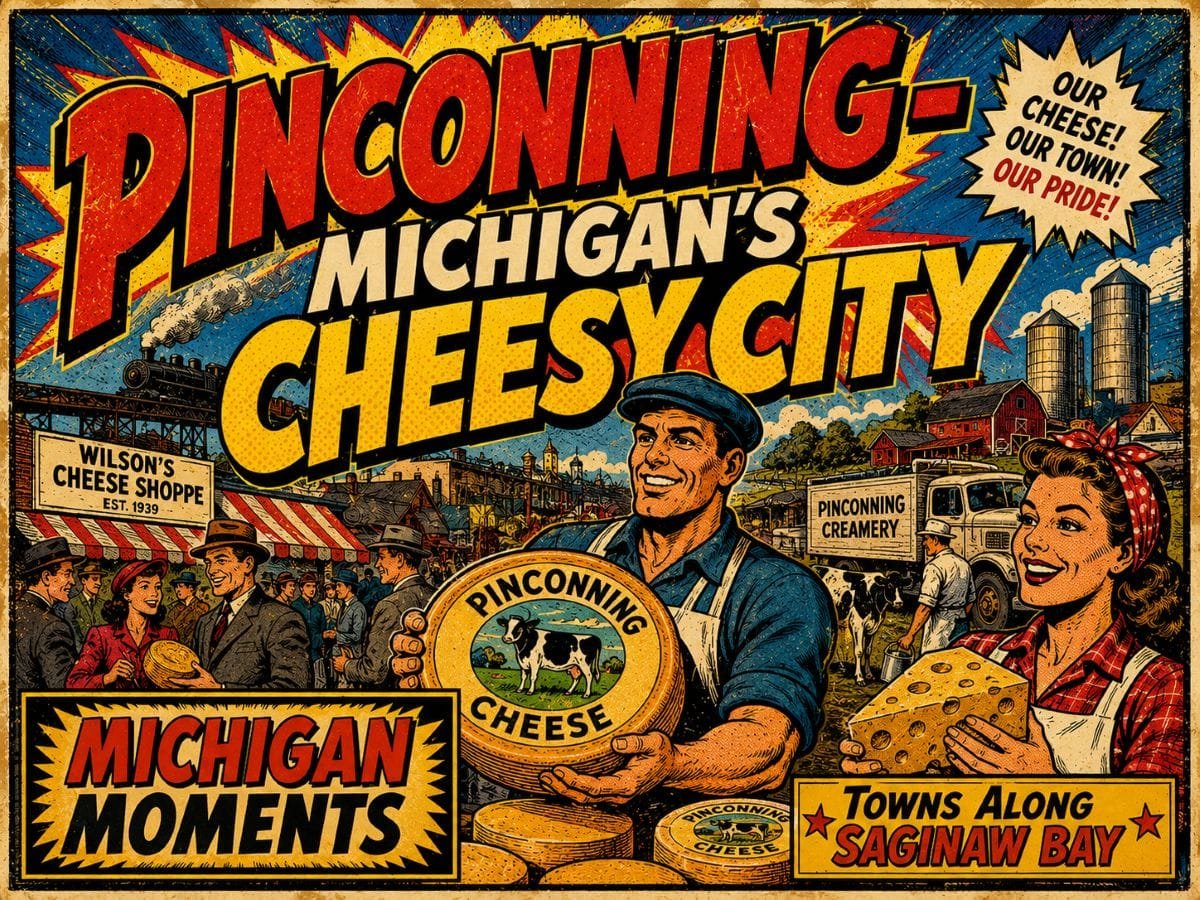
by Pinconning started as a Bay County lumber settlement. When the timber ran out, dairy farmers and a Wisconsin cheesemaker gave the town a second act that still defines it more than a century later.
When it comes to small towns with big stories, few compare to Pinconning, Michigan. Long before it was known for sharp Colby wheels and roadside cheese shops, Pinconning was a rough-edged lumber camp carved out of Bay County’s dense timber. From its earliest days along the Pinconning River in the 1870s to its rise as the “Cheese Capital of Michigan” by mid-century, Pinconning, Michigan, history reflects the industrial grit, rural ingenuity, and evolving identity of small-town America. This article traces the town’s journey—from log trains and stave mills to dairy barns and pickle plants.
Table of Contents
Key Takeaways
Pinconning began as a lumber settlement in 1872 along the Pinconning River. An early logging railroad helped move timber, but depleted forests eventually forced the community to find another economic base. Dairy farming filled the gap, and cheesemaker Dan Horn arrived in 1915 with a Colby-style recipe that could be aged into increasingly sharp cheese. His daughter, Inez Wilson, later turned that product into a roadside attraction and helped establish Pinconning’s reputation as Michigan’s “Cheese Capital.”
Video – Pinconning: From Pine to Cheese
There is a practical way to explain the history of Pinconning, Michigan.
Follow the money.
First came trees. Then came cows. Then came cars.
Each changed the town.
Pinconning began as a lumber settlement on the western side of Saginaw Bay. When the surrounding timber was exhausted, local farmers turned increasingly to agriculture and dairy production. Then, in 1915, a Wisconsin cheesemaker named Daniel “Dan” Horn arrived and created the product that would eventually become synonymous with the community.
But cheese alone did not make Pinconning famous.
That required a highway, generations of travelers heading north and Horn’s daughter, Inez Wilson, who understood something decades before the phrase “destination marketing” became common: People will stop for a product if you give them a reason to remember where they bought it.
The result was one of Michigan’s better small-town reinvention stories.
Where Is Pinconning, Michigan?
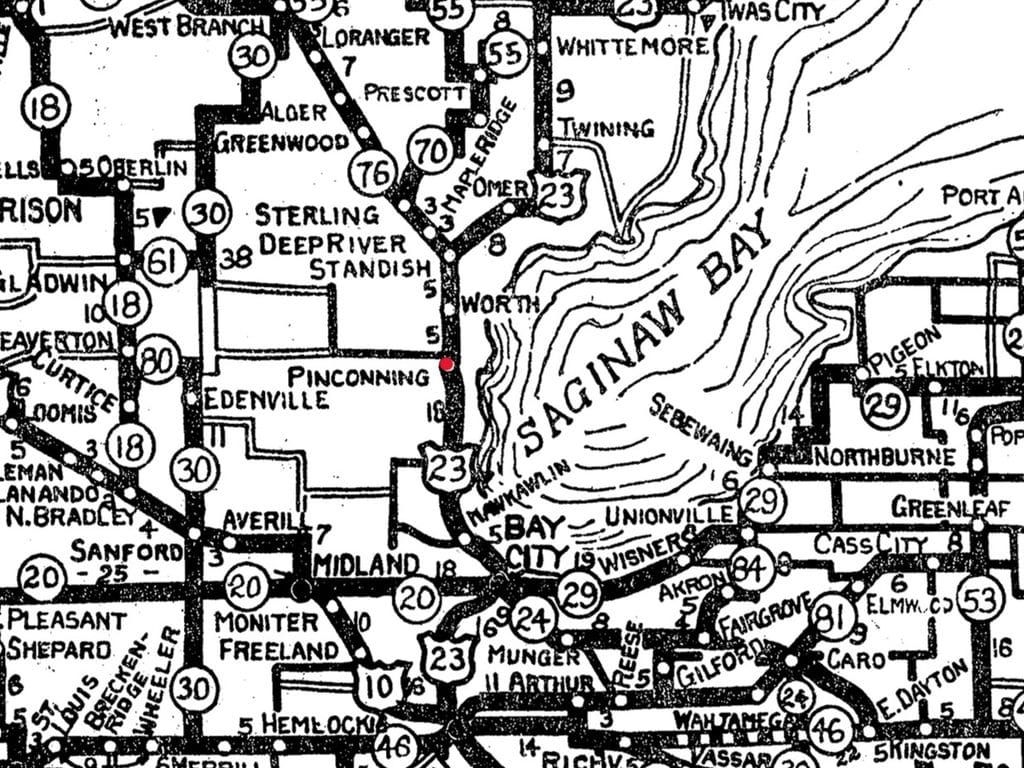
Pinconning is in northern Bay County, a short distance west of Saginaw Bay. The city had 1,204 residents in the 2020 census and covers less than one square mile. M-13 runs through town, while Interstate 75 passes a few miles to the west.
The city’s name predates the lumber settlement.
Pinconning’s official history traces the name to an Ojibwe term recorded as “O-pin-nic-con-ing,” generally translated as “potato place” or “place where wild potatoes grow.” The Pinconning River carries the same name.
That river helped determine why the town formed where it did.
Lumber Town Origins – Pinconning Began With Timber (1870s)
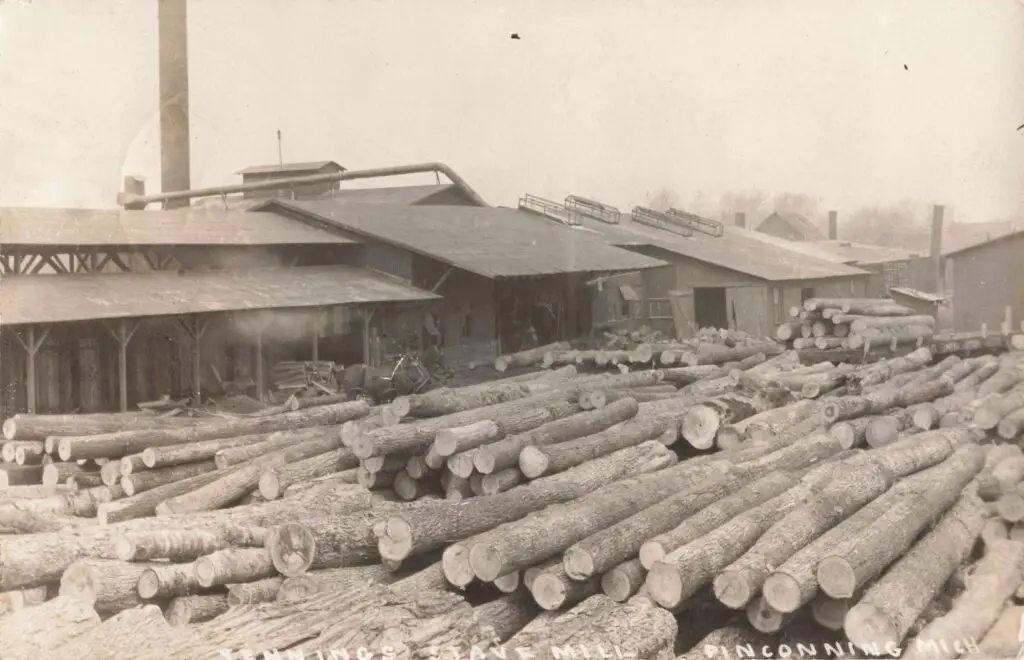
George VanEtten and Henry Kaiser established a lumber settlement along the Pinconning River in 1872. They chose the site for its vast stands of white pine, cedar, oak and other timber, as well as abundant wildlife, fish, and even wild potatoes in the area. (In fact, the name “Pinconning” comes from a local Chippewa word O-pin-nic-con-ing, meaning “potato place” or “place where wild potatoes grow”.) Van Etten and Kaiser’s firm built a company general store and laid out a 100-acre village plat by 1873, even securing a post office for the nascent settlement. This bold venture came on the heels of devastating forest fires in 1871 that had scorched nearby pinelands, yet the founders pressed on with their lumber enterprise.
Their names remain easy to find in modern Pinconning.
Kaiser Street and Van Etten Street recall the men whose lumber operation helped establish the community.
Logging presented a transportation problem. Rivers could float timber, but lumber companies needed a more dependable way to bring logs from cutting areas to mills.
Pinconning’s answer came quickly.
An Early Logging Railroad Reached Deep Into the Woods
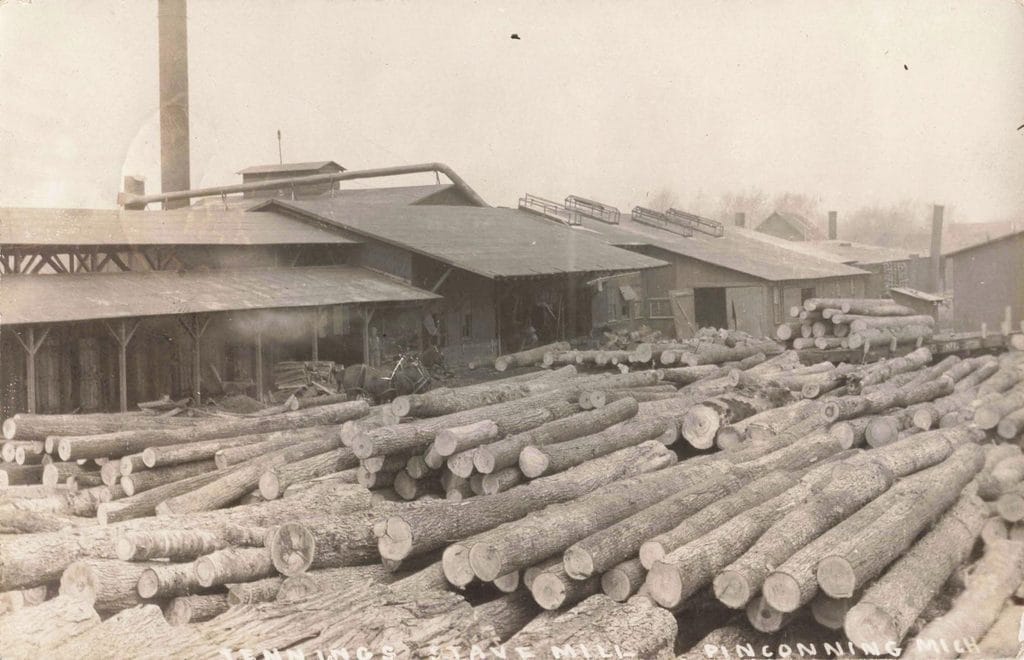
One of Pinconning’s early claims to fame was Michigan’s first logging railroad. In 1873, Van Etten and Kaiser constructed the Pinconning & Kaiserville Railroad – an 11-mile private line that connected their Pinconning sawmill to a remote logging outpost called Kaiserville in the west. Built on the cheap “tram road” principle, the railroad’s ties were made of heavy timber with maple wood rails, yet locomotives still managed to haul loaded flatcars at up to 10–20 miles per hour.
It has sometimes been described as Michigan’s first logging railroad. Research into Great Lakes logging transportation shows that lumbermen elsewhere in Michigan were using rail systems earlier. What made Pinconning’s operation important was its early use of a locomotive-powered logging line disconnected from a conventional mainline railroad.
That is actually the more interesting story.
Pinconning was experimenting with rail transportation at a time when Michigan lumber companies were still working out how to move huge quantities of timber efficiently.
The railroad changed names and owners several times. It eventually became part of the Michigan Central system in 1883.
But railroads could not solve the industry’s largest problem.
Eventually, there were fewer trees to cut.
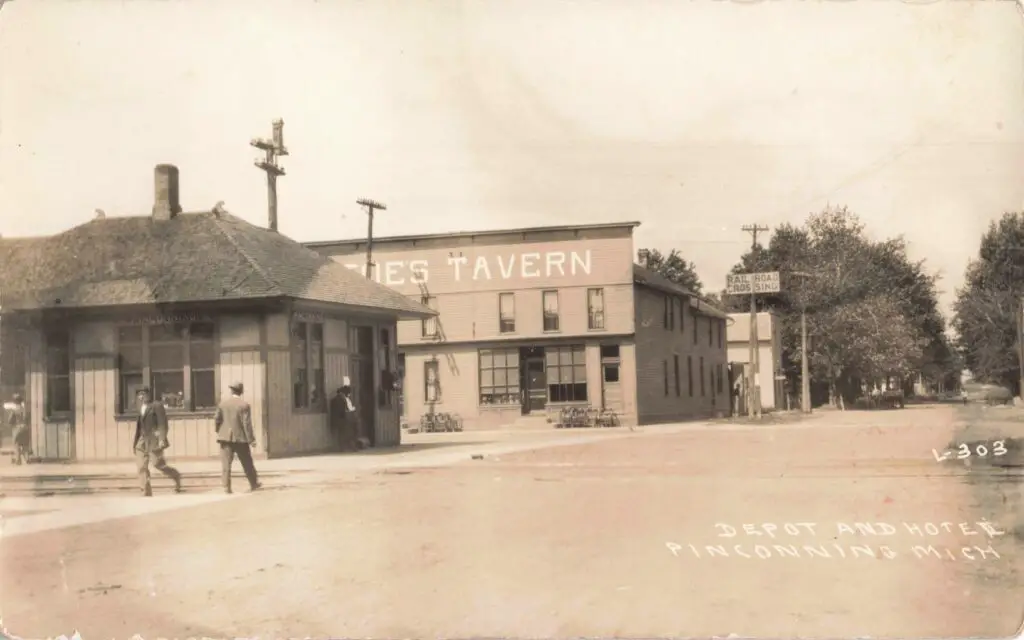
By 1875 the line was extended east to Saginaw Bay, allowing lumber to be shipped out by boat. For a time the little wood-railed railway was Pinconning’s lifeline – there were no real roads to speak of (the first paved road to town wouldn’t arrive until 1920). The rail line changed hands and names several times (becoming the Glencoe, Pinconning & Lake Shore Railroad, then Pinconning Railroad, etc.) before the Michigan Central RR purchased it in 1883.
Pinconning prospered in the late 1870s as millions of feet of timber were hauled out, but as the surrounding pine forests became depleted in the 1880s, the lumber boom faded. Van Etten and Kaiser had also established a second sawmill at Kaiserville and amassed 16,000 acres of timberlands, but that satellite village faded once the logs were gone. Pinconning was compelled to seek a new direction as its logging era came to a close.
When the Trees Disappeared, Farms Followed
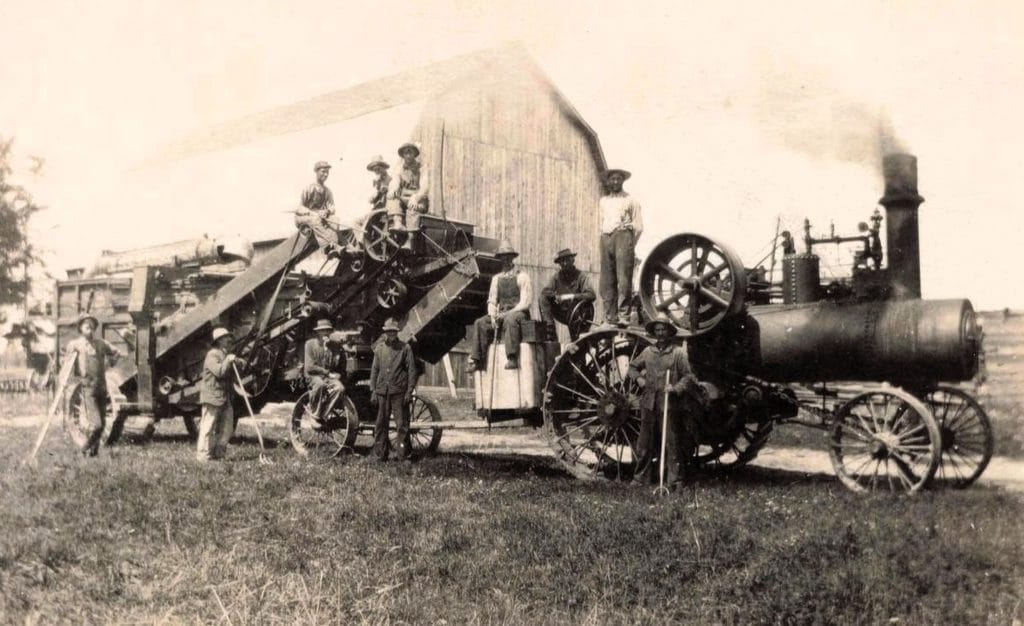
Like other northern Lower Peninsula lumber communities, Pinconning had to confront the consequences of intensive logging.
Cutover land replaced the forests that had driven the first economic boom. Agriculture became increasingly important as settlers converted some of that land to farms. Dairy farming proved especially significant.
In 1907, William Reid established the Pinconning Creamery, giving area dairy farmers a commercial outlet for their milk. Pinconning’s official history credits this growing dairy business with setting the stage for what happened next.
There was one obvious problem. Farmers could produce more milk than the local population could drink.Cheese offered a solution. Milk that spoiled quickly could be turned into a product that lasted much longer and could be transported to distant customers.
From Timber to Dairy Farming
As the cut-over forests were converted to farms, dairy farming emerged as the next chapter for Pinconning. The sandy, wet flats along Saginaw Bay turned out to be suitable for pasture, and by the early 1900s farmers in the Pinconning area were raising cows – soon producing more milk than local markets could consume.
In 1907 a man named William Reid arrived from Ohio and established the Pinconning Creamery, the town’s first dairy processing plant. Reid’s creamery encouraged local agrarian families to invest in dairy, providing a ready outlet for their milk. By 1911, Reid’s operation had expanded and some historians later credited him with setting the foundation for Pinconning’s future identity as a cheese-making center. It was, however, a subsequent newcomer who truly put Pinconning on the map – in a very cheesy way.
A Small Village Takes Root (1880s–1900s)
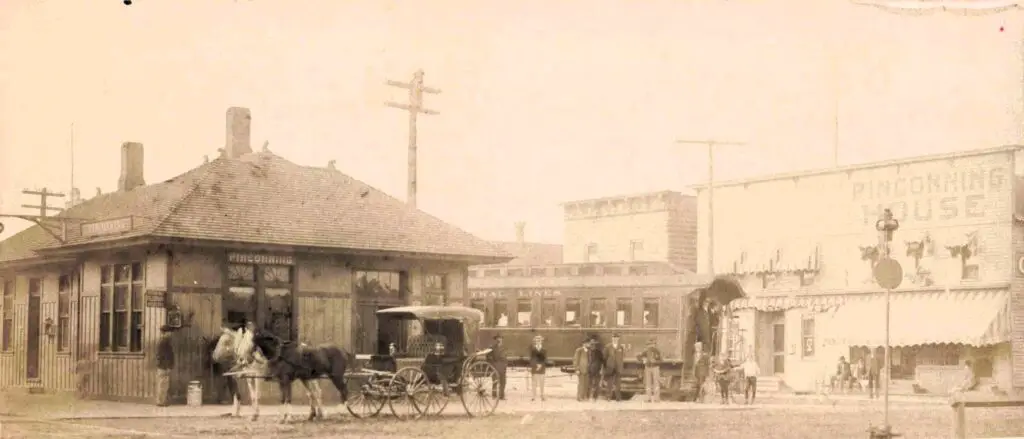
Despite the end of the big timber days, the community of Pinconning had firmly planted itself. Kaiser and Van Etten formally platted the village in 1873, and it was incorporated as an official village in 1887 (with a re-incorporation under state law in 1891). By 1900, Pinconning’s population was 729 residents – a modest but stable town in northern Bay County. Early residents built institutions that marked the town’s growth: a brickyard was opened and a brick schoolhouse was erected (though a fire tragically destroyed the school in 1904).
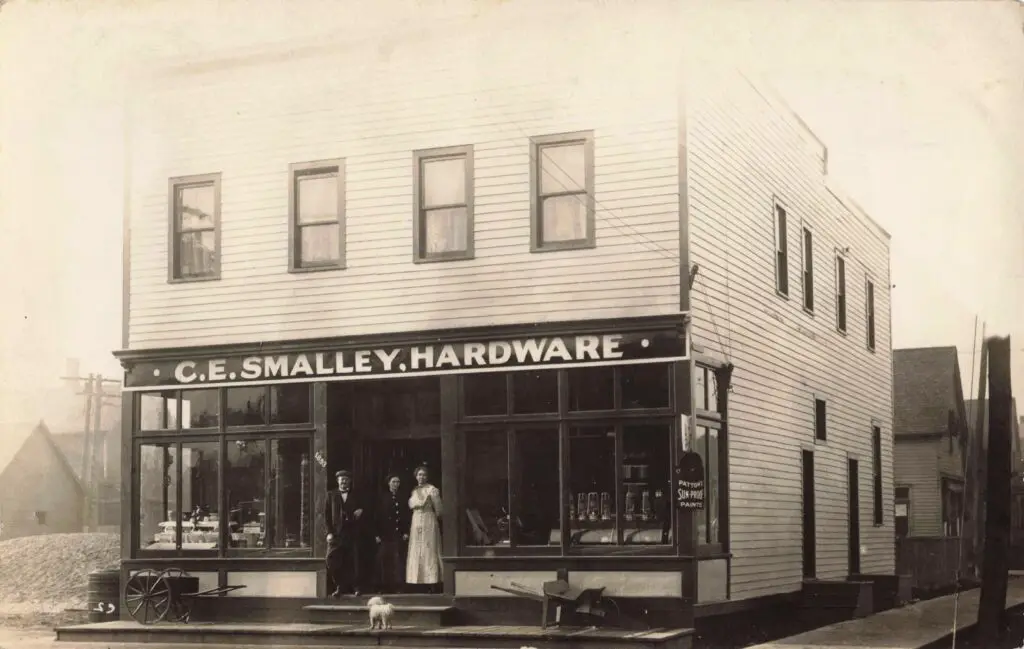
Local commerce got underway with a pioneer general store run by C.H. Rhodes and others, and the Pinconning Press newspaper began publishing by 1893. Notably, the first church in the area was actually an Indian mission established at the mouth of the Pinconning River – a reminder of the Native American presence and influence in the region. By the turn of the century, Pinconning had a rudimentary downtown and civic life, but it needed a new economic engine after lumbering.
Industry Expands
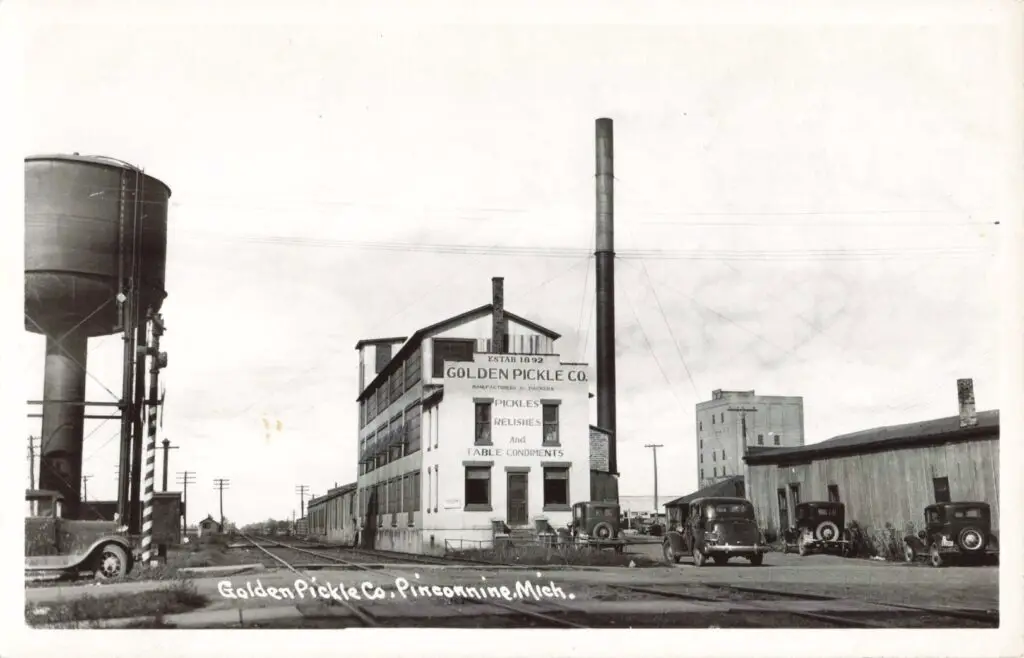
Cheese wasn’t the only thing being packed into crates in Pinconning. The Golden Pickle Company, founded in 1892, produced jars of pickles, relishes, and condiments from local farms. Nearby, the Chicory Factory helped to make a substitute for coffee a reality and a little profit. These small industries kept families employed through the Great Depression and beyond.
Hazel Beach and Early Tourism
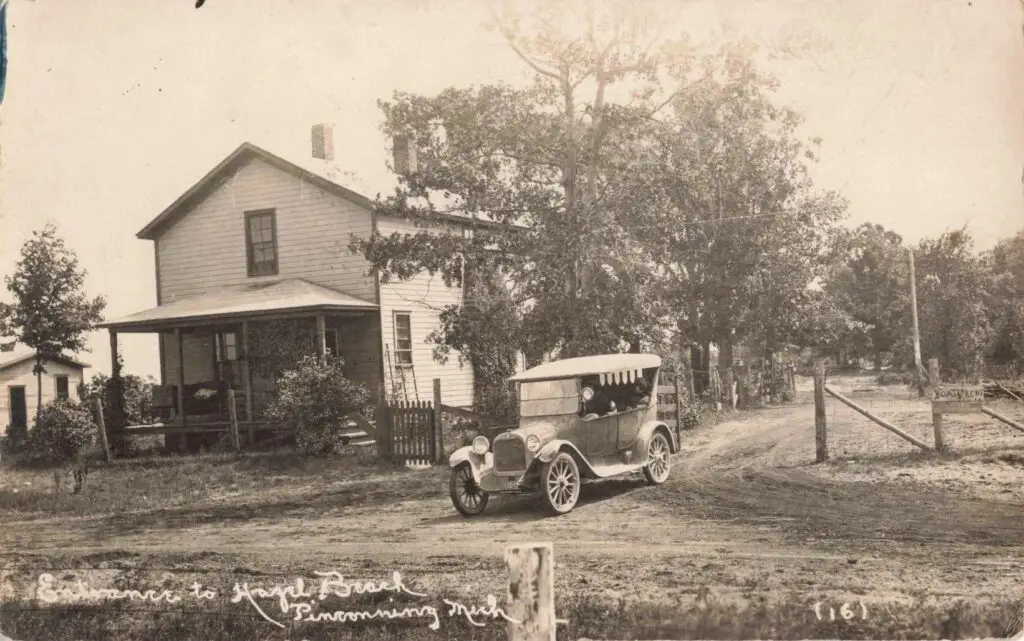
Not far from town, Hazel Beach became a favorite warm-weather escape. Early postcards show tin-roofed cottages, boat rentals, and families lounging on porches. Detroiters and Flint families made the trip north on U.S. 23, stopping in Pinconning for cheese—and a break from the city.
The Creation of Pinconning Cheese (1915)
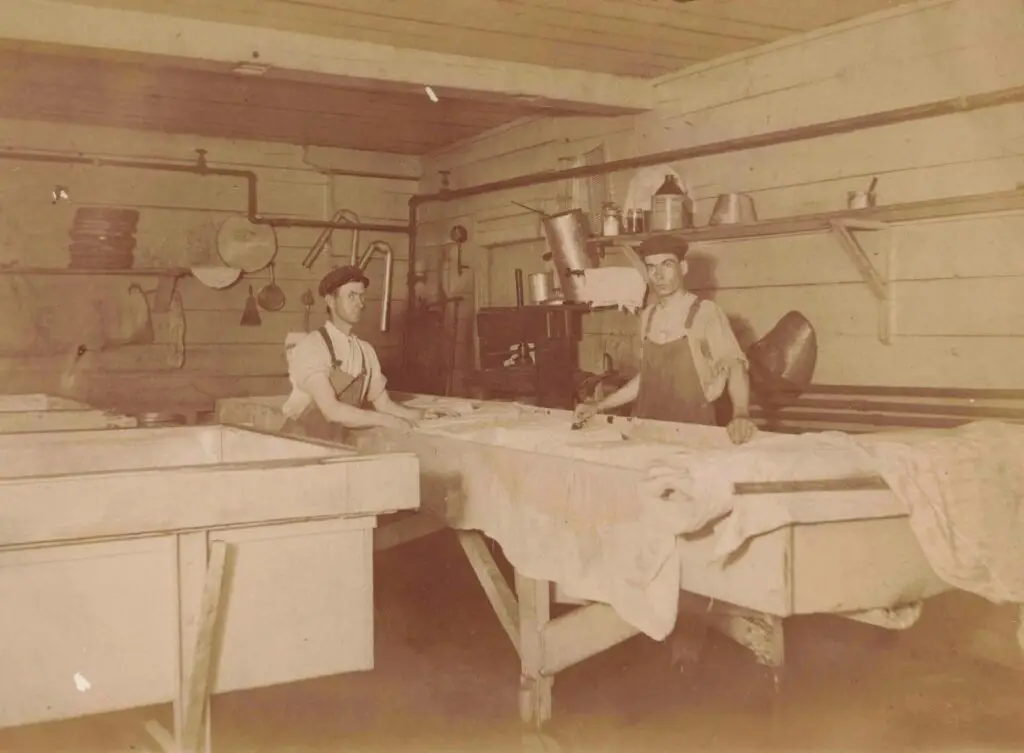
In 1915, Daniel “Dan” Horn, a European immigrant and veteran Wisconsin cheesemaker, moved to Pinconning in search of opportunity. Horn (identified in different accounts as of German or Russian origin) immediately saw potential in the surplus of local milk. He had years earlier developed a special Colby-style cheese recipe – Colby being a milder cousin of Cheddar invented in Wisconsin. Horn’s unique twist on Colby did not require strict refrigeration, since it could age at slightly warmer temperatures (important in an era when iceboxes and root cellars were the only cooling methods).
What Is Pinconning Cheese?
Pinconning cheese is a Colby-style cow’s-milk cheese that can be aged far longer than typical young Colby, allowing its texture and flavor to become progressively sharper.
That ability to age is central to its identity.
Dan Horn moved from Wisconsin to Pinconning in 1915. Local accounts differ over parts of Horn’s European family background, so the safest historical description is simply that he was an experienced cheesemaker who came to Michigan from Wisconsin. Pinconning’s own sources agree on an important point: Horn brought cheesemaking knowledge with him and began producing the cheese that became associated with the town.
Horn’s formula had a major practical advantage for its time.
It could tolerate aging conditions that required less refrigeration than many other cheeses. Root cellars and cool storage spaces therefore became useful when mechanical refrigeration was not yet common in homes and small businesses.
That feature also created something consumers could taste.
Why Pinconning Cheese Gets Sharper With Age
Young Colby tends to be mild. Pinconning cheese can be kept much longer.
As it ages, moisture decreases, texture firms and the flavor becomes sharper. Modern Pinconning retailers sell the cheese at different stages of aging, making age almost like a heat scale for the customer. Wilson’s Cheese Shoppe told PBS that its lineup has included fresh “squeaky” cheese, one-year sharp, three-year extra-sharp, six-year super-sharp and even cheese aged for 15 years.
Pinconning Cheese Co. likewise emphasizes aging as the characteristic separating Pinconning-style cheese from ordinary Colby and has marketed cheese aged for many years.
For readers wondering what to buy, the rule is fairly simple:
| Age | What to expect |
|---|---|
| Fresh or mild | Softer, creamy and mild |
| Medium | More developed flavor but still approachable |
| Sharp | Firmer with a stronger bite |
| Extra sharp | More concentrated and assertive |
| Super-aged | Firm, intense and intended for people who like very sharp cheese |
A New Twist on Colby
As it aged, this semi-hard cheese also grew sharper in flavor than ordinary young Colby. Horn set up a small cheese factory in Pinconning during World War I and began producing wheels of this robust cheese. He sold “Pinconning cheese” locally at first – including at his own Horn’s Grocery on the old U.S. 23 highway – and the product quickly became a hit with Michiganders. By creatively solving the oversupply-of-milk problem, Dan Horn had given Pinconning a new identity.
Other entrepreneurs soon followed Horn’s lead in what became a full-fledged cheese industry in Pinconning. Among them were Swiss-born Paul Hitz, who brought Old World cheesemaking skills, and local farmer Joe Turmell—both started their own cheese factories in the 1920s.
Arrival of Kraft Foods
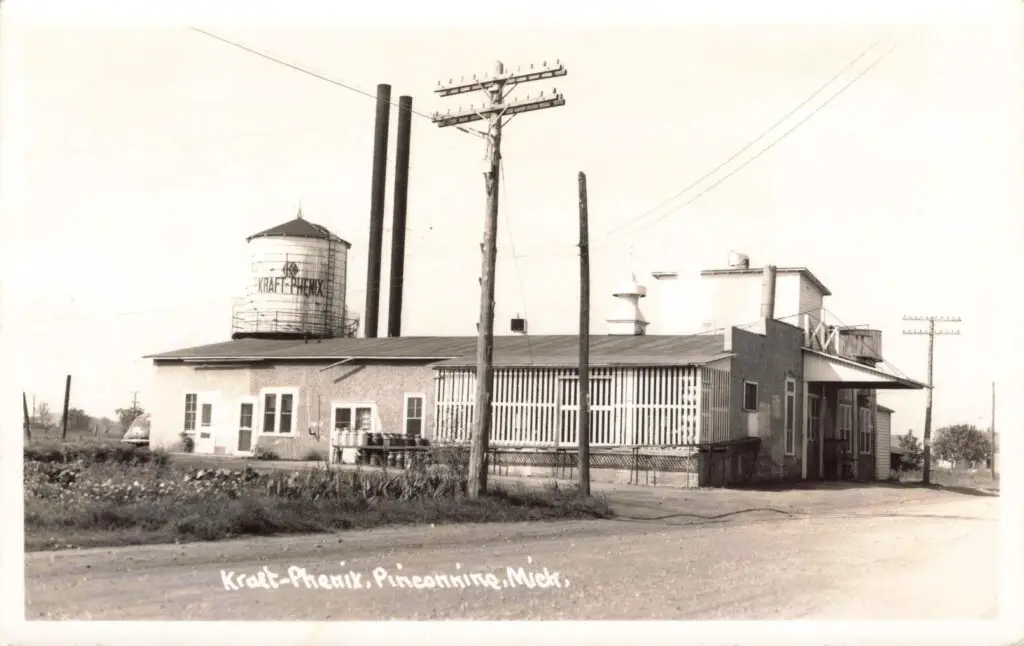
In 1936, even Kraft Foods decided to invest in Pinconning’s dairy boom: Kraft acquired the old Halpin Creamery in town and ran a cheese plant there (one that would operate for decades under Kraft’s name). At the industry’s height, as many as five cheese factories were operating in the Pinconning area simultaneously.
The once sleepy lumber village had reinvented itself as a cheese-producing powerhouse. Local farmers benefited from steady demand for milk, and “Pinconning cheese” – a rich, aged golden Colby – earned statewide fame. During the 1930s and 1940s, Pinconning’s cheese businesses prospered (even through the Great Depression and World War II) as Americans relied on cheese as an affordable, hearty food. The Pinconning product, in particular, had established itself as a best-seller across Michigan, to the point where it was even drawing tourists to the town where it was made.
Rise of the “Cheese Capital” (1940s–1950s)
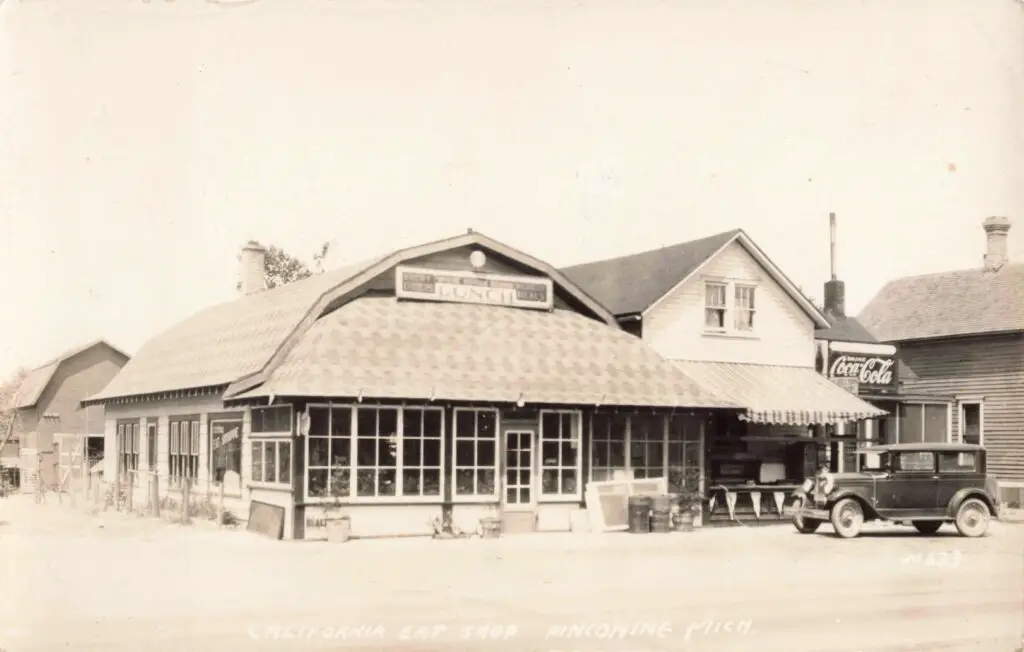
By mid-century, Pinconning was proudly known as the “Cheese Capital of Michigan.” This moniker was initially a self-proclaimed title, but it rang true – and was later officially recognized by the state, thanks to local boosters. Travelers driving Up North found it hard to resist stopping in Pinconning to sample its famous cheese. In the pre-interstate days, U.S. 23 was the main route up the Lake Huron coast, and Pinconning lay right along it. Especially during hunting and fishing season, streams of cars from Detroit and Flint would pause in Pinconning so their passengers could pick up some aged Pinconning cheese for the trip or the cabin.
Entrepreneurial families opened roadside shops to cater to this trade. One of the most iconic was Wilson’s Cheese Shoppe, which opened in 1939 when Horn’s eldest daughter Inez Horn Wilson decided to start selling her father’s cheese directly to passing tourists. Wilson’s Cheese Shoppe – today the oldest cheese store in Michigan – began as a humble retail outlet across from Dan Horn’s factory, but under Inez Wilson’s energetic leadership it grew into a cheese lover’s destination.
Dan Horn Created the Cheese. His Daughter Sold the Idea.
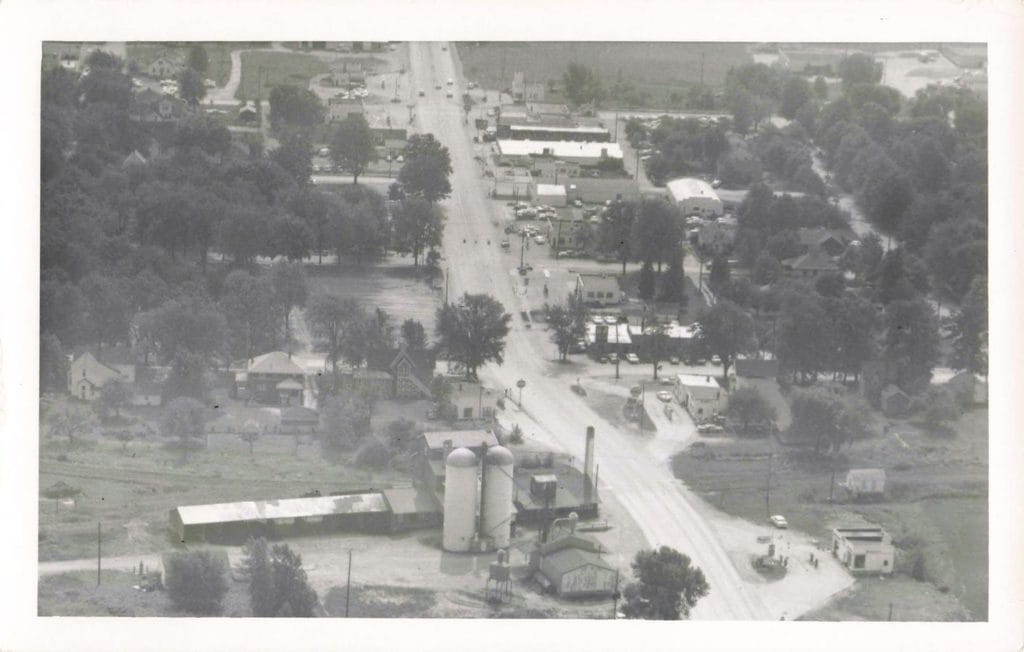
Horn’s contribution explains the product’s origin. His daughter explains why most Michiganders have heard of it.
Inez Horn Wilson, born in 1908, grew up around her father’s cheese business. In 1939, she and her husband, Lawrence Wilson, took over the grocery operation and established Wilson’s Cheese Shoppe.
The timing mattered. Automobile travel was reshaping Michigan tourism.
Before Interstate 75 carried vacationers north at freeway speeds, U.S. 23 passed directly through communities such as Pinconning. Travelers heading toward northeast Michigan had to drive through town.
Inez Wilson realized those cars represented customers. During the 1940s and 1950s, she promoted Pinconning cheese to motorists traveling north. Wilson’s expanded several times as the roadside business grew. The city credits Wilson with pushing state recognition of Pinconning as Michigan’s “Cheese Capital.”
By the 1960s, the city’s account says Wilson’s marketing was bringing about 100,000 visitors a year through the business. That may be the most important part of the Pinconning story.
Horn created a product. Inez created a destination.
The Story of the Mouse
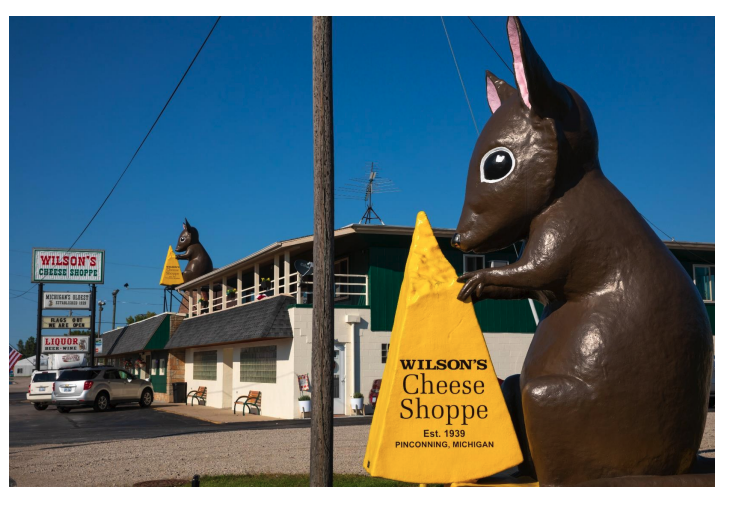
 Wilson’s Cheese Shoppe as it expanded by the early 1960s, complete with a giant mouse statue on the roof – a whimsical symbol of Pinconning’s cheese fame. During the late 1950s, Inez Wilson truly put Pinconning on the map with creative marketing. She tirelessly promoted the town’s dairy delicacy – advertising Pinconning cheese on the radio, erecting billboards up and down the highway, and even snagging celebrity endorsements for their “cheese capital”. Most famously, Inez commissioned two giant fiberglass mouse mascots in 1965, mounting one big mouse (holding a piece of cheese) on the roof of Wilson’s store and another by the road, to instantly grab the attention of passing motorists.
These humorous landmark mice became beloved symbols of Pinconning. By the end of the 1950s, thanks in large part to Inez’s efforts, tens of thousands of visitors were detouring into Pinconning each year to buy cheese and snap photos with the big cheese-eating mouse. The City of Pinconning embraced its role, officially dubbing itself the “Cheese Capital of Michigan” – a title it wears proudly to this day.
The cheese trade remained strong through the 1940s and ’50s, though by around 1960 local milk production was declining as small family farms began to disappear. The cheesemakers adapted by sourcing milk from outside the immediate area, and the Pinconning brand continued to flourish. What began as a lumber camp in the wilderness had transformed into a uniquely flavoured part of Michigan’s cultural heritage.
Notable Personalities and Local Legends
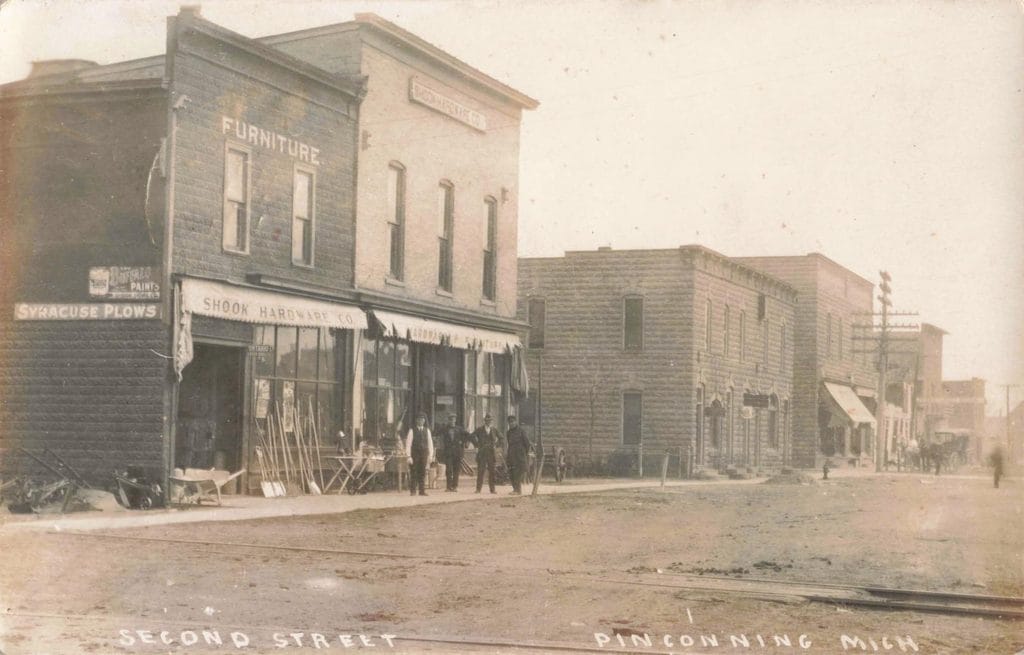
Pinconning’s history is peppered with colorful individuals who left a lasting impact. The town’s very founders are remembered in its geography – Van Etten Street and Kaiser Street downtown bear the names of George Van Etten and Frederick A. “Henry” Kaiser, the lumbermen who started it all.
Decades later, another Pinconning native would gain fame on the national stage: Arthur E. Summerfield, born in Pinconning in 1899, who rose to serve as the 57th U.S. Postmaster General under President Dwight Eisenhower. Summerfield had moved away as a child, but his roots ran deep – his father, William Summerfield, had been Pinconning’s very first rural mail carrier around the turn of the century. In a fitting trajectory, the mail carrier’s son modernized the nation’s postal system.
Back home, one of Summerfield’s contemporaries, Russell J. Schafer, earned the nickname “Mr. Pinconning.” Schafer was a local businessman (owner of a major Chevrolet dealership) and a tireless civic leader who served for 19 years on the city council and seven years as mayor in the mid-century. He championed local improvements and even helped establish the nearby Delta College in the 1950s. Under leaders such as Schafer, Pinconning was incorporated as a city in 1955 and continued to modernize its infrastructure.
I-75’s Impact on Pinconning
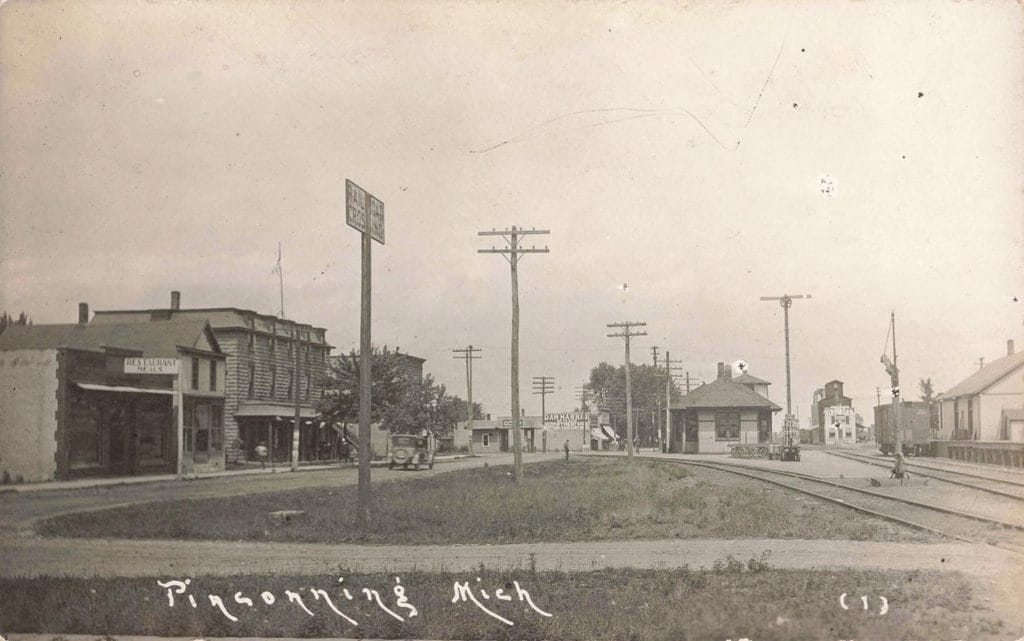
By 1960, Pinconning was a small city with an outsized personality – a place where giant mice beckoned from cheese shop rooftops and where the smell of curing cheddar had long since replaced the smell of fresh-cut pine. The opening of Interstate 75 in the mid-1960s would eventually siphon off some pass-through traffic from U.S. 23, but Pinconning’s allure did not fade.
U.S. 23 Helped Create Michigan’s Cheese Capital
Pinconning’s history would have developed very differently without transportation. First, the river carried logs. Then the railroad moved timber and people. Finally, the highway delivered customers. That progression is one of the strongest ways to understand the town.
The old U.S. 23 route through Pinconning is now M-13. Interstate 75 eventually shifted much of the long-distance traffic west of downtown, but the older route preserves the setting where Pinconning’s roadside cheese industry became famous.
The highway explains why cheese shops could become tourism businesses rather than simply food processors. A driver heading north could pull over, buy cheese, smoked fish, meat or candy and be back on the road quickly. Long before modern highway travel plazas, places such as Wilson’s served as memorable stops on the trip north.
Cheesetown Festival
To this day, the community celebrates its heritage each summer with the CheeseTown Festival, and generations of travelers have made a point to swing through “the Cheese Capital” for a hunk of Pinconning cheese and a snapshot with its famous mouse. In the span of less than a century (1872 to 1960), Pinconning’s story evolved from lumberjacks and log trains to milk cows and cheese wheels – an only-in-Michigan tale of resilience, resourcefulness, and yes, richness (in flavor, if not in fortune). And that historical journey provides ample material for any Michigan Moments episode looking to share the legacy of this unique little town.
Watch More Michigan Town Stories From This Region
These Michigan Moments episodes feature communities tied to Saginaw Bay, Lake Huron, railroads, farming, fishing, tourism and small-town change. Watch another nearby town story and see how each place fits into Michigan’s larger past.
Tawas
A Lake Huron town shaped by waterfront travel, regional trade and the pull of Michigan’s sunrise coast.
Watch TawasAu Gres
A Saginaw Bay community tied to fishing, boating, shore life and changing coastal commerce.
Watch Au GresOmer
One of Michigan’s smallest cities, with a story tied to rail service, river traffic and Arenac County life.
Watch OmerPinconning
Famous for cheese, Pinconning also reflects farming, highways and small-town trade near Saginaw Bay.
Watch PinconningWest Branch
A northern Michigan crossroads shaped by rail lines, highways, shopping and regional travel.
Watch West BranchLinwood
A Saginaw Bay town tied to shoreline life, fishing, boating and the working communities of Bay County.
Watch LinwoodFinal Thoughts About Pinconning Michigan History

The story of Pinconning Michigan history is one of transformation, rooted in the demands of survival and driven by the promise of opportunity. What began as a rail-linked lumber village grew into a thriving agricultural hub and a statewide destination for cheese lovers. Through industry shifts, changing economies, and evolving identities, Pinconning carved its place in Michigan’s story not through size, but through character. Today, its past remains proudly visible—preserved in cheese shops, railroad relics, and the quiet shores of Hazel Beach.
Pinconning History Timeline
| Year | Event |
|---|---|
| 1872 | George VanEtten and Henry Kaiser establish a lumber settlement |
| 1873 | Post office opens and Pinconning & Kaiserville Railroad begins serving the lumber industry |
| 1880s | Lumber production begins declining as surrounding forests are cut |
| 1887 | Pinconning incorporates as a village |
| 1907 | William Reid establishes Pinconning Creamery |
| 1915 | Dan Horn arrives from Wisconsin and begins producing Pinconning cheese |
| 1936 | Kraft establishes a cheese operation in Pinconning |
| 1939 | Inez and Lawrence Wilson establish Wilson’s Cheese Shoppe |
| 1940s-50s | Highway tourism helps Pinconning cheese gain statewide recognition |
| 1965 | Wilson’s giant mouse mascots appear |
| 1993 | Kraft’s long-running Pinconning operation closes |
| Today | Pinconning continues marketing itself as Michigan’s Cheese Capital |
FAQ About Pinconning, Michigan
What is Pinconning, Michigan, famous for?
Pinconning is best known for Pinconning cheese, an ageable Colby-style cheese first associated with local cheesemaker Dan Horn in 1915. The city has long promoted itself as Michigan’s Cheese Capital.
What makes Pinconning cheese different from regular Colby?
Pinconning cheese uses a Colby-style formulation but is notable for its ability to age for long periods. As it ages, it becomes firmer and substantially sharper.
Who invented Pinconning cheese?
Local histories credit cheesemaker Daniel “Dan” Horn, who moved from Wisconsin to Pinconning in 1915.
Why is Pinconning called the Cheese Capital of Michigan?
Cheese manufacturing became an important local industry, but Inez Wilson played a major role in turning that industry into a public identity. The City of Pinconning credits her statewide promotion with helping secure recognition of the town as Michigan’s Cheese Capital.
Where did the name Pinconning come from?
The city’s history connects the name to an Ojibwe term meaning “potato place” or a place where wild potatoes grew.
Sources For Pinconning Michigan History
- City of Pinconning (Official Site)
City of Pinconning. “History of the City.” City of Pinconning, . Accessed 21 May 2025.
City of Pinconning. “Inez Wilson: A Michigan Cheese Pioneer.” City of Pinconning, 30 Dec. 2018, . Accessed 21 May 2025.
City of Pinconning. “85 Years of Wilson’s Cheese Shoppe.” City of Pinconning, 2 July 2024, https://cityofpinconning.org/2024/07/wilsons-cheese-shoppe-celebrates-85-years-in-business/. Accessed 21 May 2025. - UpNorthTripod (Independent Michigan History Site)
“Pinconning, Michigan – Bay County’s Cheese Capital.” UpNorthTripod, http://upnorth.tripod.com/pinconning.html. Accessed 21 May 2025.
“Pinconning Railroad History.” UpNorthTripod, http://upnorth.tripod.com/pinrail.html. Accessed 21 May 2025. - Second Wave Media
Rentschler, Mark. “Pinconning’s Cheese Heritage Still Strong After More Than 100 Years.” Second Wave Media, 14 Oct. 2021, https://www.secondwavemedia.com/baycity/features/Pinconning-Cheese.aspx. Accessed 21 May 2025. - Gander Newsroom (Michigan News Analysis)
Becker, Kyle. “Meet the Woman Who Made Pinconning the Cheese Capital of Michigan.” Gander Newsroom, 9 Aug. 2022, https://gandernewsroom.com/2022/08/09/pinconning-cheese-michigan/. Accessed 21 May 2025. - Michigan Railroads (Rail Infrastructure History)
“Pinconning, MI.” MichiganRailroads.com, https://www.michiganrailroads.com/stations-locations/73-bay-county-09/500-pinconning-mi. Accessed 21 May 2025. - University of Michigan Library – David V. Tinder Collection
University of Michigan Library. “Entrance to Hazel Beach, Pinconning, Mich.” David V. Tinder Collection of Michigan Photography, William L. Clements Library, https://quod.lib.umich.edu/t/tinder/x-4448/tinder-rppc-008896. Accessed 21 May 2025.
(Other historical postcards and real photo images featured in the narrative are from the Tinder RPPC collection hosted at the University of Michigan Library Digital Collections.) - Pinconning Cheese Company
“Old-Fashioned Pinconning Cheese.” Pinconning Cheese Company, https://pinconningcheese.com/product-category/cheese/old-fashioned-pinconning-cheese/. Accessed 21 May 2025.