 by
On July 11, 1918, a 200-foot steel warship entered the Rouge River near Detroit. It was not built by an established shipyard. It came from a new factory operated by Henry Ford, the automobile manufacturer who had transformed American transportation with the Model T.
Ford was attempting something few industrialists had tried before: manufacturing warships using techniques borrowed from automobile production. The United States Navy wanted 100 steel patrol boats to fight German submarines during World War I. Ford eventually built 60, but the conflict ended before the fleet reached combat.
The history of Henry Ford Eagle Boats is a remarkable chapter in Michigan’s industrial past. It tells the story of an enormous new shipyard, thousands of workers, an ambitious manufacturing experiment, and a fleet whose service continued long after the war for which it was built.
History of Ford’s Eagle Boats
Ford’s Eagle Boats: Historical Timeline
From an urgent World War I naval contract to the creation of one of Michigan’s most important industrial facilities.
Ford’s Eagle Boats:
Historical Timeline
From the submarine crisis of World War I to the birth of the Ford Rouge industrial complex, follow the extraordinary story of Michigan’s forgotten naval fleet.
Select any event to view its history and photographs.
Watch: Henry Ford’s Forgotten Navy
Michigan Moments tells the story of Henry Ford’s attempt to build a fleet of warships at the Rouge River during World War I.
Why the Navy Needed Henry Ford to Build Warships
By 1917, German submarines were sinking Allied merchant ships in the Atlantic. Known as U-boats, the vessels attacked ships carrying food, fuel, ammunition, and military supplies to Britain and France. Germany hoped to weaken the Allies by disrupting the ocean supply routes. The United States entered World War I in April 1917, increasing the demand for naval escorts and anti-submarine patrol vessels.
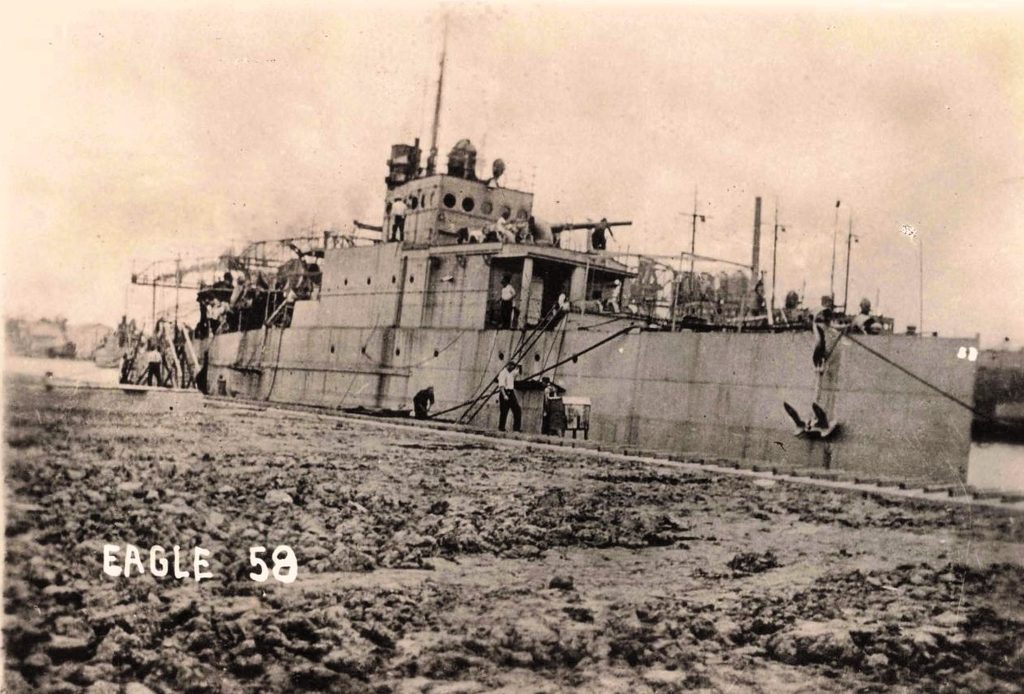
American shipyards were already busy with wartime contracts. The Navy needed a way to build smaller patrol boats rapidly without relying entirely on traditional shipbuilding methods.
Henry Ford believed he had an answer.
At his Highland Park automobile plant, Ford had demonstrated the value of standardized components and carefully organized production. His Model T manufacturing system divided complex work into smaller operations that could be repeated efficiently.
Ford proposed applying similar principles to steel warships. In January 1918, the Navy agreed to order 100 patrol vessels. The boats became known as the Eagle class.
The Eagle Boats: 200-Foot Submarine Hunters
The Eagle Boats were designed for anti-submarine patrols and escort duties. They were much smaller than battleships and carried weapons intended to engage submarines and smaller surface targets.
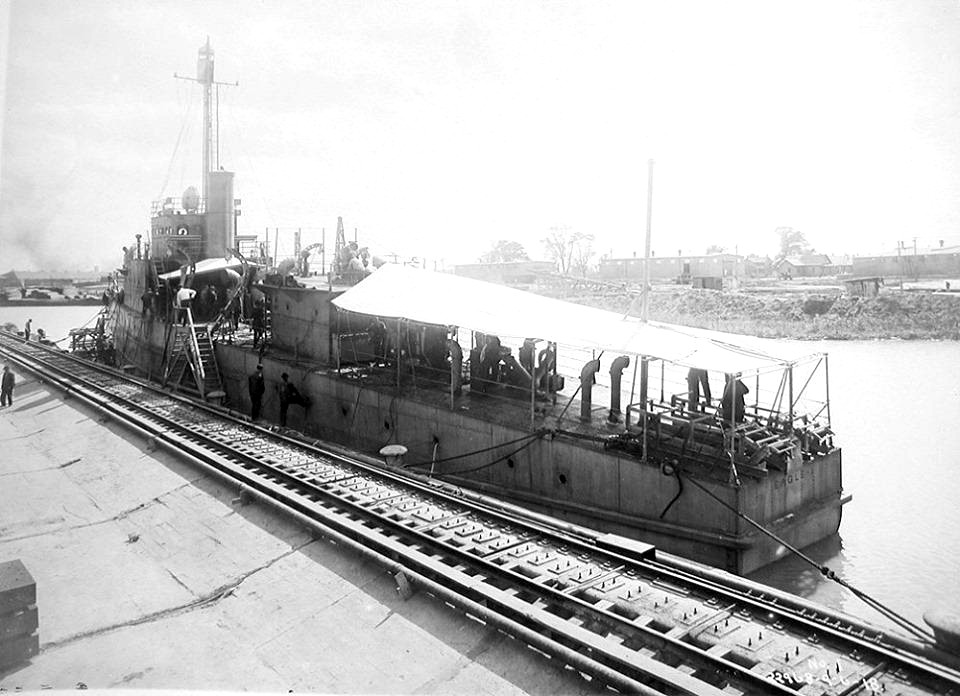
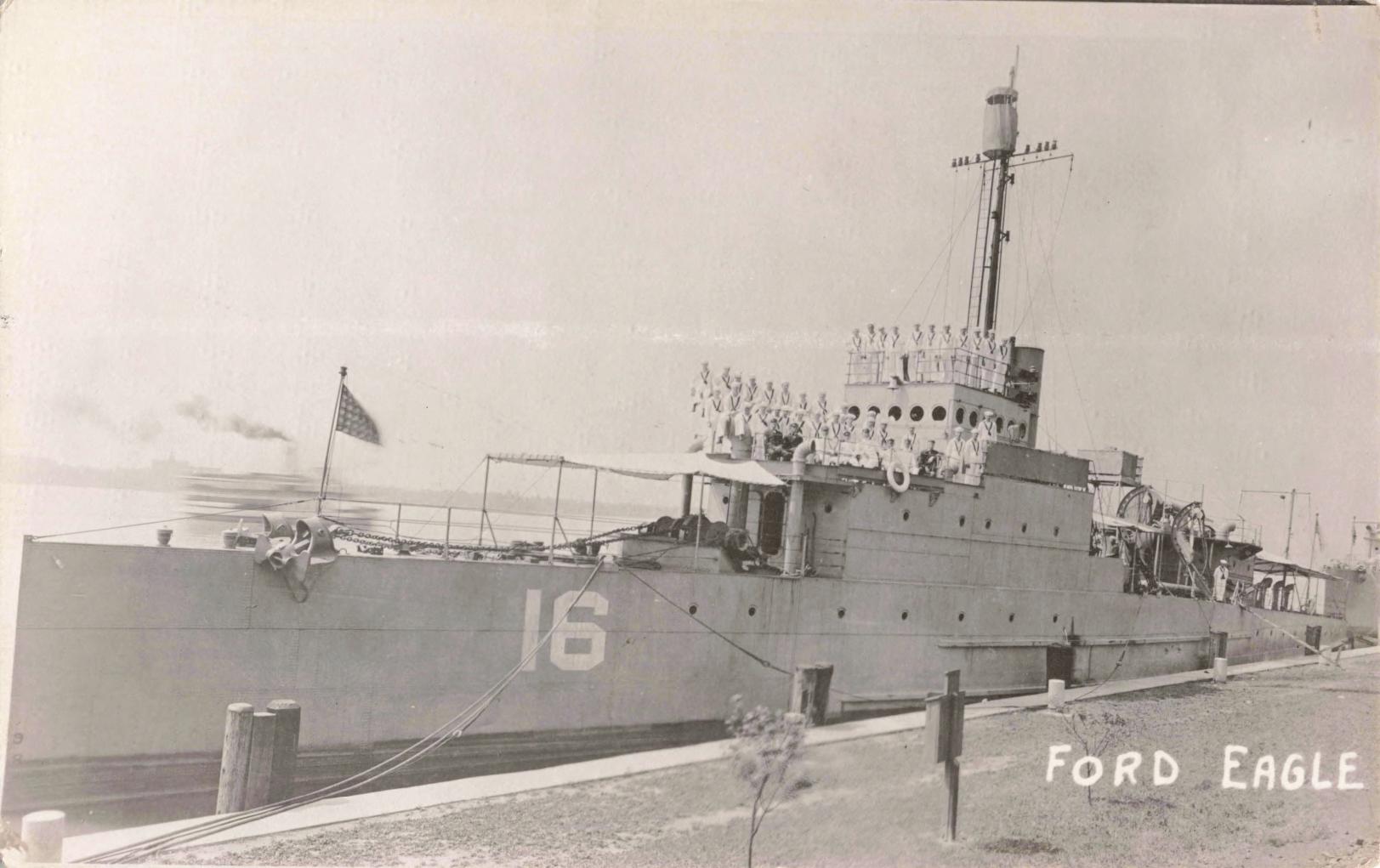
Each vessel measured approximately 200 feet long and 33 feet wide. An oil-fired steam turbine powered a single propeller, giving the boat a maximum speed of about 18 knots.
The usual crew consisted of four officers and 54 enlisted sailors. Armament included deck guns and depth charges, while underwater listening equipment helped crews search for submarines.
The design was unusual. Ford favored flat steel plates and relatively straight hull sections that could be manufactured and joined using standardized methods.
The vessels had a boxlike appearance, earning nicknames such as “Pickle Boats” and “Cheese Boxes.”
They were not elegant warships, but elegance was never the objective. The Navy wanted patrol vessels that could be built quickly and deployed in large numbers.
Building a Massive Shipyard on the Rouge River
Ford selected land along the Rouge River in Dearborn for the new shipbuilding operation. Today, the site is associated with the famous Ford River Rouge automobile complex. In early 1918, however, much of that industrial development was still ahead.
Construction began in February 1918. Workers dredged and widened portions of the river, built docks, laid railway tracks, and erected the enormous assembly building. Architect Albert Kahn designed the main structure, which measured approximately 1,700 feet long.
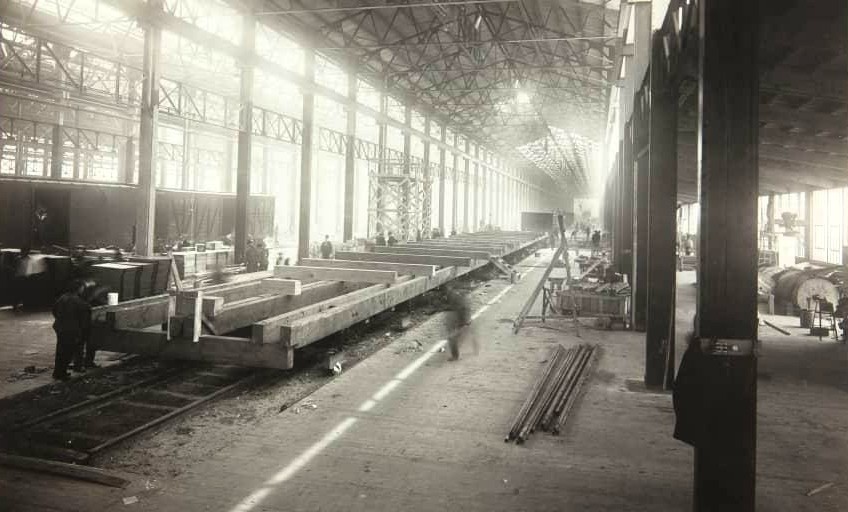
Preparing the first Eagle Boat keel inside Ford’s Rouge Plant B in May 1918. The factory was designed to accommodate multiple vessels under construction. Photo: From the Collections of The Henry Ford, artifact THF270303.
Inside the building were three parallel production tracks, each capable of accommodating seven boats. Up to 21 vessels could be under construction at the same time. The Eagle Boats did not travel along a continuously moving automobile conveyor. Instead, the hulls rested on specially designed railcars that moved between seven fixed workstations.
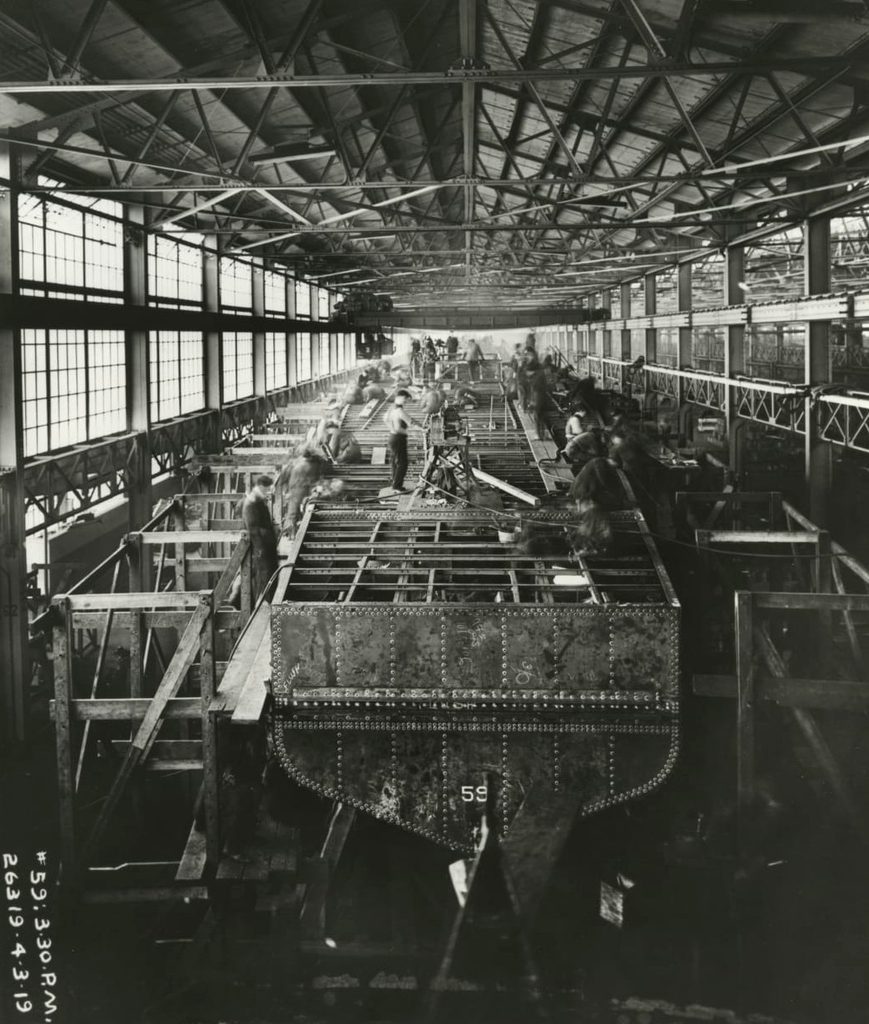
Overhead cranes lifted steel components into position. Workers riveted plates, assembled bulkheads and installed equipment as the vessels advanced through production. The system was an ambitious attempt to make shipbuilding more predictable and efficient.
Thousands of Workers Faced Unexpected Problems
Ford’s automobile factories had considerable manufacturing experience, but building steel ships required different skills. Workers had to learn specialized riveting techniques and carefully join hull plates to produce watertight structures. The Navy also required inspections, modifications, and corrections during construction.
Each Eagle Boat required an enormous number of rivets. The company established training programs to prepare workers for unfamiliar shipbuilding tasks.
Wartime shortages created additional problems. Ford needed steel, machinery, skilled labor and reliable transportation to the new factory. The company used Model T trucks pulling passenger trailers to transport workers. Employment eventually approached 8,000 people. Despite the resources committed to the project, production fell behind schedule.
The company was learning how to build ships while simultaneously trying to manufacture them in large numbers.
The First Ford Eagle Boat Launches July 11, 1918
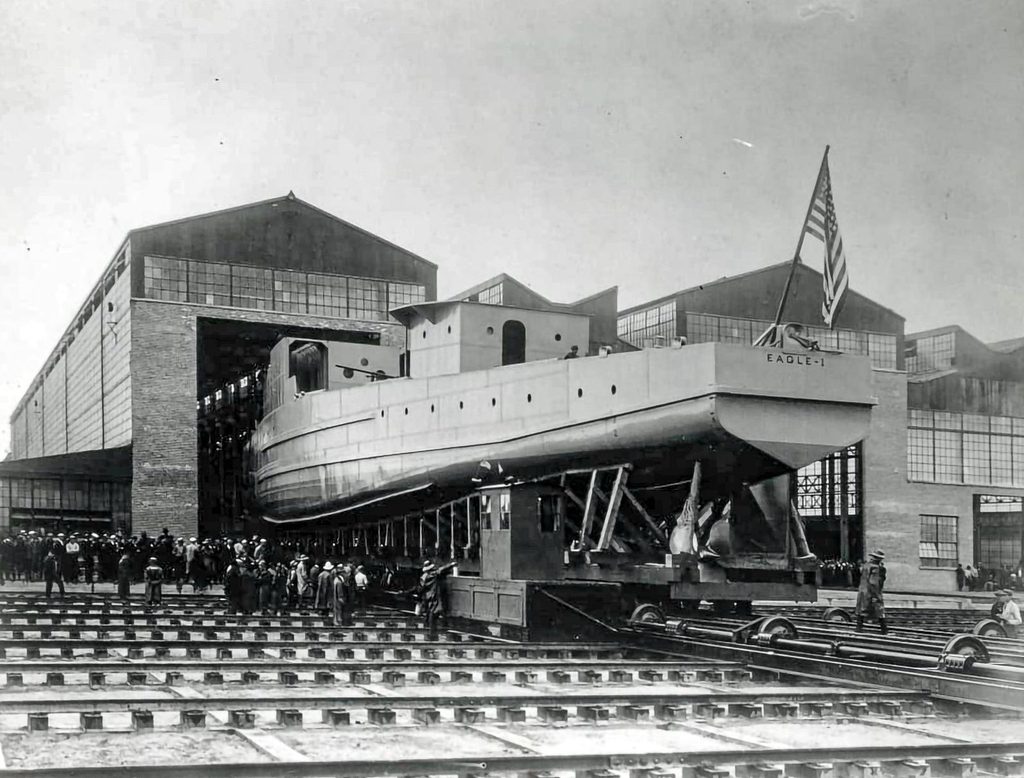
On July 11, 1918, Ford reached a major milestone when the first Eagle Boat entered the Rouge River. The launching method was unusual. Instead of sliding down traditional inclined shipways, the vessel was transported on special rail-mounted equipment and lowered into the water using a hydraulic platform.
The launch demonstrated that Ford’s factory could manufacture a steel naval vessel. However, the boat still needed additional equipment, inspections, and testing before it could enter military service. Eagle 1 was commissioned on Oct. 30, 1918.
Eleven days later, the war ended.
World War I Ends Before Ford’s Navy Is Ready
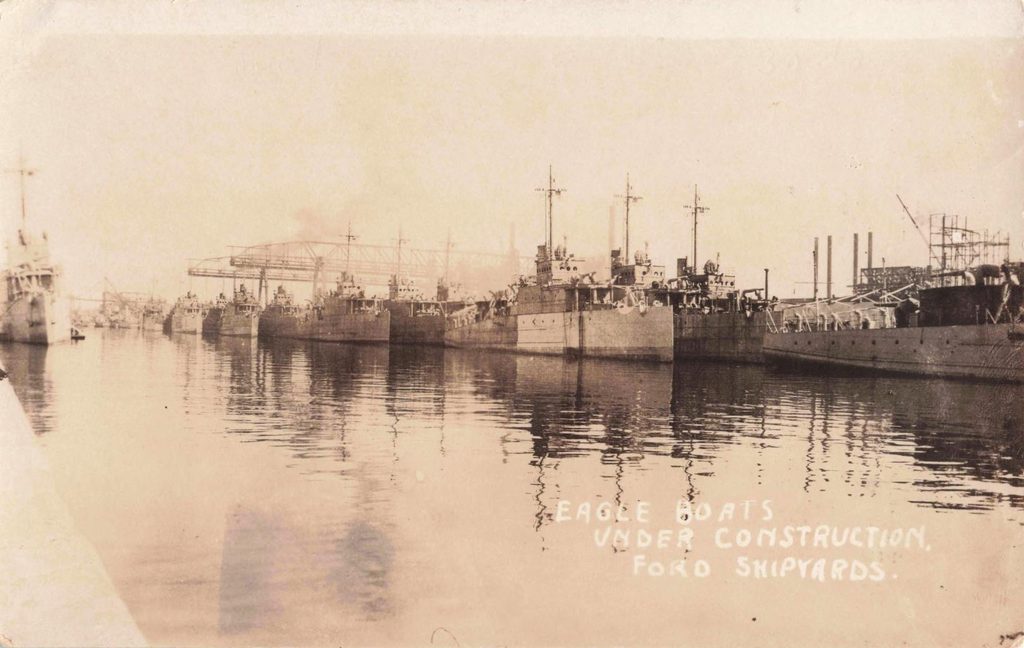
On Nov. 11, 1918, the armistice ended fighting on the Western Front. Americans celebrated the conclusion of a devastating war. At Ford’s Rouge factory, the news created an unusual problem. The company had constructed a massive shipbuilding operation for a military emergency that was suddenly over.
By Armistice Day, workers had laid 28 keels and launched 12 Eagle Boats. Only seven had been commissioned into the Navy. None had seen combat against German submarines.
The Navy reduced its original order from 100 vessels to 60. Ford continued production during 1919, completing the remaining ships. Ironically, the factory became most efficient after the war had ended.
Ford Builds an Eagle Boat in Just 10 Days
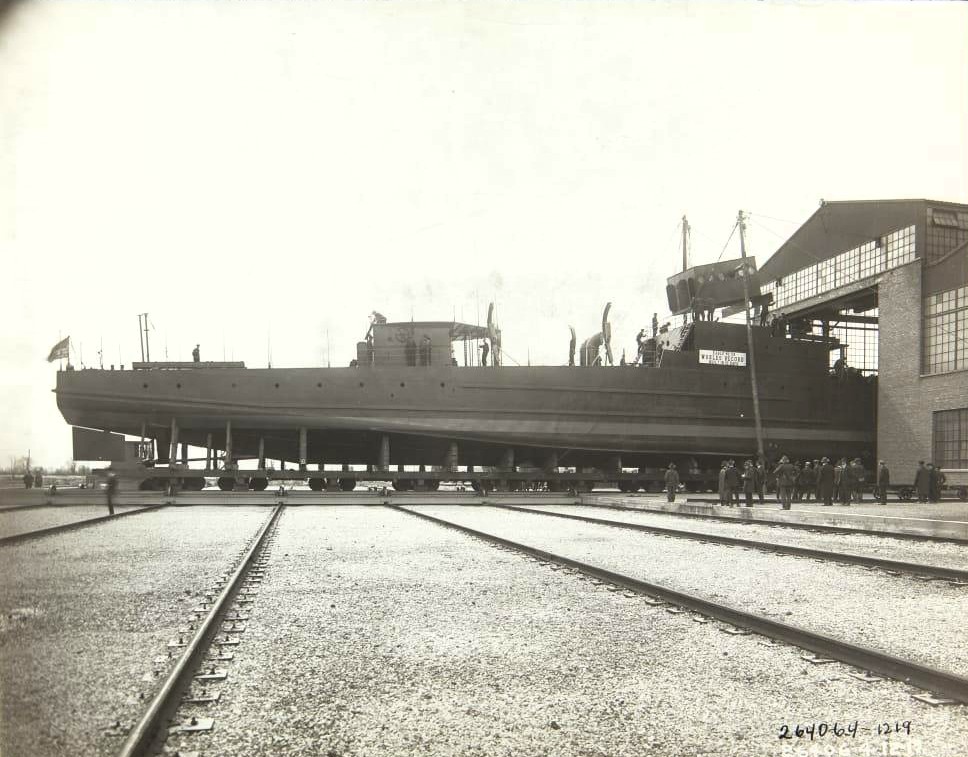
As workers gained experience, the factory improved its production methods. Problems that delayed the earliest vessels became lessons for later construction. By 1919, the operation was producing Eagle Boats much faster than during its first months.
In April, workers completed Eagle Boat No. 59 in just 10 working days after laying its keel. The achievement demonstrated how much the manufacturing process had improved. Yet the success came too late to meet the original wartime objective.
The factory had learned how to build ships quickly. The war that demanded them was already over.
What Happened to Ford’s Eagle Boats After World War I?
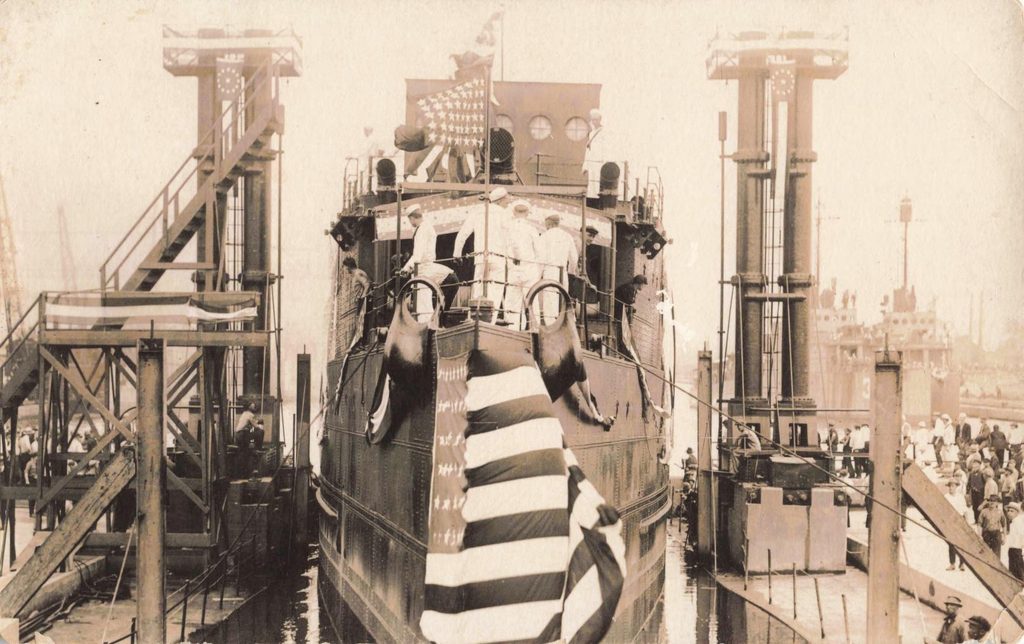
Although the Eagle Boats missed combat during World War I, several continued serving the United States government. Some were assigned to naval patrols and training duties. Five eventually entered service with the United States Coast Guard.
Three vessels also participated in American naval operations in northern Russia during the Allied intervention in the Russian Civil War. Eagle Boats 1, 2, and 3 operated around Arkhangelsk in 1919. Their duties took them far from the Michigan factory where they had been built.
Eight Eagle Boats remained in service during World War II. One would suffer a tragic fate.
The Tragic Sinking of Eagle 56 in April 1945
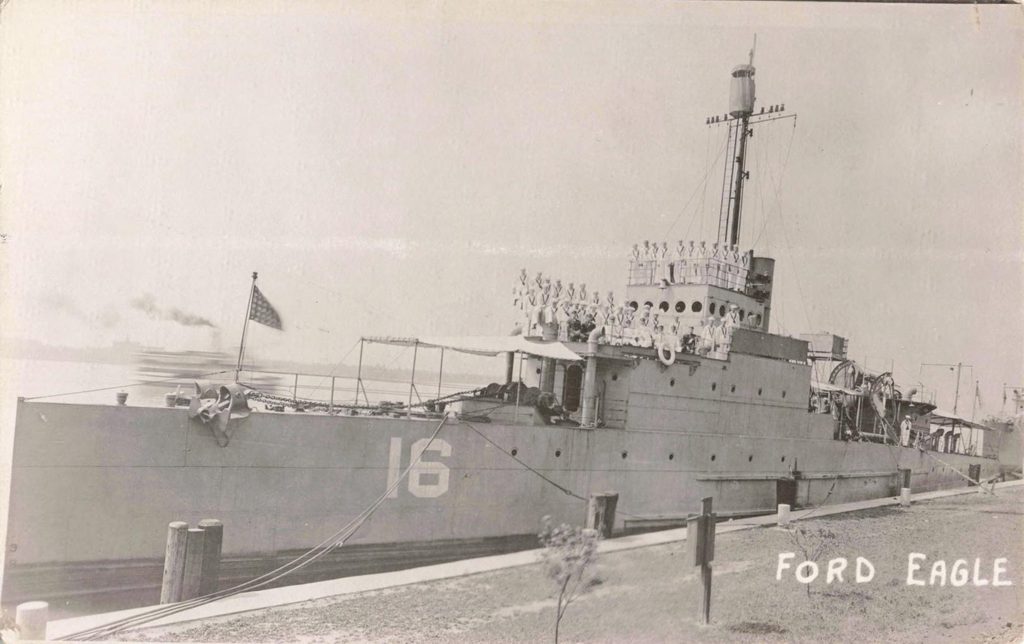
On April 23, 1945, Eagle 56 was operating off Cape Elizabeth, Maine. The patrol vessel, officially designated PE-56, was towing targets for Navy aircraft conducting bombing practice. Germany was nearing defeat, but its submarines remained active in the Atlantic.
Without warning, an explosion tore through the Eagle Boat.
The ship broke apart and sank. Of the 67 sailors aboard, only 13 survived. Fifty-four Americans lost their lives. Several survivors reported evidence of a German submarine. However, the Navy’s original investigation attributed the sinking to an internal boiler explosion. For decades, that remained the official explanation.
Later historical research identified German submarine U-853 as responsible for the attack. In 2001, the Navy formally recognized that an enemy torpedo had sunk Eagle 56. Originally built to hunt German submarines during World War I, the vessel finally encountered one during the closing weeks of World War II.
The Eagle Boats Helped Establish Ford’s Rouge Complex
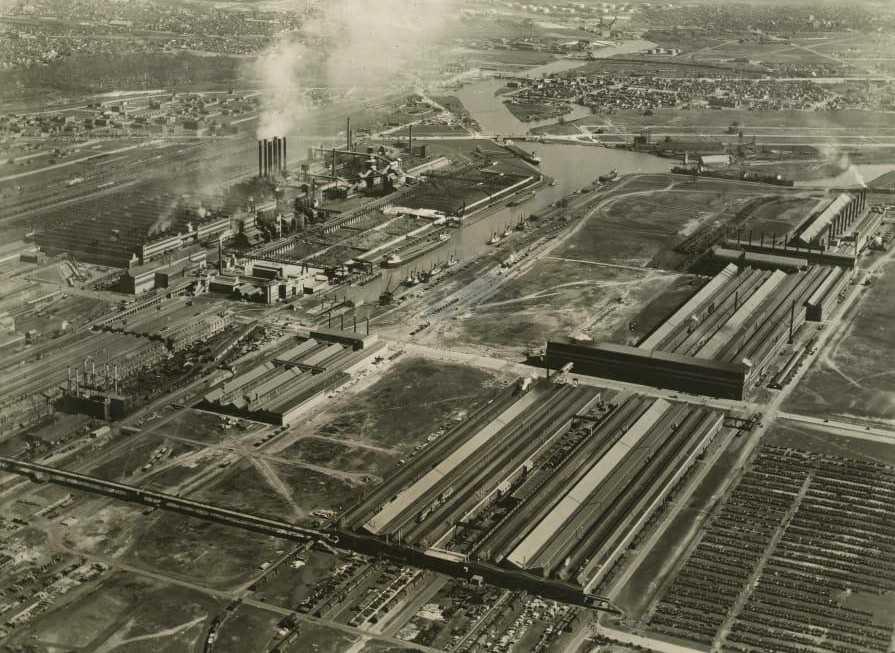
After the Eagle Boat contract ended, Ford acquired the large assembly building from the federal government. The structure became part of the growing River Rouge manufacturing complex.
Over the following decades, the Rouge developed into one of the world’s best-known automobile production facilities, with steelmaking, glass production, parts manufacturing, and vehicle assembly operations. The former Eagle Boat assembly building remained in industrial use until 2004. It was demolished in 2008.
The warships eventually left naval service, but the industrial site built to manufacture them continued shaping Michigan’s economy for generations. The Eagle Boat program demonstrated both the possibilities and limits of mass production. Ford adapted factory methods to steel shipbuilding, but early difficulties showed that experience and specialized skills remained essential.
The Navy ordered 100 boats. Ford completed 60. None fought in World War I. Yet the project left an industrial legacy far greater than its original military assignment. Before Ford’s River Rouge complex became famous for producing automobiles, thousands of Michigan workers built a fleet of steel warships along the river.
It remains one of the most unusual chapters in Michigan manufacturing history.
Do you have family photographs or stories about relatives who worked at Ford’s Rouge plant during its early years? Share them in the comments. Those records may help preserve another part of Michigan’s industrial history.
Historical Sources and References
The Henry Ford. “Building Eagle Boats at the Rouge.” The Henry Ford. Historical photographs, production records and construction history.
The Henry Ford. “Eagle Boats Research Guide.” The Henry Ford Research Guides. Contract information, manufacturing methods and naval service.
Ford Motor Company, Photographic Department. “Launching of First Eagle Boat at Ford Rouge Plant, 1918.” The Henry Ford, artifact THF97490.
Ford Motor Company, Photographic Department. “Launching World Record Eagle Boat #59, Built in 10 Days, April 1919.” The Henry Ford, artifact THF270319.
U.S. Naval Institute. “The Eagle Boats of World War I.” Proceedings, June 1973. Naval design, construction and later operations.
Naval History and Heritage Command. “H-047-1: Operation Teardrop.” U.S. Navy. The sinking of Eagle 56 and subsequent historical findings.
National Archives and Records Administration. “The Reel Story of the Great War.” Prologue, winter 2017. Ford’s wartime motion-picture records, including Eagle Boat construction footage.
The Henry Ford. “Ford Rouge Factory Tour History and Timeline.” The Henry Ford. Development of the Rouge industrial complex.