 by
by The history of Ovid, Michigan, between 1890 and 1940 is a story of a small town’s rise to regional significance. Tucked into the fertile farmland of Clinton and Shiawassee counties, Ovid blossomed during the late 19th and early 20th centuries thanks to the twin forces of railroads and local enterprise.
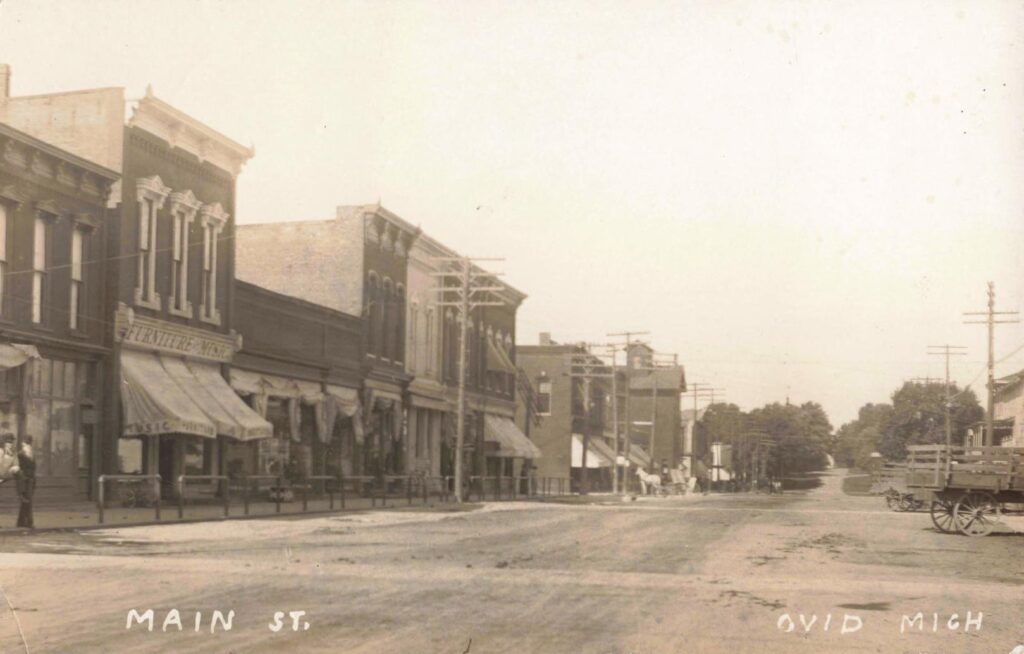
Settled in 1836 and incorporated as a village in 1869, Ovid entered the 1890s as a humble farming community. Over the next fifty years, it evolved into a bustling hub of agricultural processing, with electric lights, busy streets, and a close-knit community spirit. This article explores the History of Ovid, Michigan, during its golden era, highlighting how rail infrastructure, key businesses, and economic trends shaped its journey. (All images are historical, circa 1890s–1930s, from the Ovid area.)
Railroads Connect Ovid to the World
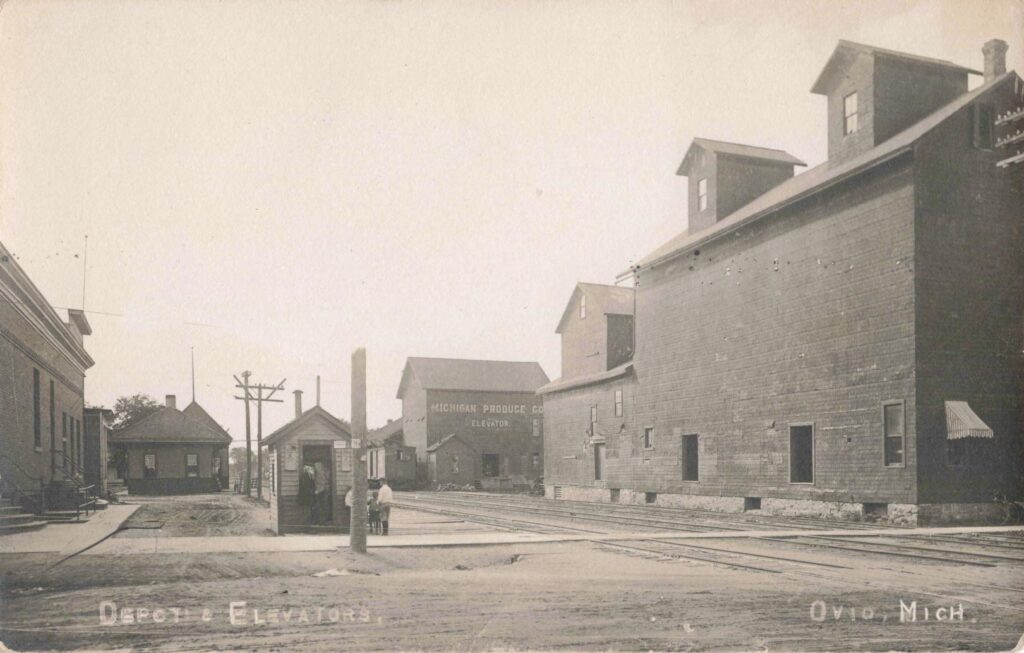
In the late 19th century, the railroad was king – and Ovid was lucky to have one. The Grand Trunk Western Railroad built a line passing through Ovid as part of its Detroit–Grand Rapids route. In fact, the tracks that ran “from Detroit via Durand to Grand Rapids” cut right by Ovid’s border, with a depot just inside Clinton County. This strategic location turned Ovid into a small but important railway stop.
Notably, the line had an interesting origin: it was initially planned by the Chicago & North Western Railway as part of a link between Port Huron and Chicago. By 1877, the C&NW had completed the segment from Lansing to Flint – a key puzzle piece in Michigan’s rail network. A few years later, the Grand Trunk Railroad (a Canadian-based system expanding into Michigan) took over the route. Under Grand Trunk Western (GTW) management, Ovid’s stretch of railroad gained double-track capacity and robust freight traffic, becoming an essential corridor for goods and passengers alike.
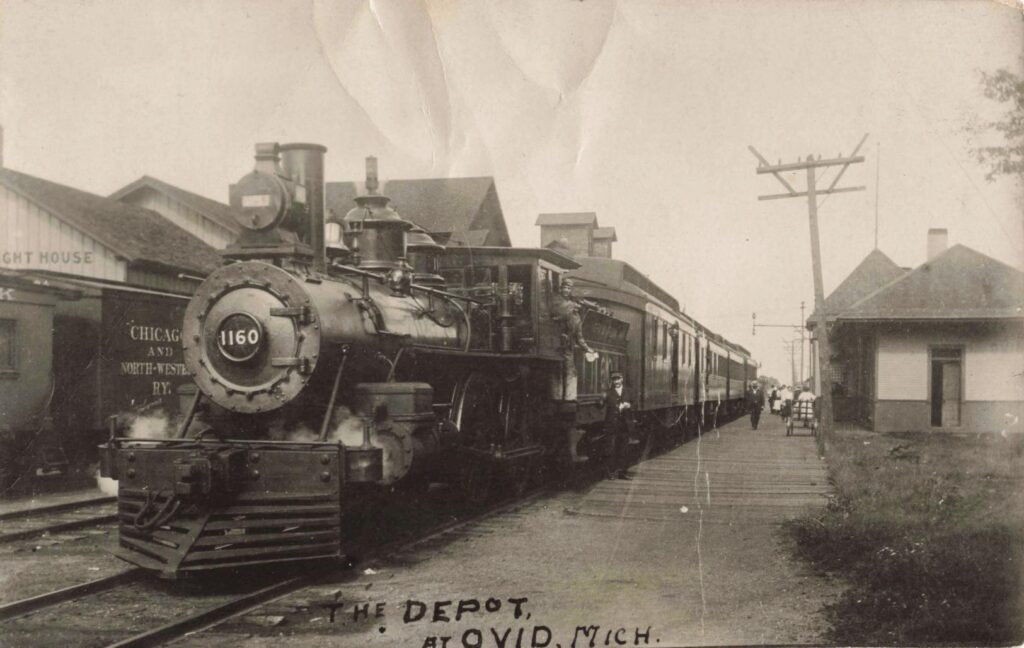
By 1900, Ovid would see several trains a day. Freight trains hauled out local produce, while passenger trains brought travelers and salesmen into town. The presence of the railroad cannot be overstated – it was the economic engine of Ovid’s growth. A 1917 report notes that the Grand Trunk Western depot in Ovid had both an operator and an agent on duty during the day to handle the volume of business. The depot itself, pictured below, featured a classic gabled roof and a water tower to service steam locomotives.
Thanks to the railroad, Ovid’s farmers and factories were no longer isolated. They could ship their goods to distant markets and receive supplies with unprecedented speed. The railroad’s influence touched every aspect of town life – spurring population growth, enabling new businesses, and even influencing social life (with train schedules dictating mail delivery and the arrival of out-of-town visitors). In short, the coming of the railroad in Ovid laid the groundwork for the town’s golden age.
Booming Industries in the Early 1900s
With reliable rail transport in place, Ovid became an attractive location for agriculture-related industries. By the late 1800s and early 1900s, the town hosted a remarkable array of businesses for its size. According to local history, Ovid supported a cooperage (barrel-making factory), a flour mill, a lumber company, a foundry, a saw mill, and a tannery, alongside numerous retail stores and hotels. It even had a well-known carriage manufacturer. Let’s look at some of the key enterprises that drove Ovid’s economy:
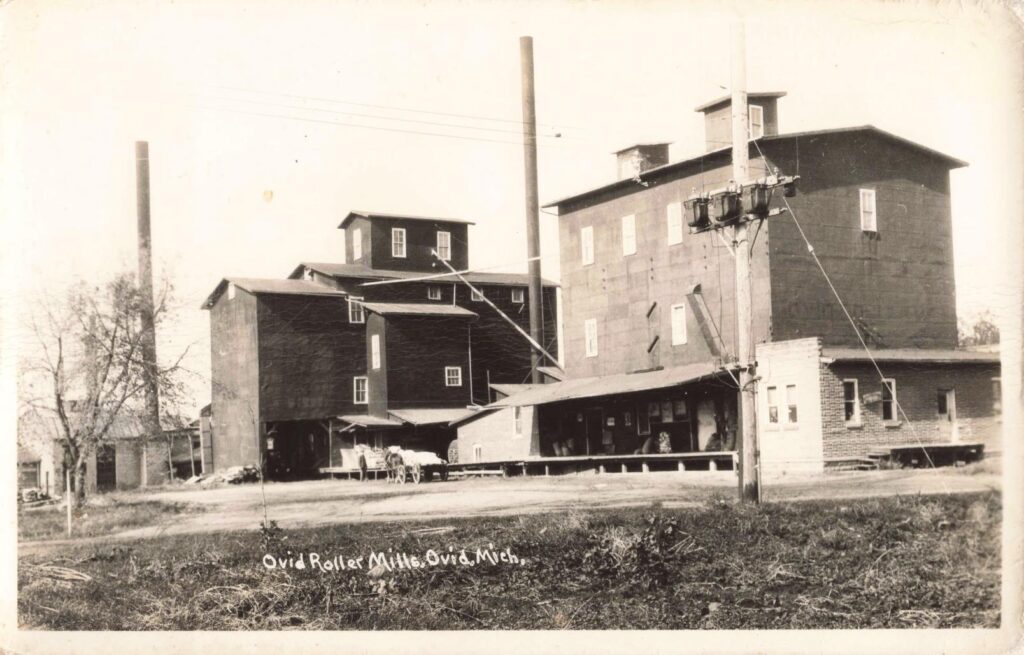
Ovid Roller Mills: Perhaps the most crucial industry was the flour mill. Ovid’s first flour mill dated back to the 19th century, but by the 1890s it had modernized into a “roller” mill – using steel rollers instead of old-fashioned millstones to grind grain. Operated in the early 1900s by proprietor Robert Hyslop (an immigrant miller noted in county histories), the Ovid Roller Mills processed wheat, corn, and other grains grown by local farmers. The mill complex, shown above, included grain elevators and storage, and it was strategically located near the railroad for easy shipment of flour. Farmers would bring wagon-loads of wheat to be milled; some flour was sold locally, and the surplus could be shipped via rail. The mill also produced animal feed, ensuring that virtually nothing went to waste.
Michigan Produce Company Elevator: In an agricultural community, grain elevators were vital. The Michigan Produce Co. Elevator in Ovid was a large storage facility where farmers sold their harvests (corn, wheat, oats, and beans). The elevator would dry, grade, and store the grain, then funnel it into railcars on the adjacent tracks. By aggregating local produce, this company could ship carloads to wholesalers and markets in Lansing, Flint, or even Chicago. One historical photo (Figure 1 above) shows the elevator’s name proudly painted on its side, standing right next to the GTW depot – a physical symbol of how closely tied farming was to the railroad. During peak harvest season in the 1910s, the Michigan Produce elevator in Ovid would be a bustling scene: bushels of grain hoisted up conveyor belts and the sound of grain pouring into wooden silos. This efficient system enabled Ovid to punch above its weight in the agricultural economy.
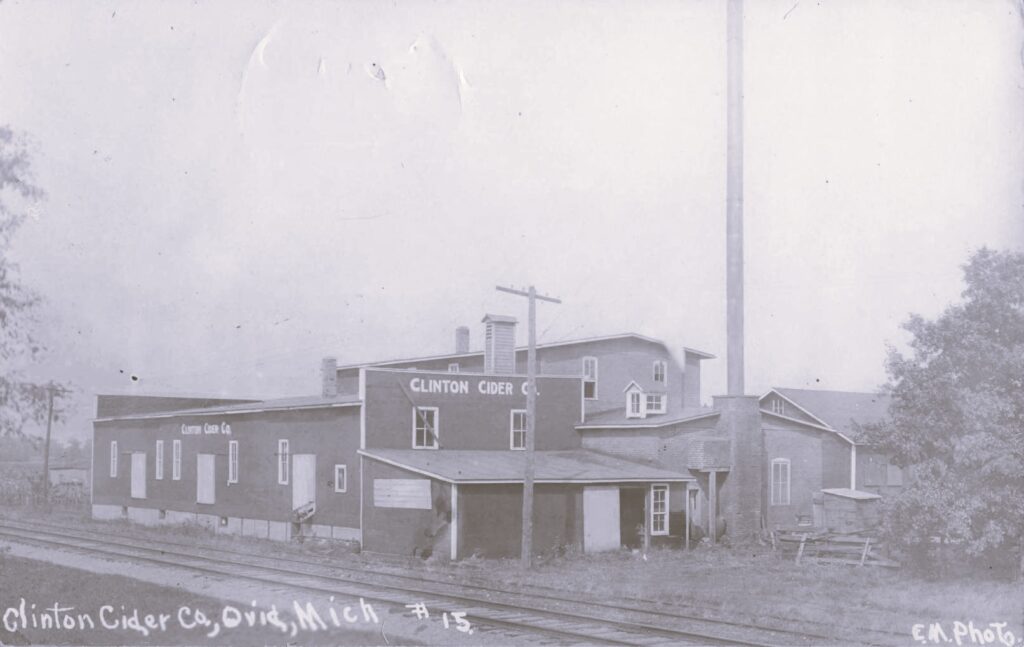
Clinton Cider Company: Ovid’s fertile land wasn’t just for grain – it was great for apples too. Around the turn of the century, a cider and vinegar mill opened in town, capitalized as the Clinton Cider Co. (named after Clinton County). By 1914, the Clinton Cider Co. was thriving, as evidenced by surviving postcards of the facility. This factory took in wagonloads of apples from local orchards every fall. Using large presses (initially powered by steam, and later electric motors), it would crush the apples to extract juice.
The fresh cider was sold for drinking, while a significant portion was fermented into vinegar – an essential preservative and cooking ingredient in the era. Barrels were filled and shipped by rail to customers across Michigan. One fun anecdote: in the era of Prohibition (1920–1933), hard cider was one of the clandestine alcoholic beverages people could produce; Ovid’s cider works may have seen brisk business as folks quietly turned sweet cider into “apple jack.” The mill’s big vinegar tanks and the aroma of apple mash made it a memorable landmark in Ovid’s industrial landscape.
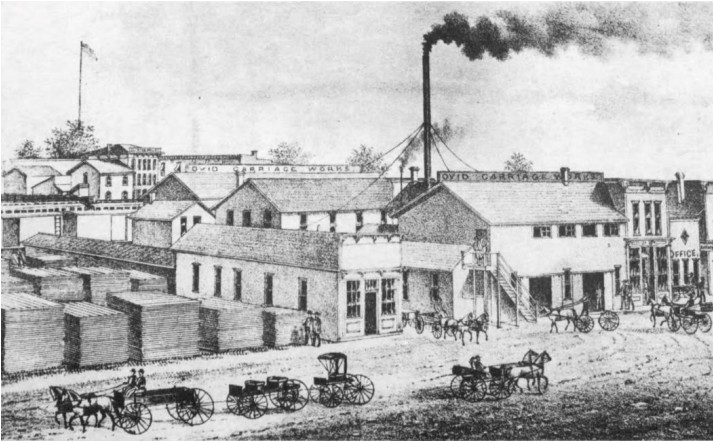
Schafield & Danforth Carriage Works: One of the most famous businesses in Ovid was a carriage manufacturing company. As the City of Ovid’s official history notes, “the most well-known business was that of Schafield and Danforth, which manufactured carriages”. In the late 1800s, before automobiles became common, carriages and wagons were in high demand. Schafield & Danforth built horse-drawn buggies reputed for their quality.
Customers from around the region ordered Ovid-made carriages – essentially putting the town on the map for craftsmanship. The factory likely employed skilled woodworkers, blacksmiths, and upholsterers. They made everything from simple farm wagons to fancy surreys with fringe on top. Ovid’s Carriage Works prospered through the 1890s; however, by the 1910s, the rise of the automobile began to cut into the carriage trade. The company eventually closed (or shifted to other products) as Model T Fords replaced horse-drawn buggies. Still, the legacy was such that modern Ovid commemorates it with an annual Ovid Carriage Days festival.
These industries – flour milling, produce handling, cider making, and carriage building – formed the backbone of Ovid’s economy during its peak years. They also complemented each other. For example, the cooperage (barrel factory) in town likely supplied barrels to the cider mill and the flour mill. The railroad provided coal to power the mills’ steam engines and carried away finished goods. This synergy of local businesses made Ovid a self-sustaining little economic ecosystem around 1900.
Civic Improvements: Lights, Water, and Community Life
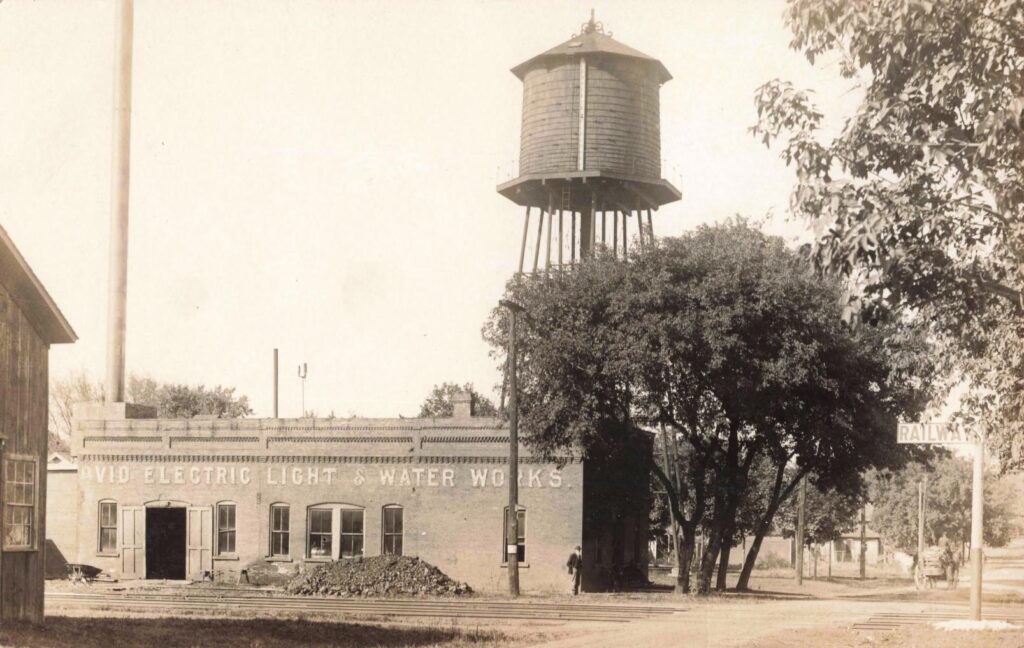
As Ovid’s businesses grew, so did its confidence and infrastructure. The early 20th century brought significant civic improvements that enhanced daily life:
Electric Light & Water Works: In 1899, Ovid made a giant leap into the modern age by establishing the Ovid Electric Light and Water Works. Many small towns of the era still relied on kerosene lamps and well water, but Ovid invested in a combined utility plant. According to state records, an “Ovid Electric Light Plant” was in operation by the late 1890s. The facility included a waterworks (with a tall metal water tower) and an electric generation station – likely powered by coal-fired steam boilers. This gave the town reliable running water (for fire hydrants, businesses, and homes) and electricity for lighting.
The impact of electricity in Ovid was dramatic. The first electric streetlights were installed downtown, casting steady light on the boardwalks and storefronts. Residents could gather in the evening under streetlamps to socialize, extending community life past dusk. Businesses like the Life Saver Inn and local stores could operate into the evening, no longer limited by oil lamp glow. The water system meant clean drinking water and a welcome end to hauling water from wells. It also meant better fire protection – crucial for a town built largely of wood. Ovid’s investment in utilities underscores how the history of Ovid, Michigan is a story of embracing progress. By 1910, Ovidians had amenities on par with those of much larger cities.
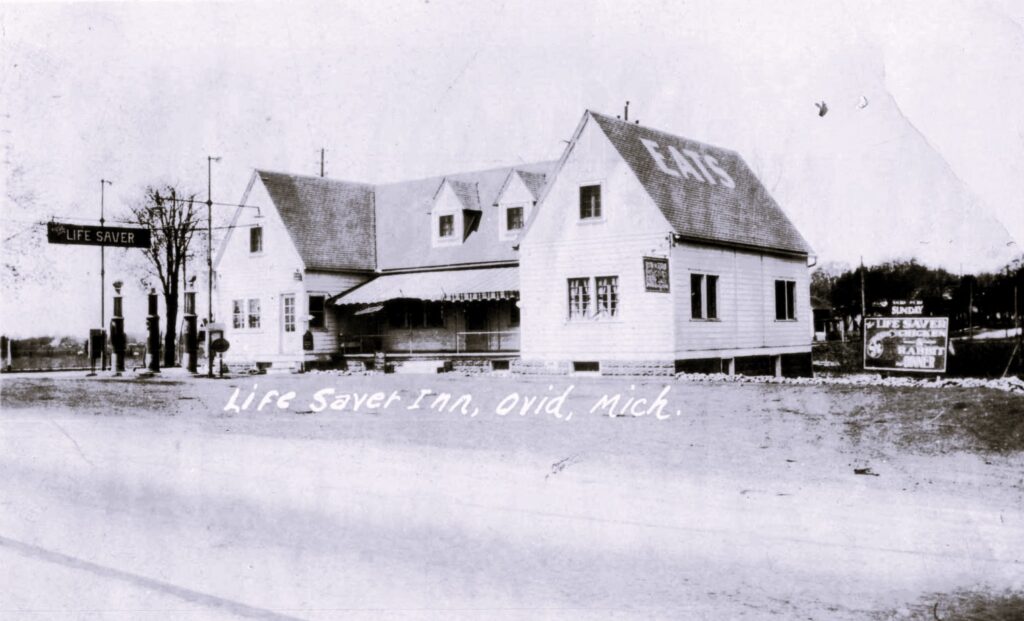
Life Saver Inn and Social Hubs: With prosperity and rail connectivity, Ovid developed a lively social scene. The Life Saver Inn became a favorite gathering place. This inn (later known as the Lifesaver Inn, spelled as one word) was a combination hotel, restaurant, and tavern located near the town center. It earned its quirky name by being a “life-saver” for late-night travelers – essentially the only spot in town to find a meal or bed after an evening train arrival. During Ovid’s boom years, the Life Saver Inn’s guest register filled with traveling salesmen (“drummers”), railroad workers, farmers from outlying areas, and even the occasional celebrity passing through.
Local lore (passed down by the Ovid Historical Society) notes that the Life Saver Inn later added a bowling alley and went through various incarnations (Tri-Ami Lanes, Nic’s Bar). But in the 1890–1940 period, it was truly in its prime. Community banquets, lodge meetings, and holiday dances were often held in its halls. One can imagine a Christmas 1910 scene: the inn festooned with holly, a warm fire in the hearth, as townsfolk gather for a charitable dinner. Or picture a summer night around 1925: farmers sitting on the inn’s porch, sipping cold sarsaparilla, listening to a baseball game on the radio (Ovid’s first radio likely arrived in the 1920s, made possible by that electric supply). The Life Saver Inn symbolized Ovid’s hospitality and community spirit.
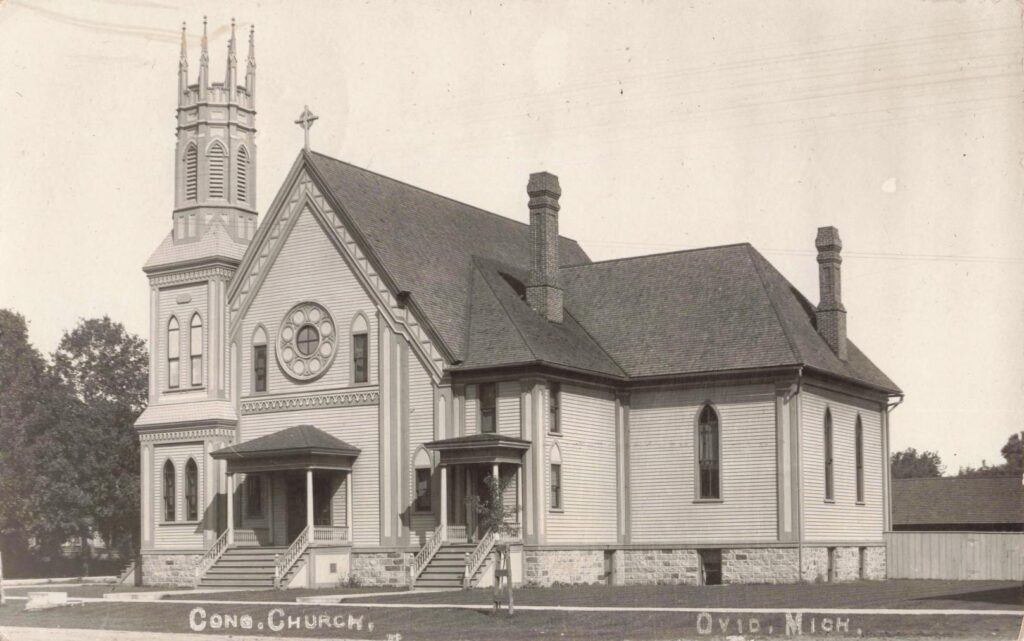
Other social hubs included the town’s churches (the Congregational Church built in 1872, for example, which still stands and is on the historic register), the public school, and fraternal organizations like the Masons or Odd Fellows. The local newspaper, the Ovid Register-Union, kept everyone informed and often sponsored debates, essay contests, or fair events. An item from a 1903 Lansing paper noted an Ovid agent for the Grand Trunk Railroad by name, indicating how closely residents followed each other’s doings. In essence, community life in Ovid during the early 20th century was vibrant and tight-knit, buoyed by the town’s economic successes.
Economic Challenges and the End of an Era
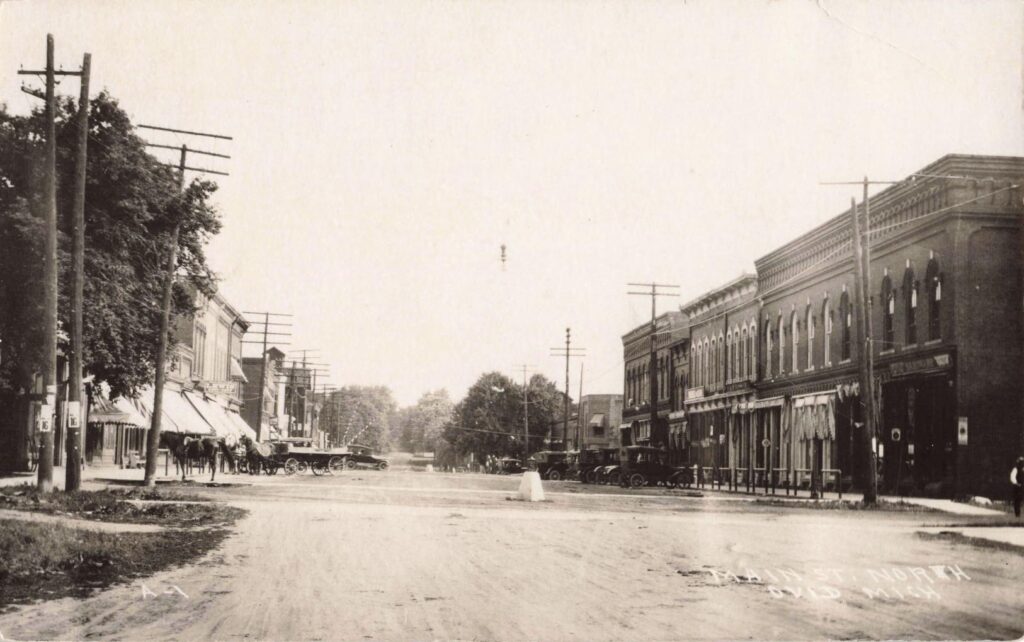
The good times in Ovid, as in the rest of America, faced challenges as the decades wore on. Two major events significantly impacted Ovid’s trajectory: the agricultural recession of the 1920s (especially after World War I) and the Great Depression of the 1930s.
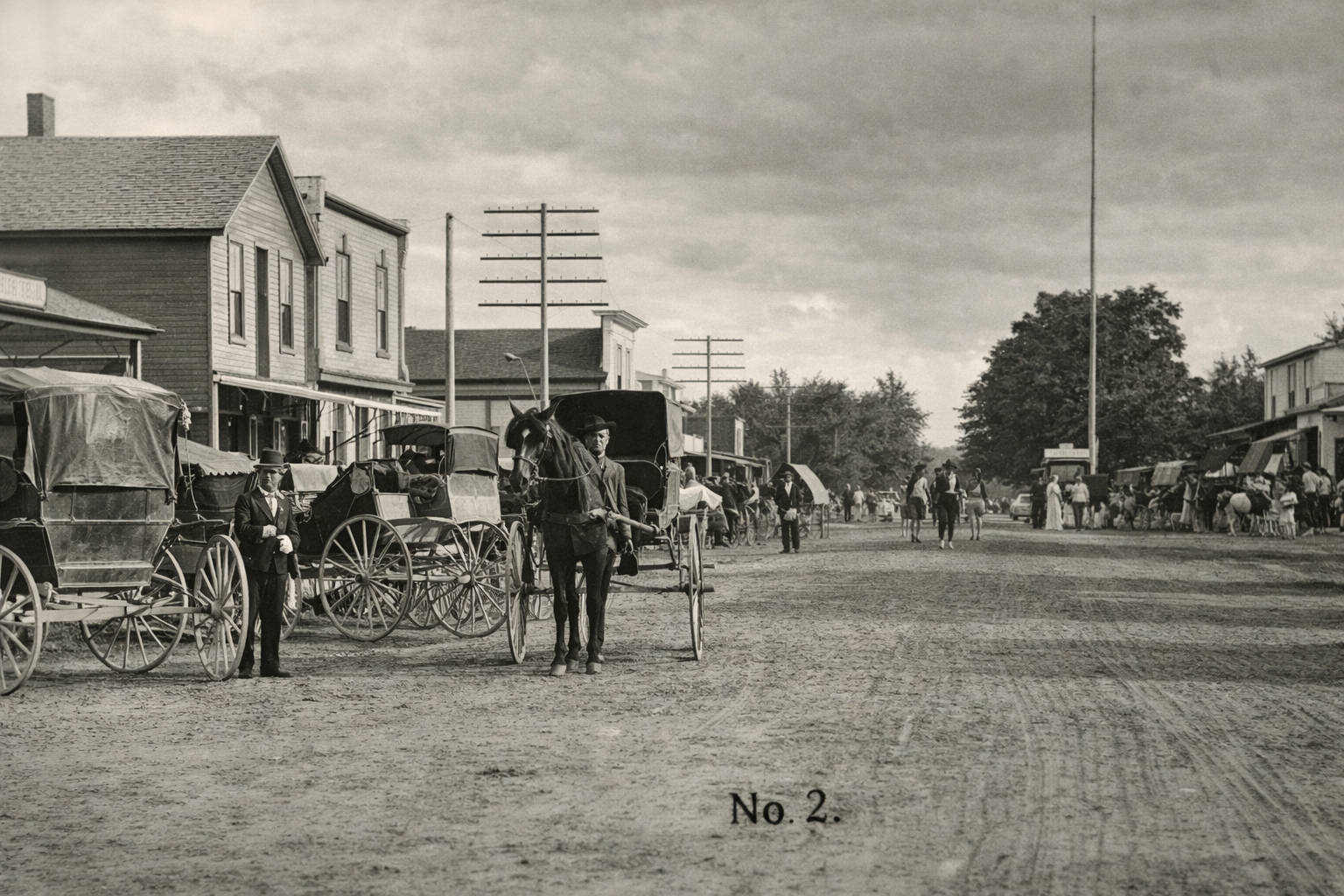
After World War I, around 1920–21, farm commodity prices, which had been high during the war, collapsed. Michigan farmers, including those around Ovid, suddenly earned much less for their crops. Small towns reliant on agriculture felt the pinch. In Ovid, this likely meant fewer upgrades or expansions – perhaps the first sign of a plateau after years of growth. The carriage factory, faced with the onslaught of Ford’s mass-produced cars, either closed or converted its operations. By the mid-1920s, one might have noticed fewer horses tied up on Main Street and more Model T’s rattling down the road. Ovid’s economy was shifting, subtly but steadily.
Then came October 1929 and the crash of the U.S. stock market. As the Great Depression took hold, banks failed and credit dried up. Ovid’s State Savings Bank (one of the institutions likely present on Main Street) may have struggled or merged with others. Oral histories recall families bartering butter and eggs because cash was scarce. The Michigan Produce Co. Elevator saw grain prices so low that some farmers hesitated to even harvest their crops – why spend to thresh wheat that might not pay for the fuel? The Clinton Cider Co. might have managed since vinegar was a staple (and perhaps bootleg hard cider kept an under-the-table income), but generally these were lean years.
During the 1930s, Ovid’s population growth stalled or reversed. (For context, the **population of Ovid village was 1,027 in 1900 and around 1,030 in 1910, then it declined to 891 by 1940, reflecting economic out-migration.) Young people left to find work in bigger cities or New Deal programs. Some local businesses closed their doors. The Grand Trunk railroad also cut back service – fewer passenger trains stopped in Ovid, and some freight routes were consolidated.
It is telling to consider a snapshot from 1940: The once-busy Ovid depot might now see only a couple of passenger trains a day, often nearly empty. The grain elevator might operate on a skeleton crew except during harvest time. The Life Saver Inn, while still open, might have more local patrons playing cards by the bar, rather than travelers renting rooms. A sense of quiet had settled over the town. The electric plant and water tower still did their jobs – those remained essential – but there were no funds for major improvements or new ventures. In 1932, Ovid’s leaders even debated turning off some streetlights to save money (a common Depression-era cost-cutting move in small towns).
And yet, the community’s resilience in the face of this adversity was evident. Local churches and charities organized soup kitchens and clothing drives. The high school continued to field a baseball team and hold graduations with pride. When one of the last big events of the era – the 1938 Ovid Centennial celebration – took place (marking 100 years since first settlement), the town put on a brave face with parades and historical reenactments. They were celebrating not just a century of existence, but the fact that Ovid had endured the storm and was still here.
Legacy: Ovid’s Heritage from 1890–1940
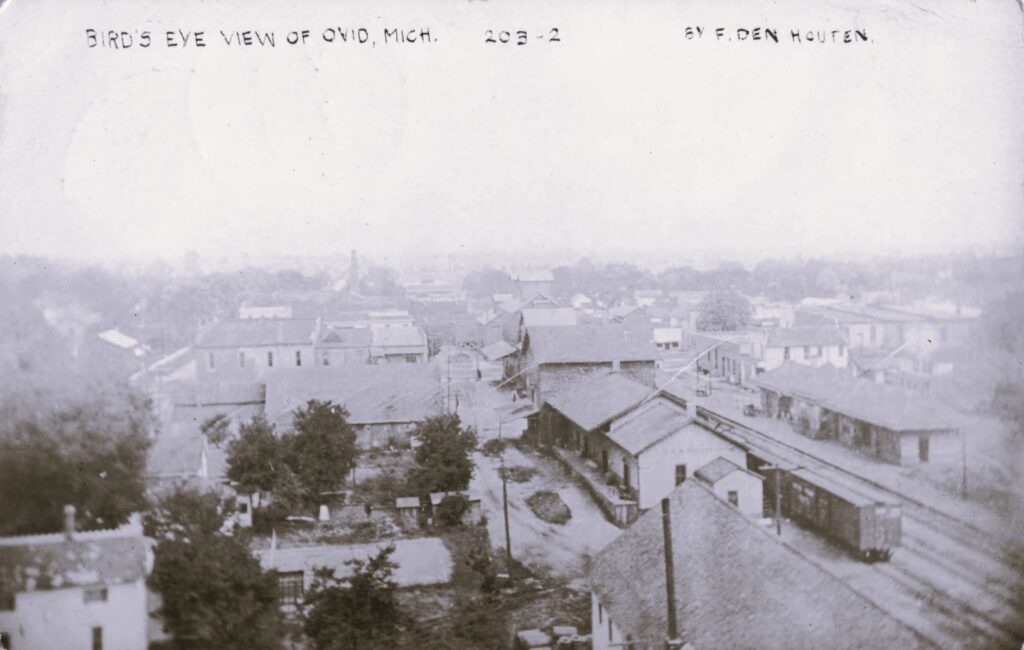
By the early 1940s, World War II loomed, and many of Ovid’s young men went off to serve in the military. The war effort actually revived agricultural demand, which helped Ovid’s farmers, but the era of Ovid as a bustling rail-town center was essentially over. The post-war period would bring further consolidation — better roads (like M-21 highway) meant trucks could bypass rail for shipping, and small operations gave way to larger firms in bigger cities. Ovid transitioned into the quiet community it remains today, with many residents commuting to nearby St. Johns, Owosso, or Lansing for work.
However, the history of Ovid, Michigan in that 1890–1940 window left an indelible mark. Many physical reminders survive: The old depot freight house still stands (though the passenger station was torn down), the concrete foundations of the Ovid Electric Plant can be found near the water tower site, and some of the brick buildings on Main Street date back to those prosperous decades. The Congregational Church (built 1872) remains as a historical structure. A few vintage houses with carriage steps out front hint at the horse-and-buggy days.
In 2015, Ovid officially became a City (having been a village for 146 years). This civic upgrade was largely administrative, but it carried symbolic weight: it acknowledged the long journey from frontier settlement to a modern community. Ovid’s 2015 city charter stands on the shoulders of the 1890–1940 era, when the infrastructure and institutions of the town were built to last.
To visit Ovid today is to walk quiet streets that once rang with the sounds of industry and progress. If you listen closely on a warm summer afternoon, you might imagine, just for a moment, the distant whistle of a 1910 locomotive, or catch the faint smell of apples and coal smoke on the breeze. Those sensations are ghosts now, but thanks to careful preservation of Ovid’s story, we can still picture that golden time. The history of Ovid, Michigan is a reminder of how even small towns can play big roles in the American saga – and how communities adapt, change, and remember.
Ken Burns-style Reflection: In the end, Ovid’s story is about people. The determined miller keeping the gears turning through the night; the entrepreneurial cider-maker betting on a bumper apple crop; the innkeeper who left the light on for late arrivals; the town leaders who wired streets for electricity when others said it was “just a fad.” Their lives infused Ovid with energy and purpose. Through booms and busts, they persevered. As we reflect on Ovid’s past, we see ordinary Americans doing extraordinary things in their corner of the world. That is the true heart of Ovid’s history – a testament to community, innovation, and the relentless hope for a better tomorrow.
Works Cited
- City of Ovid. “History.” City of Ovid (official website), 2022, ovidmi.org/history/. Accessed 28 Feb. 2026.
- MichiganRailroads.com. “Station: Ovid, MI.” Michigan Railroads – Stations & Locations, 2026, www.michiganrailroads.com/stations-locations/83-clinton-county-19/679-ovid-mi. Accessed 28 Feb. 2026.
- Shiawassee County Historical Society (transcription of 1906 text). “Railroad History – Shiawassee County.” Past and Present of Shiawassee County by J. H. Collins, 1906, excerpt available at shiawasseehistory.com/railroad.html. Accessed 28 Feb. 2026.
- Ovid Historical Society. “Now and Then – Lifesaver Inn and Ovid Roller Mills.” Ovid Historical Society Newsletter, Fall 2011, ovidhistoricalsociety.weebly.com/now-and-then.html. Accessed 28 Feb. 2026.
- Tinder, David V. David V. Tinder Collection of Michigan Photography. Clements Library, University of Michigan. Postcard images of Ovid, Michigan (1900s) – “Life Saver Inn, Ovid, Mich.”, “Clinton Cider Co., Ovid, Mich.”, “Ovid Electric Light & Water Works”, etc. Digital images accessed via University of Michigan Library Digital Collections, Feb. 2026.