 by
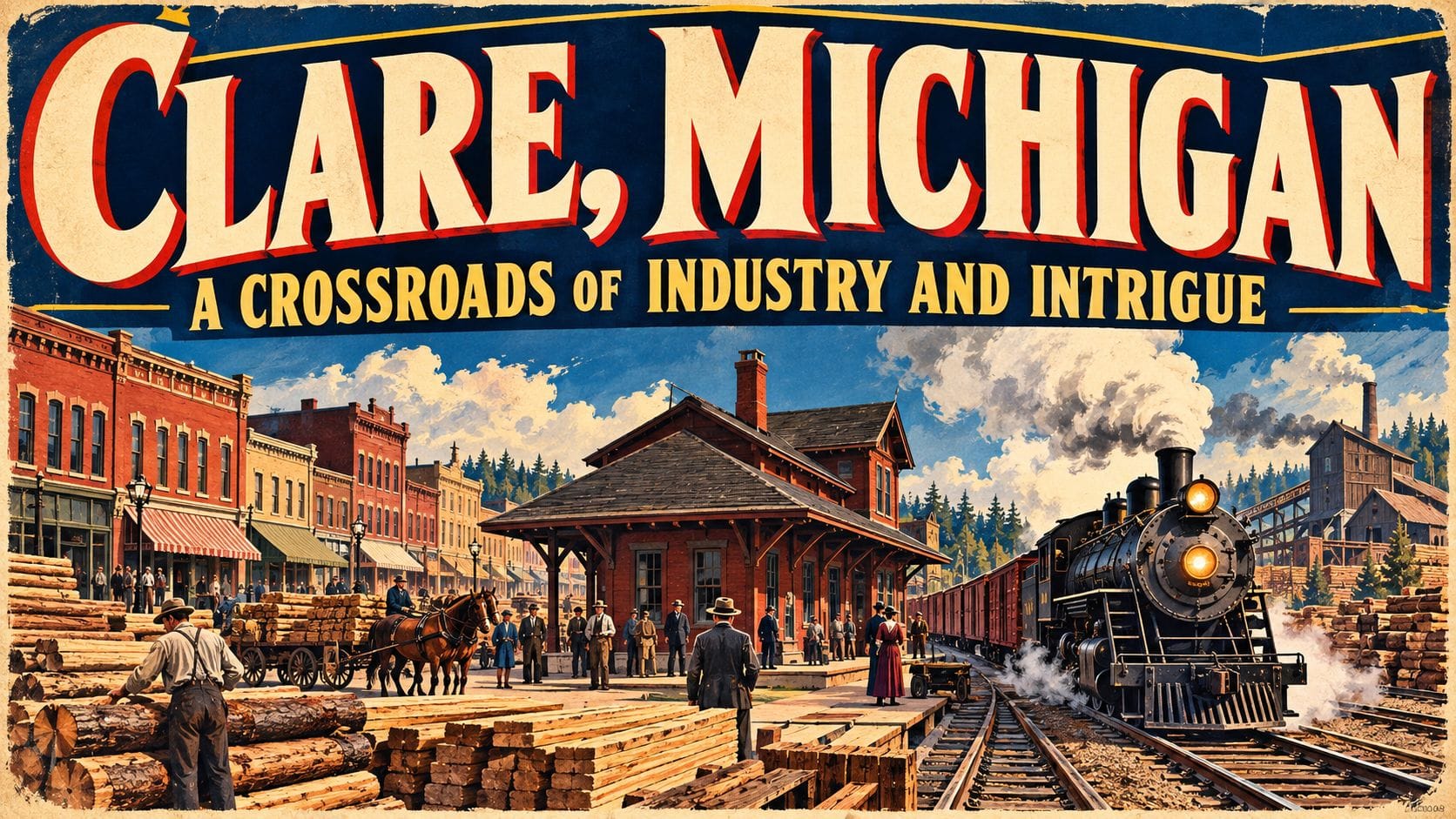
by Clare, Michigan, grew from a railroad stop into a regional center for lumber, trade and travel. The History of Clare Michigan includes the fires that reshaped its downtown and the 1938 murder at the Doherty Hotel, events that left lasting marks on the city.
About This Video – The History of Clare Michigan
Clare developed as a railroad and lumber town in Michigan’s Lower Peninsula. Its story includes downtown fires in 1904 and 1907, a growing role in regional trade and rail travel, and a 1938 murder inside the Doherty Hotel.
Video Transcript
This is Michigan Moments, recounting the pioneering moments of the Great Lakes state.
In the center of Michigan’s Lower Peninsula lies a place where rail lines once met, and ambitions collided: Clare, Michigan. What began as a lumber town on the frontier grew into a stop along the state’s north-south corridor. In the early 1900s, this small city built a reputation on timber, trade and hard work.
Founded in 1870, Clare owed its early development to the Pere Marquette Railroad’s expansion. With pine forests surrounding the region, logging operations grew quickly. Sawmills ran day and night. Workers filled boardinghouses, and money flowed into the downtown business district.
At the heart of it all was McEwan Street. In the early 1900s, the street had brick storefronts, furniture dealers, meat markets, grocers, barbers and blacksmiths. Horse-drawn wagons rattled over muddy roads, while canvas awnings shaded passersby.
Like many Michigan boom towns, Clare changed quickly. Fires swept through downtown in 1904 and again in 1907. They destroyed wooden buildings and forced the town to rebuild with brick and stone. That period helped shape Clare’s downtown.
Along the Tobacco River stood the town’s mill and dam, an important part of Clare’s early infrastructure. The mill powered industry and helped move goods through the region. Families settled nearby, and small farms supplied the town’s markets.
Clare’s economy was not limited to timber. It became a center for agriculture and commerce, as well as a stop for rail travelers. The Union Depot, with its turreted roof and steady stream of trains, brought passengers and freight from across the state. People passed through for business and trips north.
In 1938, a murder inside the Doherty Hotel brought national attention to Clare. Detroit attorney Isaiah Leeov, described in the narration as having ties to the Purple Gang, was shot by his business partner, Carl Jack Livingston, in the hotel taproom. The Doherty Hotel endured and became a local landmark.
Main Street was paved. New businesses opened. Cars replaced carriages, and families continued to work, shop and build lives in Clare. Today, the city is known for its downtown district and community life.
Photographs of parades, storefronts, flooded streets and children record parts of Clare’s past. This has been Michigan Moments, offering short stories about Michigan history.
Key Moments
- Clare’s founding and railroad beginnings
- The growth of logging and downtown commerce
- The 1904 and 1907 fires and rebuilding
- The 1938 Doherty Hotel murder
- Clare’s later growth and community life
FAQs About Clare Michigan History
When was Clare, Michigan, founded?
Clare was founded in 1870 during Michigan’s lumber boom. The Flint and Pere Marquette Railroad reached the area that year, and lumberman William McEwan laid out a town near the rail line. Clare became a village in 1879 and a city in 1891.
Why did Clare become known as a railroad and lumber town?
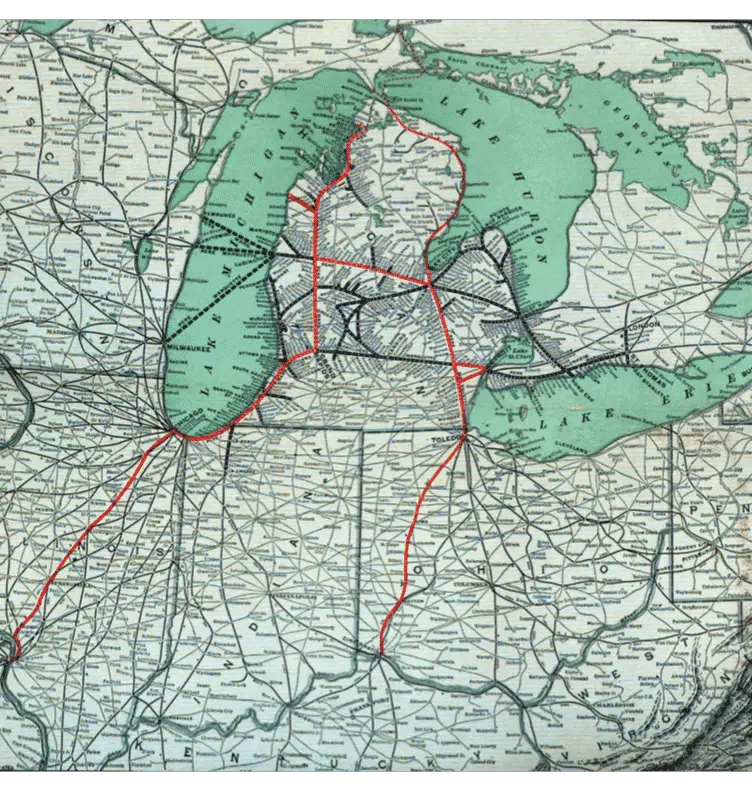
The railroad connected Clare’s surrounding forests and sawmills with markets and shipping centers. The Ann Arbor Railroad later joined the Pere Marquette line in Clare, making the city a rail hub. Lumber drove early growth, while rail connections supported trade and travel.
What happened at the Doherty Hotel in 1938?
On May 14, 1938, Carl “Jack” Livingston shot and killed Isaiah Leebove in the Doherty Hotel’s taproom. The shooting drew wide attention to Clare. The hotel had opened in 1924 and remains a landmark in the city
Related Reading