 by
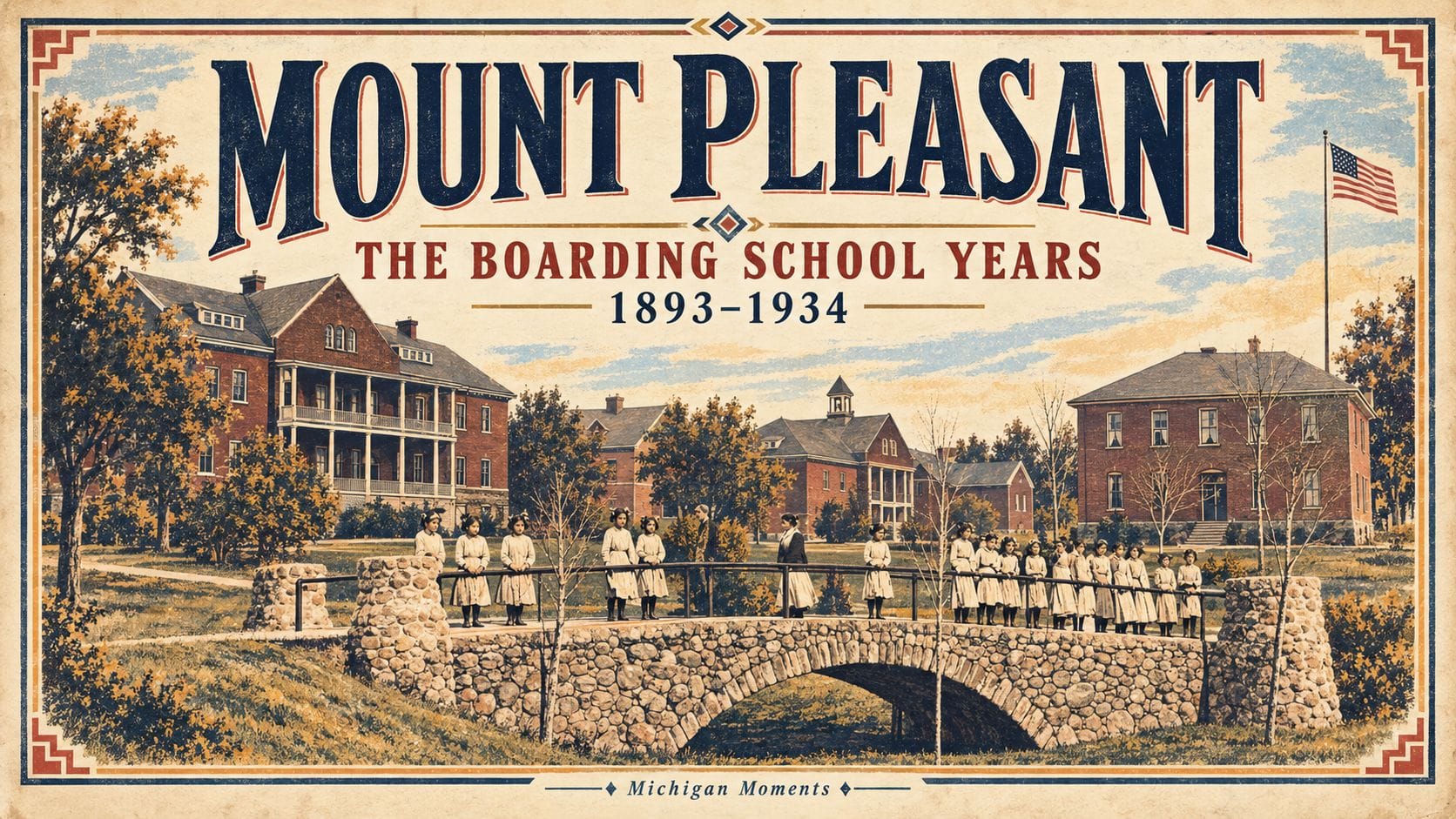
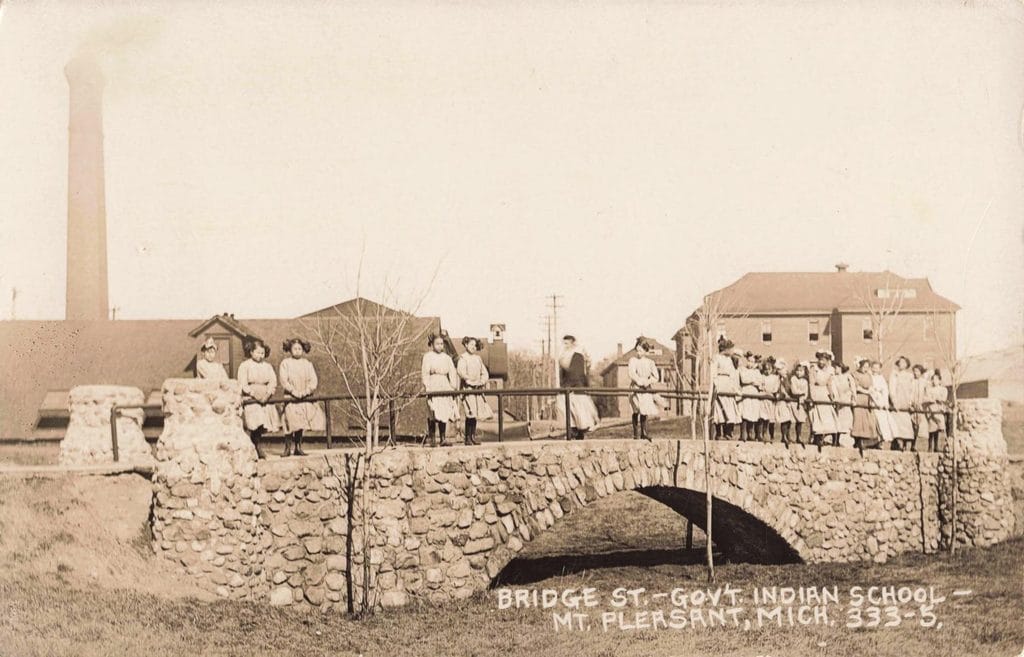
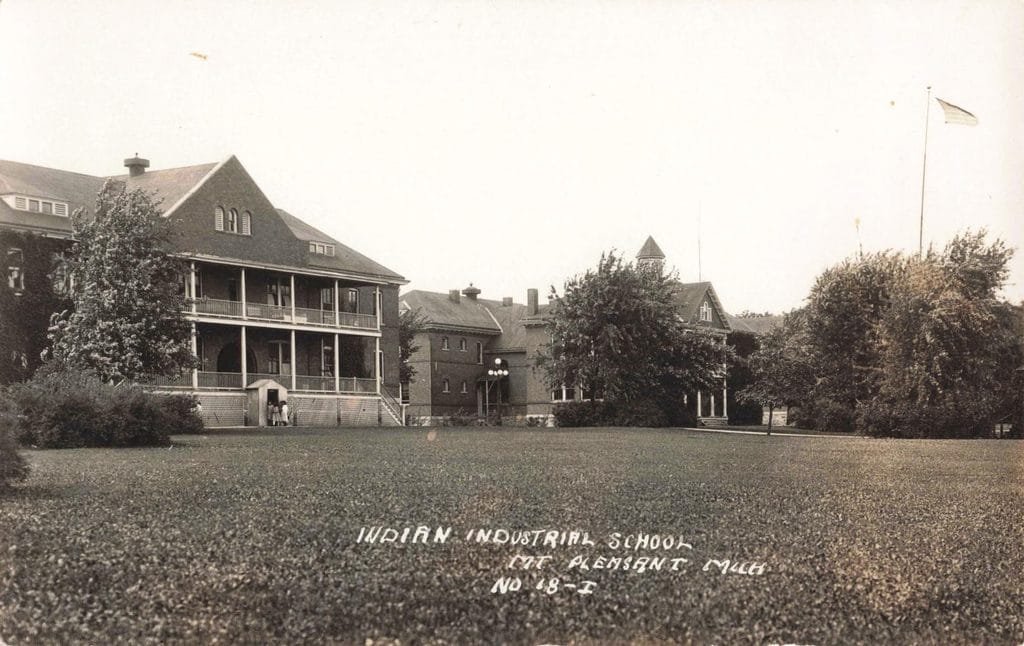
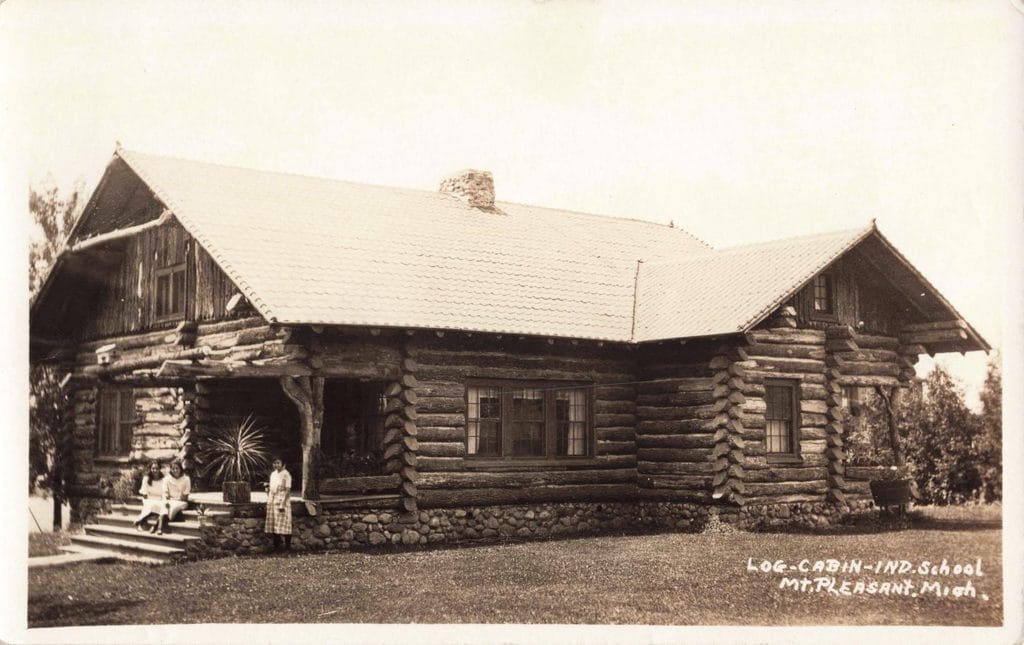
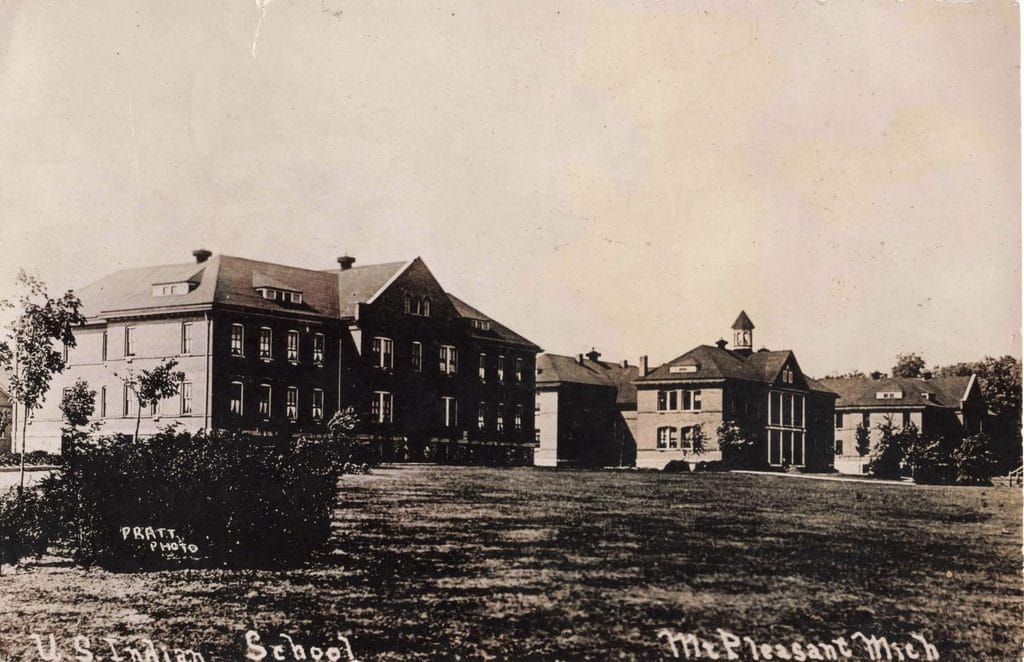
by Children stand along a stone bridge at the Mount Pleasant Indian Boarding School. Other photographs show brick campus buildings, a hospital and a log cabin. Together, the five images offer a view of the institution’s grounds. Understanding what happened there requires evidence beyond the camera’s frame.
The school operated from 1893 to 1934, according to the Saginaw Chippewa Indian Tribe’s historical materials. It belonged to a federal boarding school system intended to assimilate Native children into white American society. That policy disrupted family relationships and targeted the languages, beliefs, and cultural practices children brought from home.
A Michigan campus within a national system
The Mount Pleasant school opened June 30, 1893, and closed June 6, 1934. The Ziibiwing Center’s curriculum guide reports an average annual enrollment of 300 students. There were also schools in Baraga and Harbor Springs. For decades, the US took thousands of Native American children and enrolled them in off-reservation boarding schools. In fact, this was government policy to assimilate an entire people by forcibly removing children from their families and indoctrinating them into the Anglo language, religion, and way of life.
Its institutional name included “industrial,” a word associated with vocational training. But describing the campus solely as a place of education leaves out its central purpose. The Saginaw Chippewa Indian Tribe’s account states that students were forbidden to speak their languages or honor their traditions.
The federal government’s investigation places those restrictions within the framework of a national policy. Its 2022 report documented practices that included assigning English names, cutting children’s hair, suppressing Native languages and religious practices, and organizing children into military-style units. These were methods of changing children’s identities through institutional control.
What the five photographs can establish
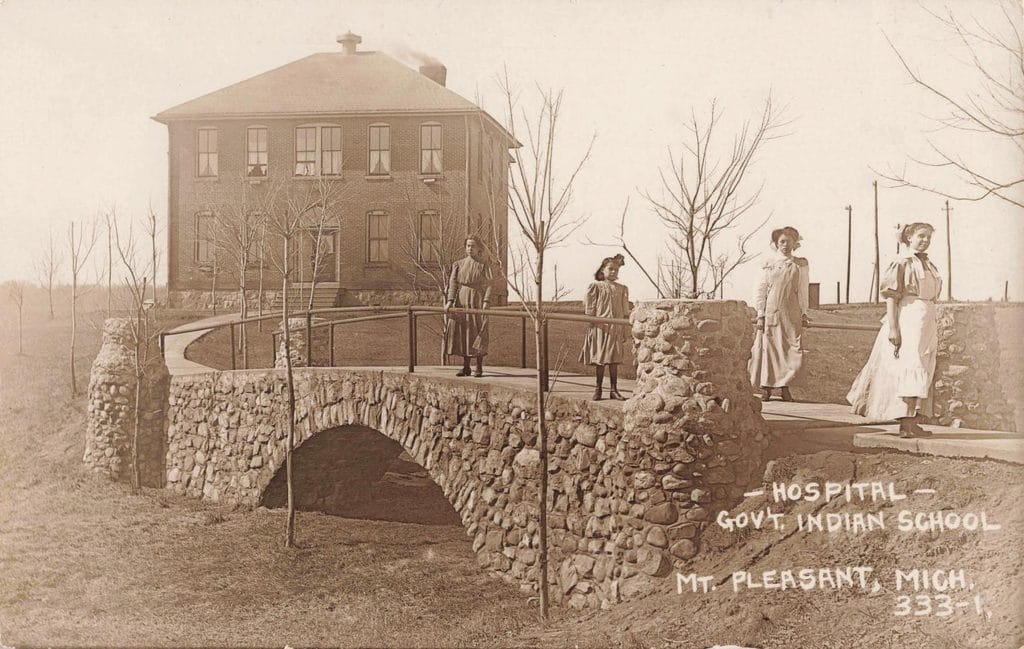
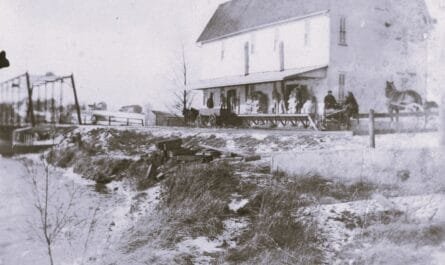
The bridge photograph places children together on a stone crossing, with school buildings behind them. The hospital image shows another view of a crossing and the building identified in its caption. Two broader views show substantial brick buildings. The remaining photograph shows a log structure with people near its entrance.
The supplied captions identify the setting. They do not provide reliable names, tribal affiliations, photograph dates, or personal accounts for the people pictured. Clothing and poses alone cannot establish whether someone was a student, an employee, or a visitor.
Nor can a photograph establish whether a particular child was happy, frightened, healthy or safe. A composed campus scene records a moment. It does not settle questions about daily treatment, family separation or what happened outside the frame.
The policy’s effects continued after closure
The Interior Department’s 2024 findings described federal actions intended to isolate Native children from their families and deny their cultural identities. Its investigation also addressed consequences extending across generations. Closing an institution did not automatically repair the relationships and language transmission that its policies had damaged.
Remembering people, listening to Native voices
Michigan observes Michigan Indian Day on the fourth Friday in September, which falls on Sept. 25 in 2026. The state established the observance in 1974. It offers an occasion to learn about Native communities and confront the institutions that sought to alter their children’s identities.
For this school, the Saginaw Chippewa Indian Tribe and its Ziibiwing Center provide essential historical context. Their materials help place the campus within the experiences of the people most directly affected.
These photographs deserve careful captions and honest context. The children pictured had lives beyond the institution’s records. The Native American culture in Michigan has a rich and vibrant history. Remembering them means acknowledging what is documented, being clear about what remains unknown, and making room for Native families to tell their own histories.
FAQs – Mount Pleasant Indian Boarding School
When did the Mount Pleasant Indian Boarding School operate?
The Mount Pleasant Indian Industrial Boarding School opened June 30, 1893, and closed June 6, 1934, according to the Saginaw Chippewa Indian Tribe’s historical materials.
What was the purpose of Native American boarding schools?
The federal boarding school system sought to assimilate Native children into white American society. Its methods included separating children from their families and suppressing Native languages, religious practices and cultural traditions.
What do these Mount Pleasant school photographs show?
The five photographs show school buildings, a hospital, a log cabin and people on the grounds, including children standing along a stone bridge. The supplied captions do not establish individual identities or personal experiences.
Sources: Mount Pleasant Indian Boarding School
Saginaw Chippewa Indian Tribe, Ziibiwing Center. Boarding school curriculum guide. https://www.sagchip.org/ziibiwing/planyourvisit/pdf/aibscurrguide.pdf
Saginaw Chippewa Indian Tribe. National Register listing announcement. https://www.sagchip.org/news.aspx?newsid=1614
U.S. Department of the Interior. Boarding school investigative report announcement, May 11, 2022. https://www.doi.gov/node/40661
U.S. Department of the Interior. Federal Indian Boarding School Initiative findings, July 30, 2024. https://www.doi.gov/node/58981
Michigan Department of Civil Rights. Michigan Indian Day, Sept. 25, 2015. https://www.michigan.gov/mdcr/news/releases/2015/09/25/mich-india