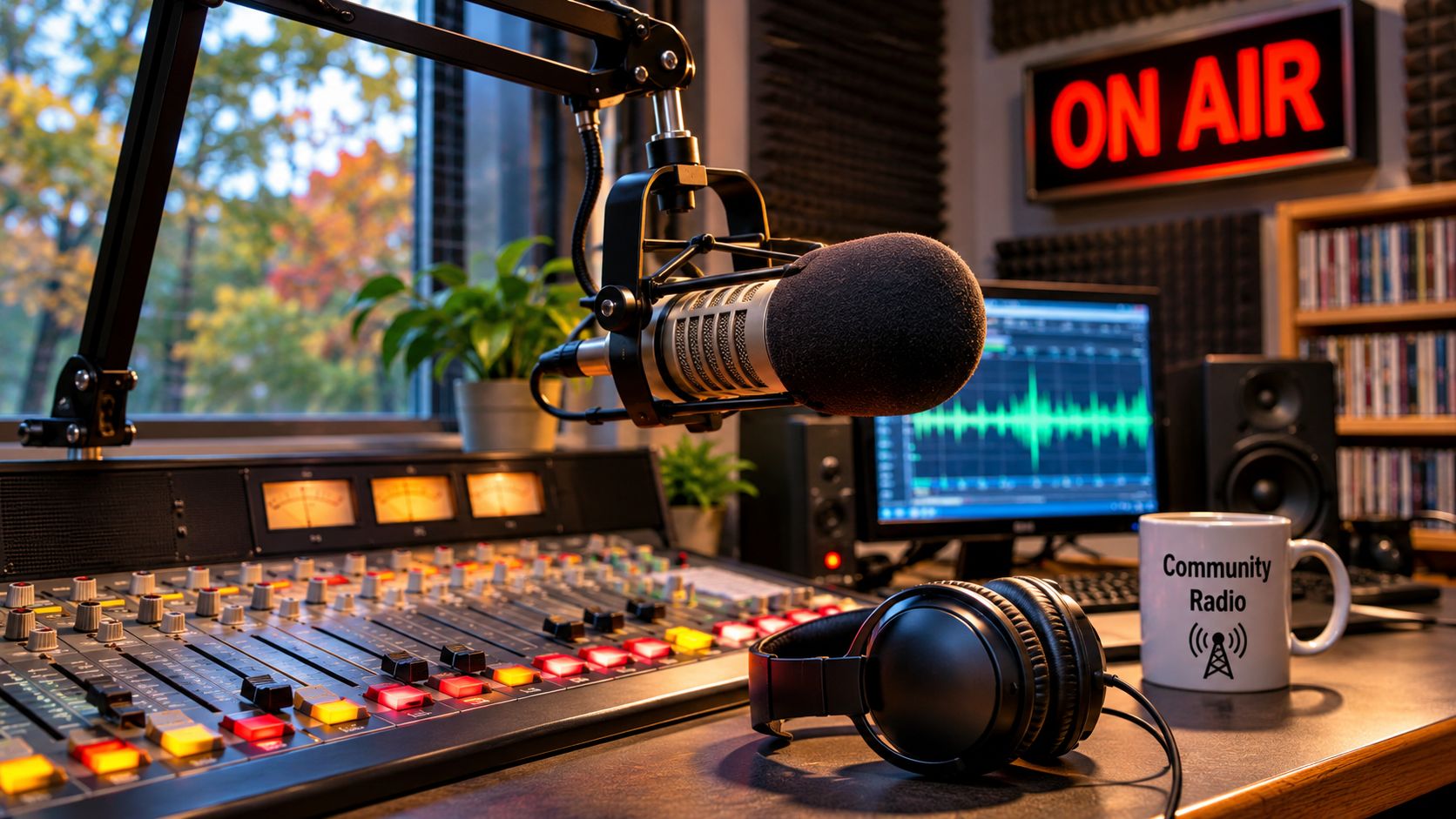
Small Stations.
Big Voices.
A statewide guide to Michigan’s low-power FM radio stations. Find local broadcasters, learn how community radio works and follow the stations bringing neighborhood voices to the airwaves.
What is low-power FM radio?
Low-power FM, or LPFM, is a class of noncommercial, locally focused radio broadcasting authorized by the Federal Communications Commission. These stations generally operate with a maximum of 100 watts and serve a relatively small geographic area. The FCC describes a typical LPFM service radius of about 3.5 miles, although reception varies by antenna placement, terrain, buildings and other radio signals.
LPFM exists to put more local voices on the air. Community organizations can offer neighborhood news, local music, cultural programming, school activities, interviews and public service announcements. These broadcasters are not miniature versions of commercial radio chains. They must operate on a noncommercial basis, although qualifying stations can receive donations and permissible underwriting support.
How Michigan’s community radio movement began
The FCC established the LPFM service in 2000 to broaden access to the FM dial. The Local Community Radio Act of 2010, signed in January 2011, helped expand opportunities for additional LPFM stations. Organizations apply during FCC filing windows; approval is not automatic, and available frequencies are limited by interference protections.
Find a Michigan LPFM station
Search by community, call sign or frequency. Filter by licensing status or tune the interactive frequency dial. This directory includes construction permits, which do not indicate an operating station.
Drag the orange tuning needle to filter by frequency. Choose “Show all stations” to reset.
Featured Michigan stations — use search or filters to browse the statewide directory
Directory source: FCC LMS-derived Michigan LPFM inventory, data as of Nov. 10, 2026 (44 licensed, one licensed silent, 24 construction permits). Station status may have changed. Station websites or listening pages have been identified for WAWL, WNUC, WXTF and WUVS. These links open broadcaster-supported listening pages; successful audio playback has not been independently tested. Other stations require further verification. Data-quality notice: The source lists DWEGV-LP in Ann Arbor as a construction permit despite an October 2020 expiration date and no working station detail page. Its current authorization is unconfirmed. WRSL-LP is authorized at 96.3 MHz in the source, but a September 2026 application proposes 91.3 MHz; the proposed frequency is not shown as approved. A construction permit does not establish that a station is broadcasting. City search is available; ZIP-distance searching requires verified transmitter coordinates and geocoding.
How can a Michigan group start an LPFM station?
LPFM licenses are generally available to eligible nonprofit educational organizations, qualifying Tribal applicants and certain public safety entities, subject to FCC rules. Individuals cannot apply for a personal LPFM station. A local presence and suitable frequency are important eligibility and engineering considerations.
1. Organize
Establish an eligible nonprofit or other qualifying entity with a local community presence.
2. Check the dial
Ask a broadcast engineer to assess channel availability, interference rules and transmitter sites.
3. Watch FCC windows
New applications are accepted only during designated FCC filing periods.
4. Apply
Submit the required application and technical documentation. Competing applicants may face additional selection procedures.
5. Build
If a construction permit is granted, install the authorized antenna, transmitter and studio facilities.
6. Obtain a license
Complete the FCC licensing process before regular operation and comply with noncommercial broadcast rules.
What makes LPFM stations different?
LPFM broadcasters work on a neighborhood scale. Unlike commercial stations, they cannot sell conventional advertising, but they may accept donations and compliant underwriting announcements. Volunteers often play major roles. Some stations stream online, which can extend their audience far beyond the range of their FM transmitters; others broadcast only over the air.
Starting a station also takes money. A realistic budget should consider engineering, equipment, antennas, site rental, studio setup, music rights, insurance, utilities and maintenance. Costs depend on the project, and FCC authorization does not provide funding.
Frequently asked questions
How far can an LPFM station be heard?
A typical LPFM service radius is about 3.5 miles, but actual listening range can be greater or smaller depending on terrain, antenna height and interference. It is not a guaranteed coverage boundary.
Can LPFM stations sell advertising?
They are noncommercial stations and cannot air conventional paid commercials. They may accept donations and qualifying underwriting acknowledgments under FCC rules.
Can anyone apply for an LPFM license?
No. Eligibility is restricted to qualifying organizations, and applications can be submitted only during FCC filing windows. Applicants must also satisfy local-presence and technical rules.
Does every station have an online stream?
No. FM broadcasting and internet streaming are separate services. This directory will show a Listen Live link only after a functioning station stream is verified.
What does a construction permit mean?
A construction permit authorizes an applicant to build specified facilities. It does not mean the station has begun regular licensed broadcasting.
Sources and corrections
Read the FCC LPFM service overview, FCC LPFM resources and the Michigan station listing. Station operators can send corrected call signs, URLs, stream links and logos to contact@thumbwind.com. Directory reference date: Nov. 21, 2026. WJLQ-LP in Muskegon is listed at 97.5 MHz based on a Nov. 10 FCC LMS-derived record (facility 788103); some older directories show 99.7 MHz. Confirm reception and current authorization with the FCC before relying on that entry.
Related Posts