by
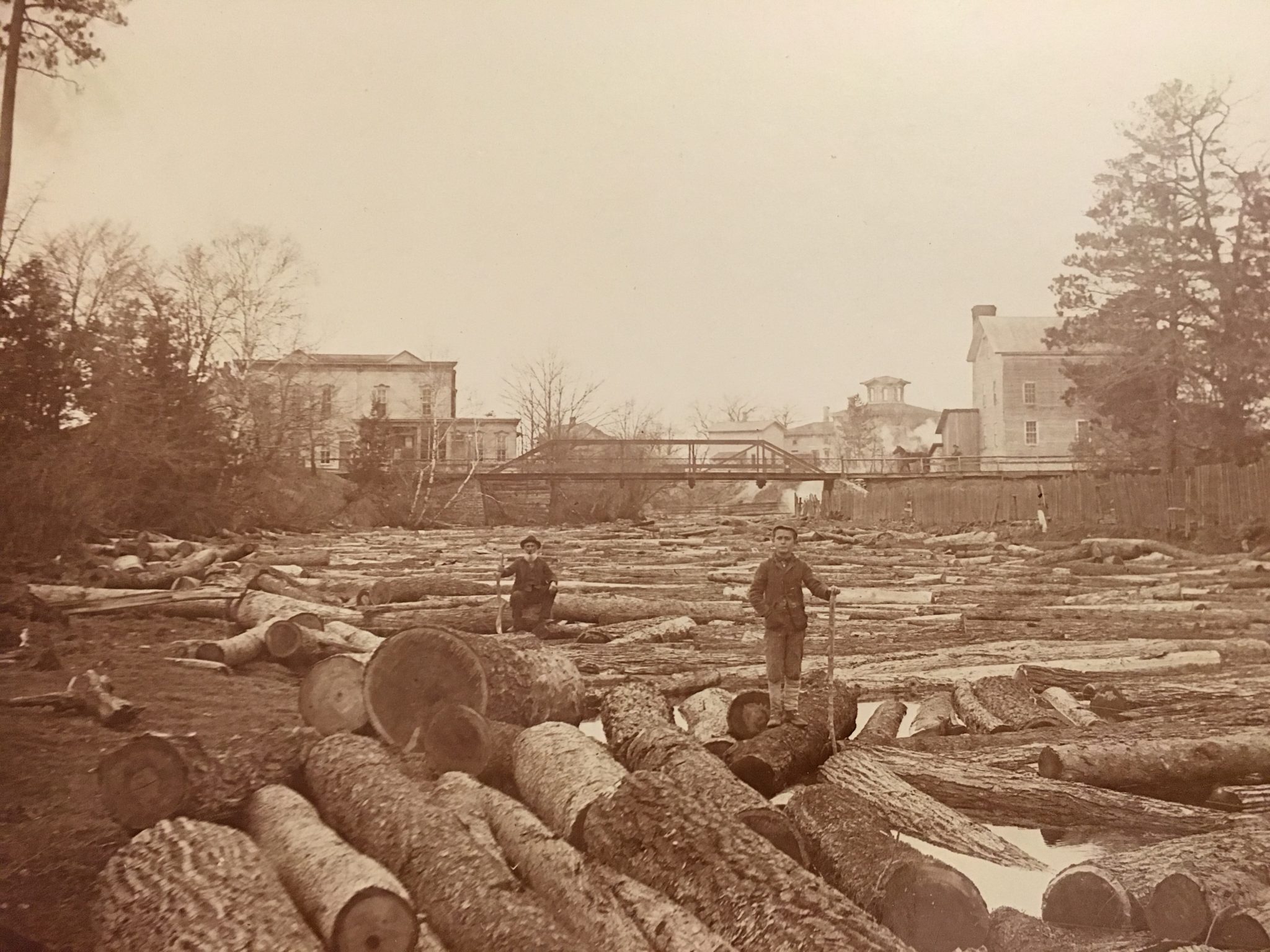
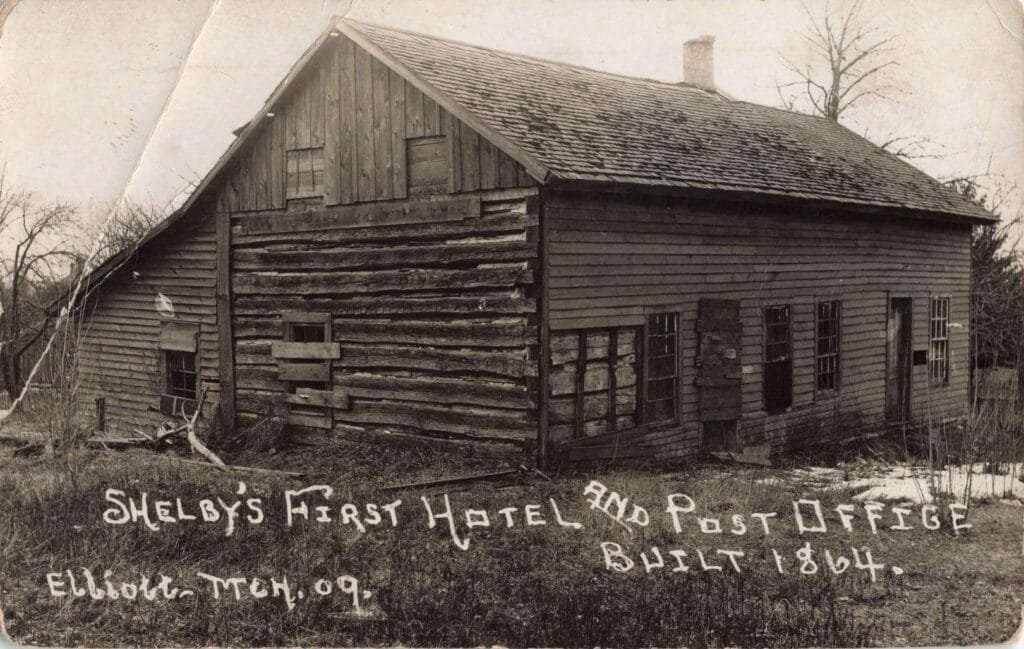
by Shelby, Michigan, began as a frontier settlement in the 1860s. Early records note that families cleared dense forests to build log cabins and farms. In the 1860s, this stretch of Oceana County was still heavily forested and sandy. Early settlers came for land, not comfort. The history of Shelby Michigan, begins in 1864, when a rough building went up that served as both hotel and post office. It was part log, part frame, and entirely practical. Travelers slept upstairs. Mail was sorted downstairs. That single structure anchored the settlement that became Shelby.
In 1866, Shelby (then part of Benona Township) had only a handful of voters, but by 1870, the Chicago & West Michigan Railroad laid tracks through the area. This was transformative: Shelby quickly grew into a village.

By 1885, the town was officially incorporated, boasting a flour and sawmill, a grain warehouse, and multiple general stores along Main Street. A contemporary history magazine celebrated Shelby as “a village of nearly one thousand inhabitants” with two hotels, dry goods and grocery shops, blacksmiths, drugstores, Odd Fellows and Masonic lodges – essentially “nearly every trade and occupation.” The railroad brought farmers’ crops, as well as new residents and ideas, to Shelby.
Watch: History of Shelby Michigan – A Town Built on Orchards and Railroads
Fruit Farming in the Great Lakes Fruit Belt
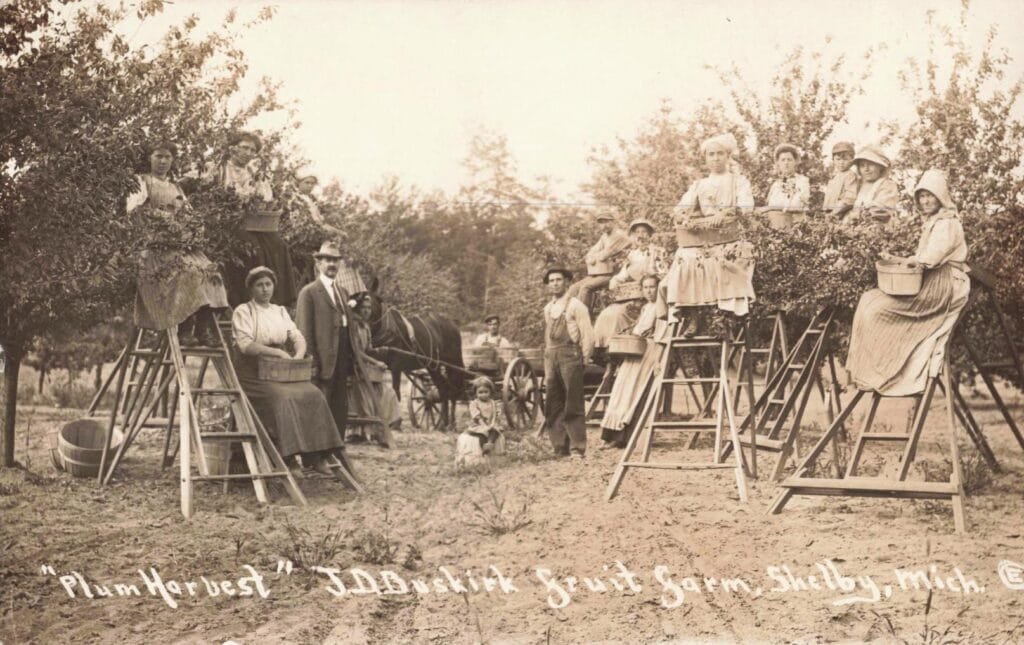
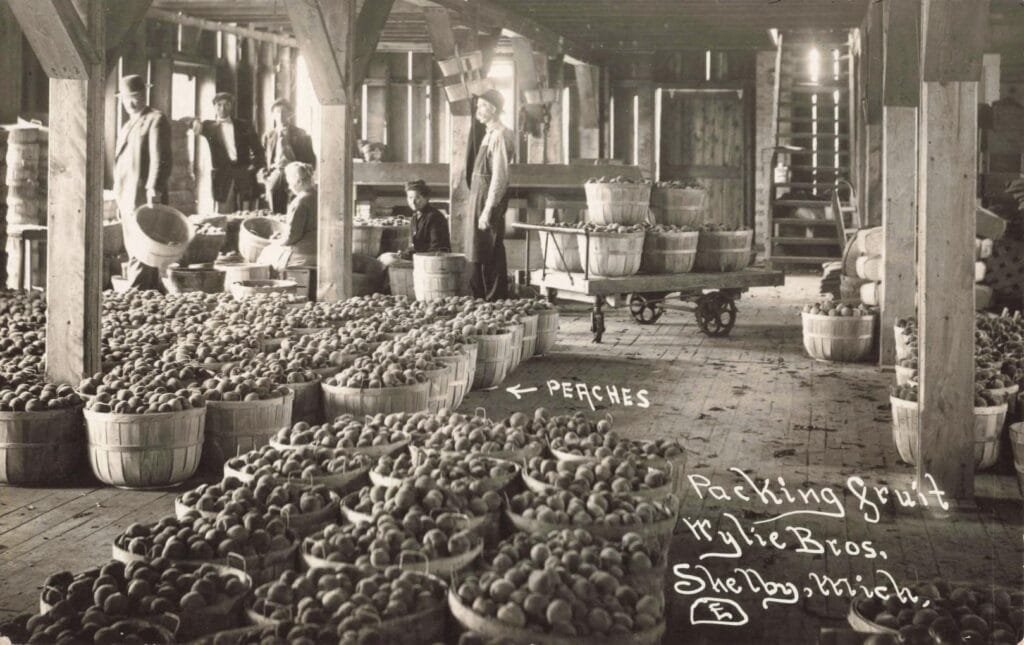
Shelby lies in Michigan’s famed Fruit Belt, where lake-effect climate allowed fruit trees to thrive. In the late 19th century, many Shelby-area farmers cleared more land for orchards. One pioneer, S. O. Field, built a large farmhouse just outside Shelby in 1899. His farm, like others, grew apples, cherries, peaches, and plums. A local history reports that by 1900, the Field family had 45,000 fruit trees on their land – a massive orchard by any measure.
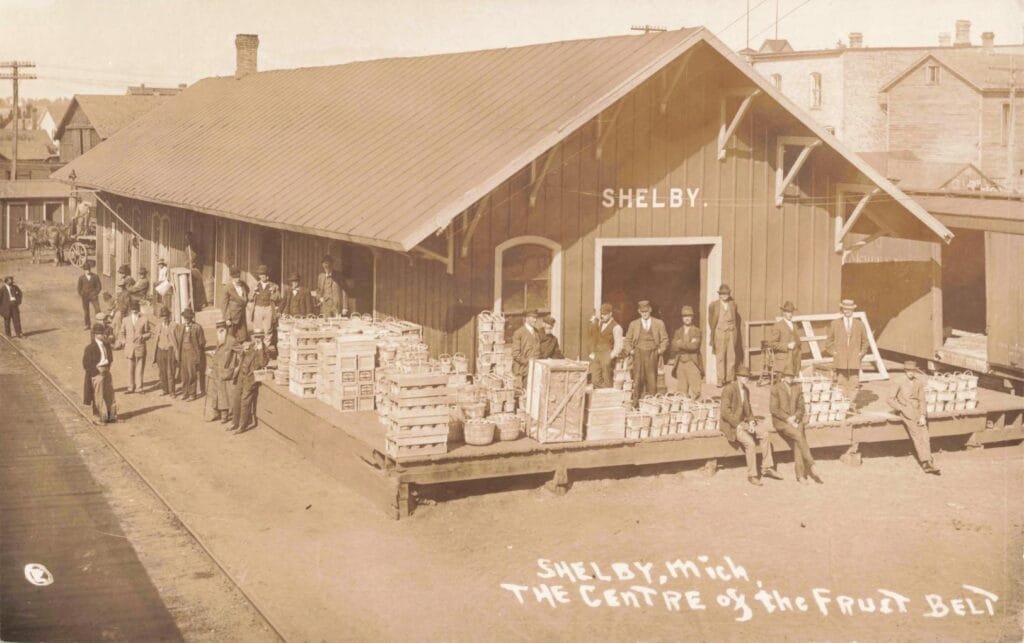
These fruits were shipped by rail to markets in Chicago and beyond. Over time, Shelby’s economy remained rooted in this harvest: roadside stands sold fresh apples and peaches, and by the 1930s, local factories pressed cider and canned preserves. Even today, seasonal workers still hand-pick fruit in the old orchards around Shelby.
Community Life: Schools, Churches, and Stores

Life in Shelby centered on school and church as much as on farming. The town’s first schoolhouse was a log cabin built in 1862; as the community grew, new buildings followed. Local reports from 1880 noted that Shelby “can boast of a commodious school building” – a brick school erected the previous year at a cost of $4,000. By the early 20th century, Shelby’s students attended classes in a sturdy brick schoolhouse (the photo above shows the 1909 school building). Teachers like Ambrose Hughes and Misses Luke and Hillings taught everything from reading to arithmetic.
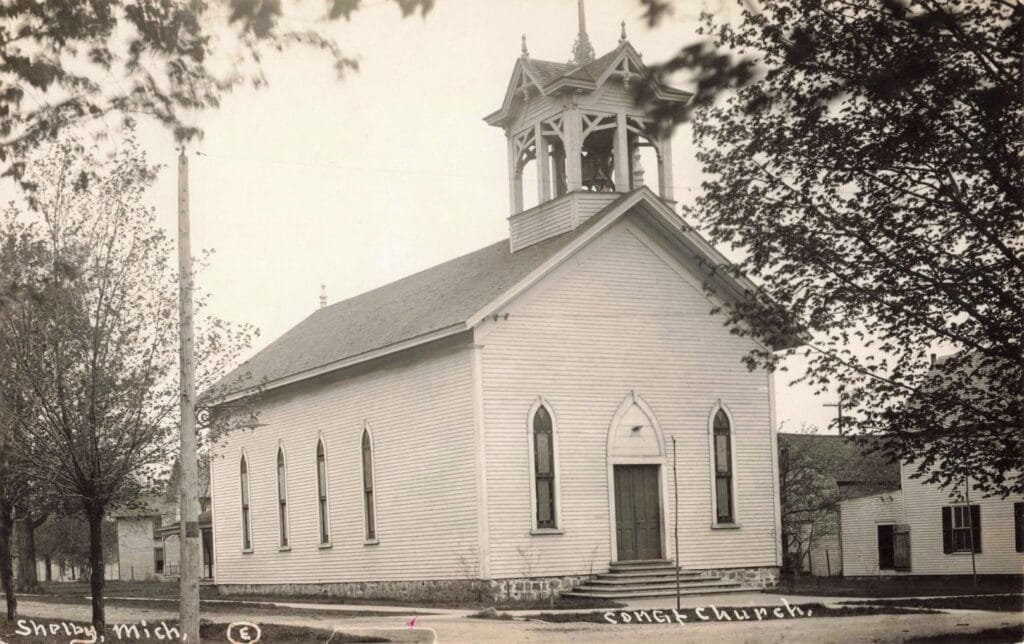
Shelby also had a lively religious life. In 1875, locals built the Congregational Church, and the Methodists soon built theirs in 1880. Each Sunday, the church bells would ring, and farmers in overalls gathered to worship after a long week in the fields.

In town, other businesses served daily needs: general stores (like Edwards Dry Goods) sold fabrics and groceries, a hardware store carried farm tools, and a livery stable kept horses and carriages. A dentist, a jeweler, and even a photographer’s studio set up shop on Michigan Avenue. New sidewalks were laid along Main Street, showing the town’s confidence. Through these decades, Shelby’s people were ordinary, hardworking folks – shopkeepers, carpenters, teachers, farmers – but together they built a thriving small town.
Suggested Reading
The Legendary Journey of the 1225 Pere Marquette: Michigan’s Pride
Visual History of the 46 US Life Saving Stations Serving Michigan
World War I and Beyond

The 1910s brought Shelby into the national spotlight in a quiet way. When the United States entered World War I in 1917, Shelby residents answered the call. Young men – farmers’ sons and high school graduates – marched down Main Street to the train depot to enlist. Neighbors and families gathered on the platform as the train pulled out, waving flags and weeping. The local newspaper listed each man who went overseas, and local women’s auxiliaries made comfort packages for them. This was Shelby’s brush with history: a solemn reminder that even a remote farming town took part in world events.
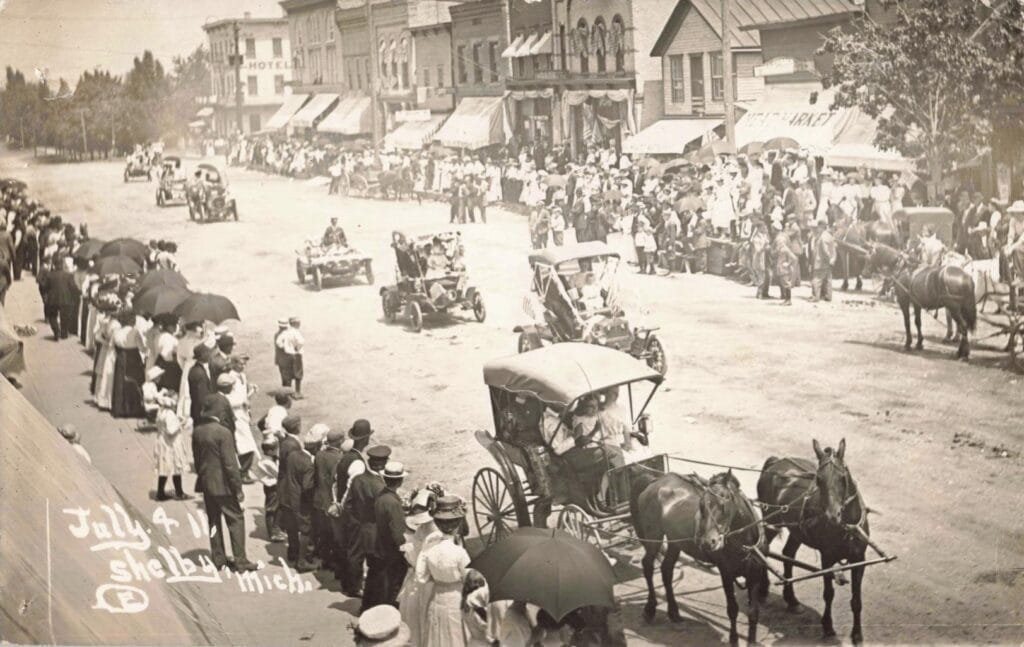
After the war, Shelby returned to a focus on agriculture. The Roaring Twenties brought some changes: a few automobiles appeared on the streets (replacing horse-drawn carriages), and new crops like tomatoes and pickles were grown. But the Great Depression hit rural Michigan hard. Crop prices fell, and some young people left for work in cities. Shelby’s population dipped in the 1930s, but the town endured. Community events like Fourth of July picnics and high school basketball games helped keep spirits up.
Shelby, Michigan, Today
The history of Shelby Michigan is still visible today. The modern village still celebrates its farming past every summer with fruit festivals. The old brick schoolhouse was replaced years ago, but a historical marker stands on the site. Main Street’s old storefronts remain, many restored, and one can almost read the faded sign for “C.W. Edwards Dry Goods” on the museum wall – the same sign seen in early 1900s postcards. Shelby’s current population is a few thousand, but the nickname “Fruit Basket of Michigan” still applies.
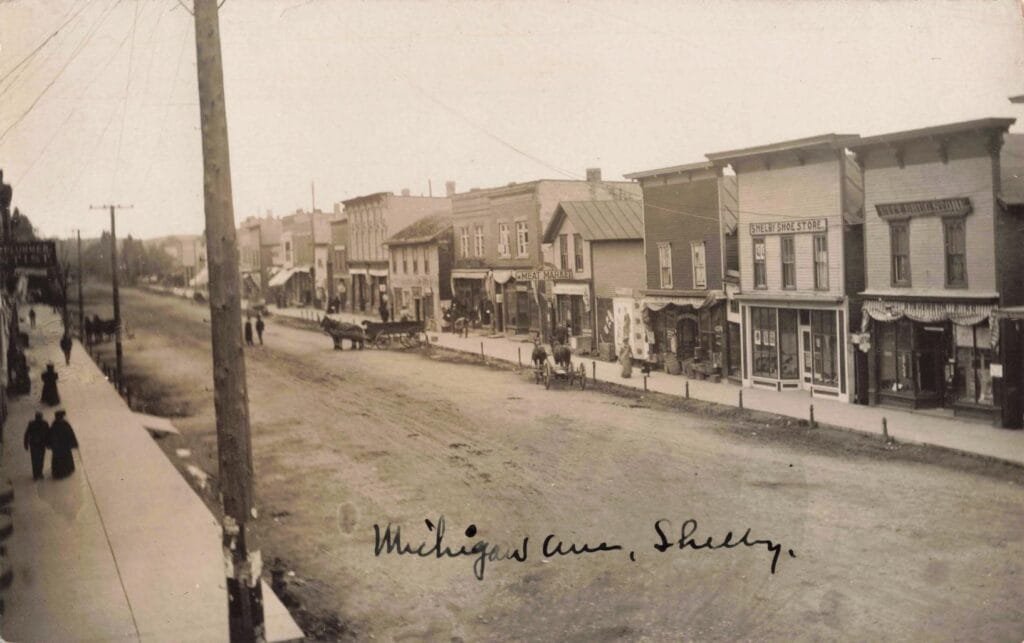
In our times, Shelby welcomes visitors curious about history. The local library holds archives of the Oceana Herald (Shelby’s own newspaper dating back to 1858), and the village museum displays artifacts such as 19th-century farming tools and a WWI sailor’s uniform. Each season, the apple orchards around Shelby bloom or burst into fruit, echoing the past century’s rhythms.
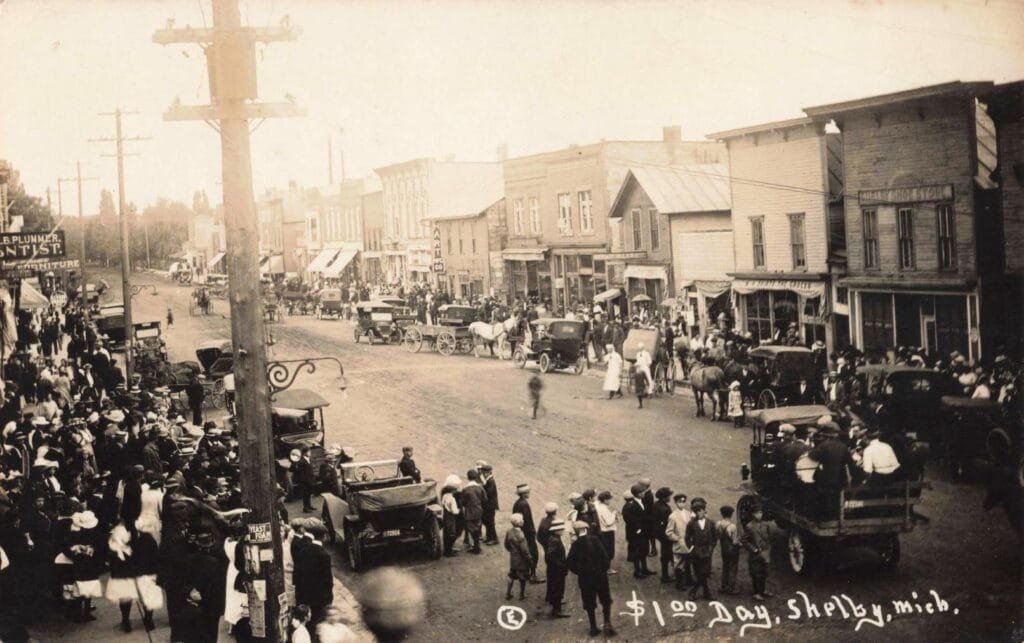
The history of Shelby Michigan remains a living story of small-town America. Its history is the story of ordinary families who planted orchards and raised children, of men who built schools and churches, and of a community that weathered hardships together. From the steam train whistles of 1872 to the digital age, Shelby’s roots in Great Lakes agriculture, railroads, and community life keep that history alive for new generations.
Works Cited in the History of Shelby, Michigan
Sources: Regional histories and archives of Shelby, Michigan.
History of Oceana County, Michigan.
H. R. Page & Co., 1882.
Shelby, Michigan Local History Collection.
Oceana County Historical Society. Accessed Jan. 19, 2026.
Michigan Fruit Belt Overview.
Michigan State University Extension. Accessed Jan. 19, 2026.
Railroads in Michigan: Historical Overview.
Michigan Department of Transportation. Accessed Jan. 19, 2026.
Sanborn Fire Insurance Maps: Shelby, Michigan.
Library of Congress. Accessed Jan. 19, 2026.
World War I and Michigan Communities.
Library of Congress, Veterans History Project. Accessed Jan. 19, 2026.
The Oceana Herald – Newspaper History.
Oceana County Library System. Accessed Jan. 19, 2026.
Michigan Fruit Canning Industry, 1890–1930.
Bentley Historical Library, University of Michigan. Accessed Jan. 19, 2026.
UpNorth Memories Collection – Oceana County RPPC Archives.
Accessed Jan. 19, 2026.